
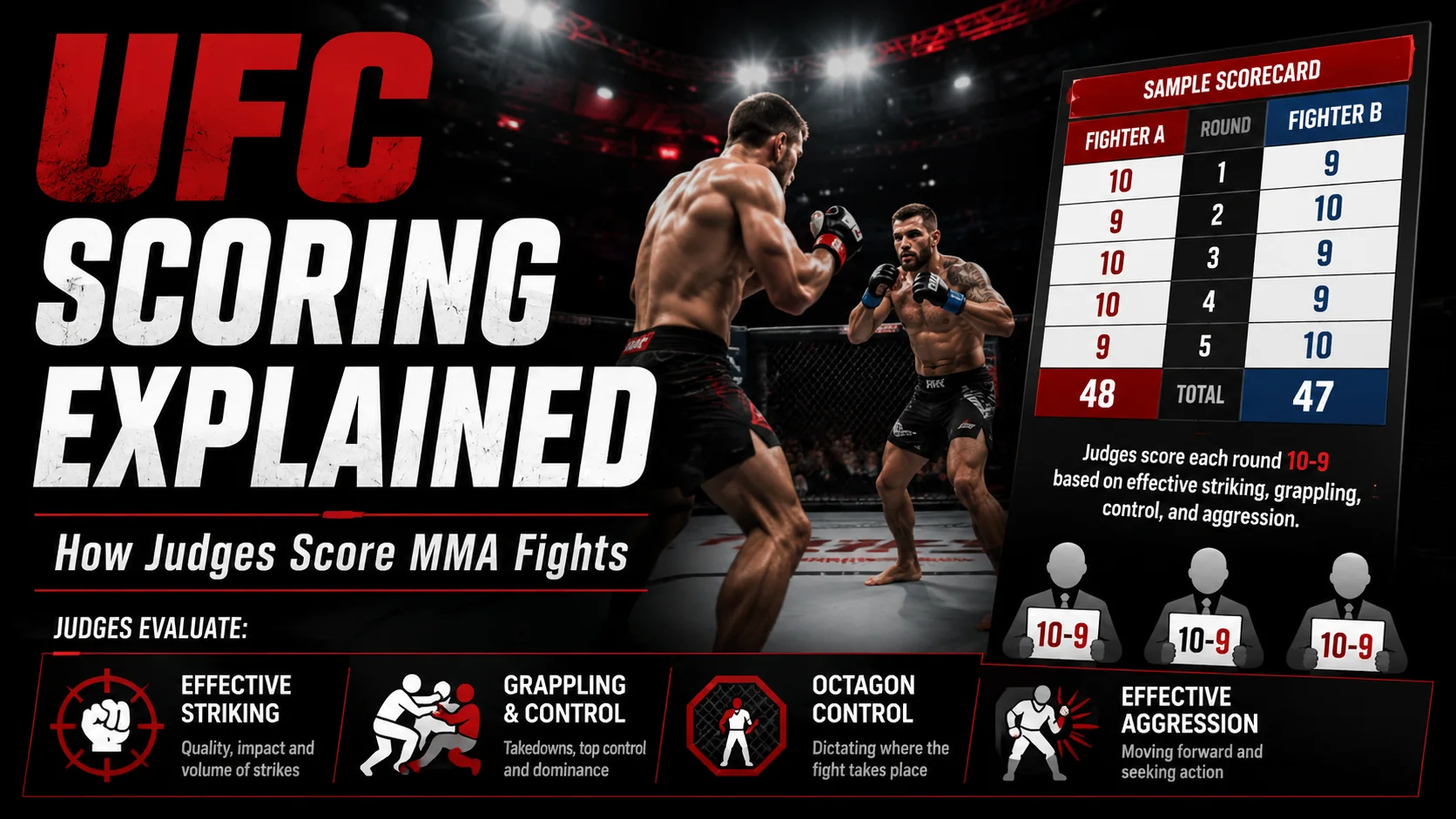
UFC scoring explained simply means understanding how three judges decide a winner when a UFC fight does not end by knockout, submission, stoppage, or disqualification. Each round is scored separately using the 10-point must system, where the round winner usually gets 10 points and the other fighter gets 9 or fewer. Judges mainly look at effective striking and grappling first, then effective aggression and fighting-area control only when the round is extremely close. Learning this system helps new fans read scorecards and understand close decisions.
- Introduction
- What UFC Scoring Means in Simple Words
- How the 10-Point Must System UFC Fans Hear About Works
- What Judges Score First: Effective Striking and Grappling
- Backup Criteria: Effective Aggression and Fighting-Area Control
- 10-9, 10-8, 10-7, and 10-10 Rounds Explained
- How Judges Turn Round Scores Into a Decision
- What Judges Are Not Supposed to Score
- Why Close UFC Decisions Become Controversial
- How to Read UFC Scorecards After a Fight
- Common Beginner Mistakes About UFC Scoring
- Quick Checklist for Watching UFC Decisions Like a Smarter Fan
- Conclusion
- Sources of Links –
- FAQ –
Introduction
If you are new to UFC, judging can feel confusing. One fan may say a fighter won because of pressure, while another may point to cleaner strikes or takedowns. That is why UFC scoring explained in plain English is so useful: it helps you understand what judges are supposed to value and what fans often misunderstand.
A UFC decision is not supposed to be a popularity contest, a crowd-noise contest, or a total-fight “vibe” contest. Judges score round by round. They compare what both fighters did in that round, apply the official scoring priorities, and then submit their scores. When all rounds are added, the result becomes a unanimous decision, split decision, majority decision, draw, or another scorecard result. Seen this way, UFC scoring explained becomes a round-by-round method instead of a guessing game.
This guide is written for beginners who already know the basics of what UFC is but want a deeper, cleaner explanation of judging. You will learn how UFC scoring works, what MMA judging criteria matter most, how to read UFC judges scorecards, and why close fights can still create debate.
What UFC Scoring Means in Simple Words
UFC scoring explained starts with one basic idea: if a fight reaches the final horn without a finish, three judges decide who won. They do this by scoring each round separately, not by simply asking who looked better over the whole fight. That is the practical reason UFC scoring explained should always start with rounds, not opinions.
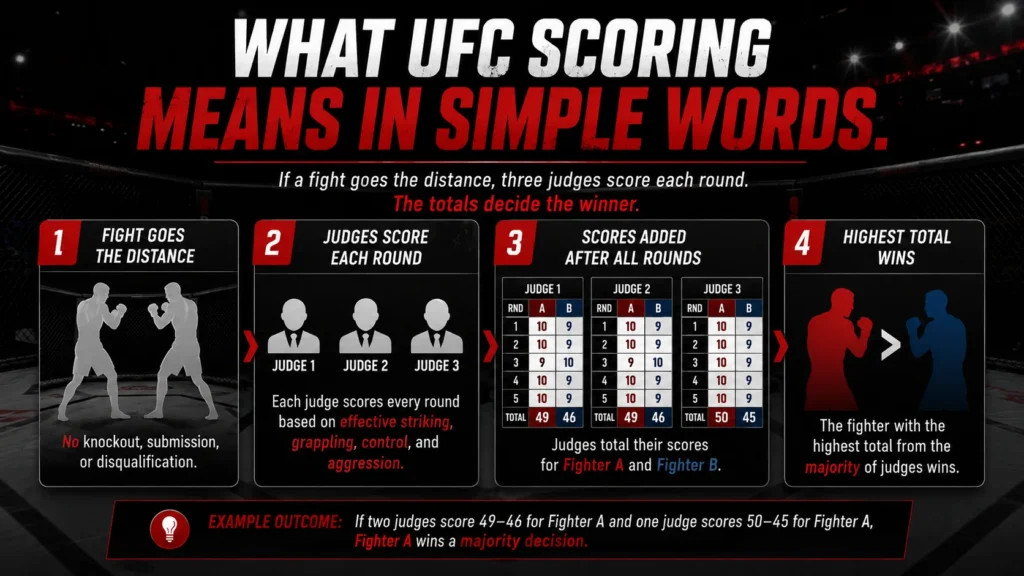
Most standard UFC bouts are three rounds. Main events and title fights are usually five rounds. If a fight goes the distance, each judge submits a score for every round. Those round scores are then added to create that judge’s final scorecard.
The most common example is a three-round fight where one fighter wins two rounds and the other fighter wins one round. In a normal close fight, the winning fighter may receive a 29-28 score from one judge. If all three judges score it the same way, fans hear “unanimous decision.”
For new fans, the key is this: winning moments matter, but winning rounds matters more. A fighter can have one huge third round and still lose if they clearly lost the first two rounds. This is one reason fans sometimes disagree with decisions after watching a dramatic finish to the fight.
- Round-by-round scoring means judges judge each round separately.
- Three judges usually score a UFC fight from cageside.
- A finish beats the scorecards because judges are only needed when the fight reaches the time limit.
- Close fights can be debated because judges may value different legal offense in close rounds.
How the 10-Point Must System UFC Fans Hear About Works
The phrase 10-point must system UFC fans search for refers to the official scoring method used in UFC and most regulated MMA bouts in the United States. Under the Unified Rules of Mixed Martial Arts, the winner of a round must receive 10 points, while the losing fighter usually receives 9 points or fewer.
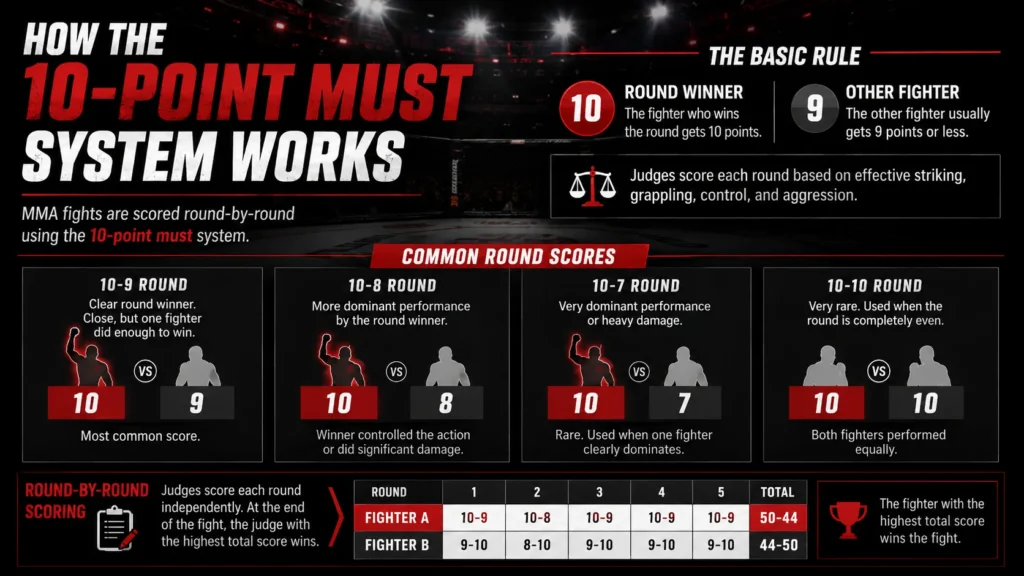
That sounds simple, but the details matter. A round can be 10-9 when it is close, 10-8 when one fighter wins by a large margin, or 10-7 in extremely rare domination. A 10-10 round is possible, but the official guidance treats it as extremely rare when judges can identify any meaningful difference. This is where the 10-point must system UFC fans hear about becomes more than a score label.
So, when fans ask how UFC scoring works, the answer is not “who landed more total strikes” or “who moved forward more.” The answer is: judges compare the legal scoring impact inside each round and then assign a score using the 10-point system. For beginners, how UFC scoring works is easier to follow when every close exchange is judged inside its own round.
| Round Score | Simple Meaning | Beginner Example |
| 10-9 | One fighter wins the round by a close or clear margin. | Cleaner strikes, better grappling, or slightly more effective offense. |
| 10-8 | One fighter wins by a large margin with impact, dominance, or duration. | A fighter badly hurts the opponent or controls and damages them for a long stretch. |
| 10-7 | A very rare round where one fighter completely overwhelms the other. | A near-stoppage round where the losing fighter is barely surviving. |
| 10-10 | An extremely rare even round. | Both fighters do almost exactly the same amount of effective work. |
- UFC Fight Rules Explained: Rounds, Fouls & Ways to Win
- How to Check UFC Results: Simple Steps for Fans
- UFC Weight Classes Explained: A Beginner Breakdown
- UFC Fight Card Explained: How Fight Night Works
What Judges Score First: Effective Striking and Grappling
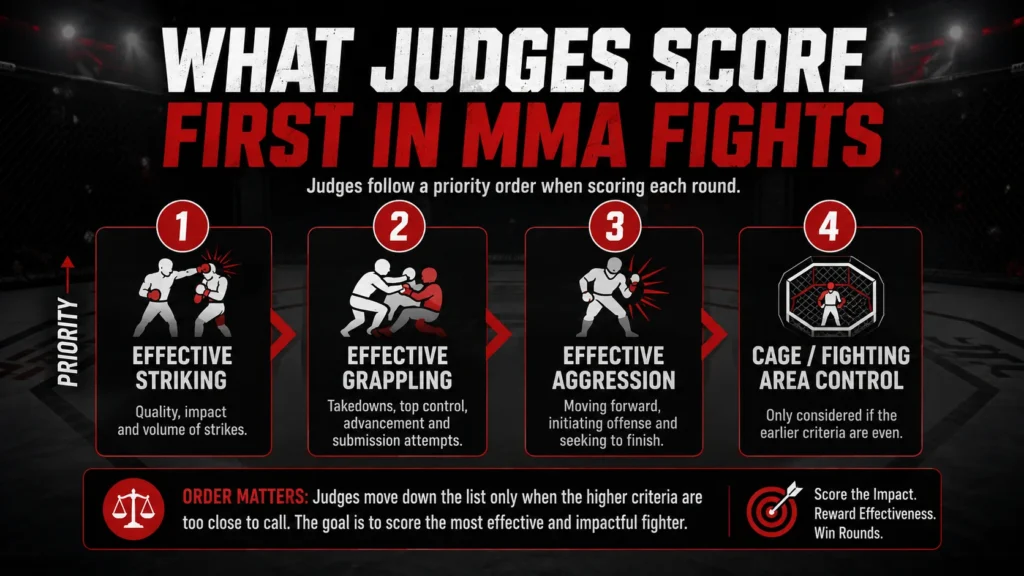
The most important part of MMA judging criteria is effective striking and effective grappling. This is the first priority. In simple terms, judges ask: Who did more legal work that could realistically move the fight toward a finish or clearly win the round? These MMA judging criteria keep judges focused on useful offense rather than noise or popularity.
Effective striking does not mean throwing the most punches. It means landing legal strikes that matter. A clean punch that visibly hurts a fighter can matter more than several light touches that do not change the fight. A hard kick, damaging elbow, or clean combination can be more meaningful than volume without impact.
Effective grappling is also not just holding someone down. Judges look for takedowns that lead to offense, submission attempts that force defense, reversals that change the fight, and dominant positions used to create damage or submission danger. A takedown with no follow-up may be less valuable than a takedown that leads to control, strikes, or a serious submission threat.
This is where many fans get confused. A fighter may have more control time, but if that control does not create offense, the round can still be close. A fighter may land fewer strikes, but if those strikes are clearly more damaging, judges may score the round for that fighter.
- Effective striking: clean, legal strikes with visible or meaningful impact.
- Effective grappling: takedowns, reversals, submissions, and dominant positions that create offense.
- Impact matters: damage, danger, and fight-changing moments often carry more weight than empty activity.
- Position alone is not enough: judges should look at what a fighter does with the position.
Backup Criteria: Effective Aggression and Fighting-Area Control
After effective striking and grappling, judges may consider effective aggression. But this is a backup criterion. It should matter only when effective striking and grappling are very close or essentially equal.
Effective aggression means a fighter is trying to finish or win the fight with meaningful forward action. It is not the same as simply walking forward. A fighter can pressure without landing. Another fighter can move backward while landing the cleaner shots. In that case, the clean offense can matter more than the pressure.
The final backup criterion is fighting-area control, sometimes called cage control or octagon control. This means dictating where the fight happens: center of the cage, against the fence, or on the ground. But under modern MMA judging criteria, this should matter only when the more important criteria are equal.
For readers, the simple rule is: damage and effective offense first, pressure second, location control last. That is the safest way to understand how UFC scoring works without falling into common fan debates. This is also why MMA judging criteria should be read in order, not treated as equal checkboxes.
- Effective aggression matters when scoring offense is basically even.
- Fighting-area control matters only when offense and aggression are both even.
- Walking forward alone does not automatically win a round.
- Backing up while landing clean shots can still win a round.
10-9, 10-8, 10-7, and 10-10 Rounds Explained
A big part of UFC scoring explained is learning what the actual numbers mean. The score is not random. It tells you how clearly a judge thought one fighter won the round. This is another place where UFC scoring explained helps fans connect the number to the round.
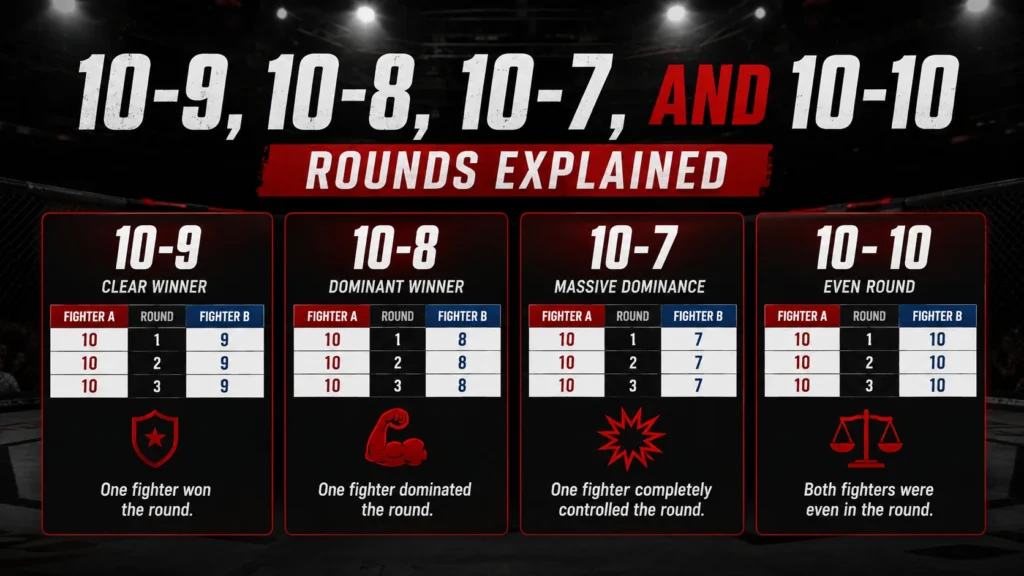
A 10-9 round is the standard score. It can be very close or clearly won, but it is not dominant enough for a 10-8. Most UFC rounds end up 10-9 because one fighter usually does enough to edge or clearly win the round without overwhelming the opponent.
A 10-8 round is much more serious. It suggests that one fighter won the round by a large margin. The official guidance emphasizes impact, dominance, and duration. A fighter does not need to dominate every second, but there should be enough strong evidence that the round was not merely close.
A 10-7 round is rare. It usually means one fighter was completely overwhelmed and the action was close to a stoppage. Fans should not expect to see 10-7 often. A 10-10 round is also rare because if judges can find any clear advantage, they are generally expected to score the round for one fighter. Even rare scores make more sense when the 10-point must system UFC uses is applied round by round.
| Score | When It Usually Applies | Fan-Friendly Explanation |
| 10-9 | Close or normal winning round | One fighter did better work, even if the round was competitive. |
| 10-8 | Large-margin round | One fighter had major impact, dominance, or long control with offense. |
| 10-7 | Extreme domination | One fighter was almost completely overwhelmed. |
| 10-10 | Rare even round | Judges see no meaningful difference between fighters. |
How Judges Turn Round Scores Into a Decision
When a fight ends with no finish, the judges add their round scores. Those totals create the final decision. This is where UFC judges scorecards become useful for fans, because scorecards show which rounds each judge awarded to each fighter. That is why UFC judges scorecards are the best tool for checking the exact round-by-round path.
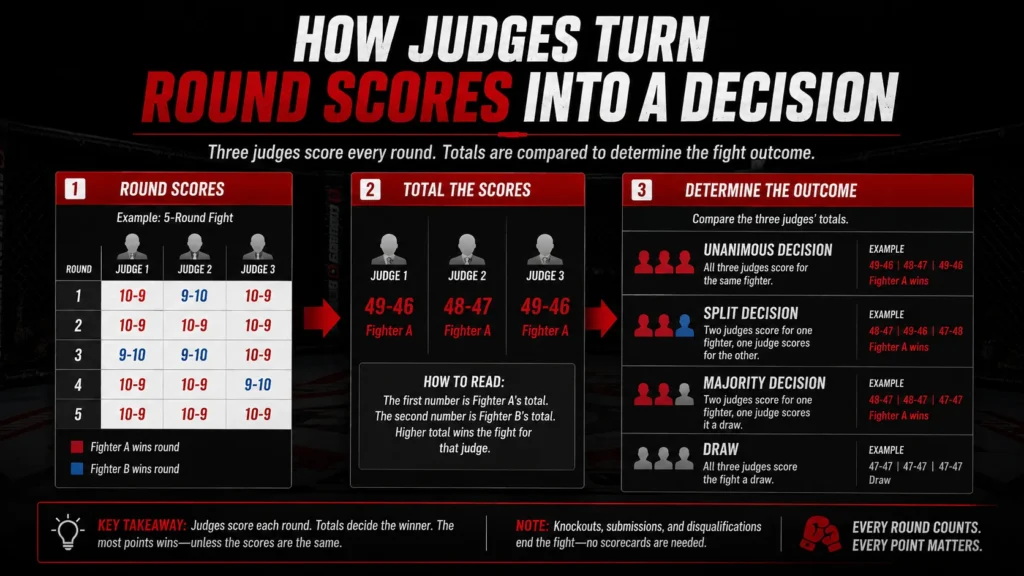
In a three-round fight, a common score is 29-28. That usually means one fighter won two rounds and lost one. In a five-round fight, common scores include 48-47, 49-46, or 50-45, depending on how many rounds each fighter won and whether any 10-8 rounds or point deductions occurred.
A unanimous decision means all three judges picked the same winner. A split decision means two judges picked one fighter and the third judge picked the other. A majority decision means two judges picked one fighter while the third scored the fight a draw. A draw can happen when the scorecards do not create a majority winner.
For new fans, the important point is that the official result is not only about the final totals. The round-by-round path matters. A controversial 29-28 score often comes down to one swing round that two judges saw differently. When reviewed carefully, UFC judges scorecards often show that one close round shaped the whole result.
| Decision Type | What It Means | Beginner Example |
| Unanimous Decision | All three judges choose the same winner. | 30-27, 30-27, 29-28 for Fighter A. |
| Split Decision | Two judges choose one fighter; one judge chooses the other. | 29-28, 29-28 for Fighter A; 29-28 for Fighter B. |
| Majority Decision | Two judges choose one fighter; one judge scores it even. | 29-28, 29-28 for Fighter A; 28-28 draw. |
| Draw | The scorecards do not produce a majority winner. | Scores can include majority draw, split draw, or unanimous draw. |
What Judges Are Not Supposed to Score
One of the most helpful parts of UFC scoring explained is knowing what does not automatically win a round. Fans often give credit for things that look impressive but may not be decisive under the official priorities. This part of UFC scoring explained prevents fans from overvaluing moments that are loud but not decisive.
For example, crowd reaction is not scoring criteria. A loud arena may react to a flurry, a takedown, or a fighter standing up from the ground, but judges are supposed to score the legal action itself, not the sound of the crowd.
Likewise, a fighter’s reputation should not matter. A former champion, a fan favorite, or a heavily promoted athlete still has to win the round under the criteria. Judges are supposed to score what happens in front of them, round by round.
Stats are useful, but they are not the complete story. UFC Stats can help fans review significant strikes, takedowns, control time, and attempts, but judging is not a spreadsheet-only process. Impact and context still matter.
- Crowd noise does not score points.
- Fighter popularity should not affect scorecards.
- Total strikes alone do not tell the whole story.
- Control without offense may not be enough to win a round.
- The final round alone does not erase earlier rounds.
Why Close UFC Decisions Become Controversial
Close UFC decisions become controversial because many rounds are not obvious. Two fighters may land different types of offense. One may land more volume, while the other lands harder shots. One may secure a takedown, while the other creates more damage on the feet.
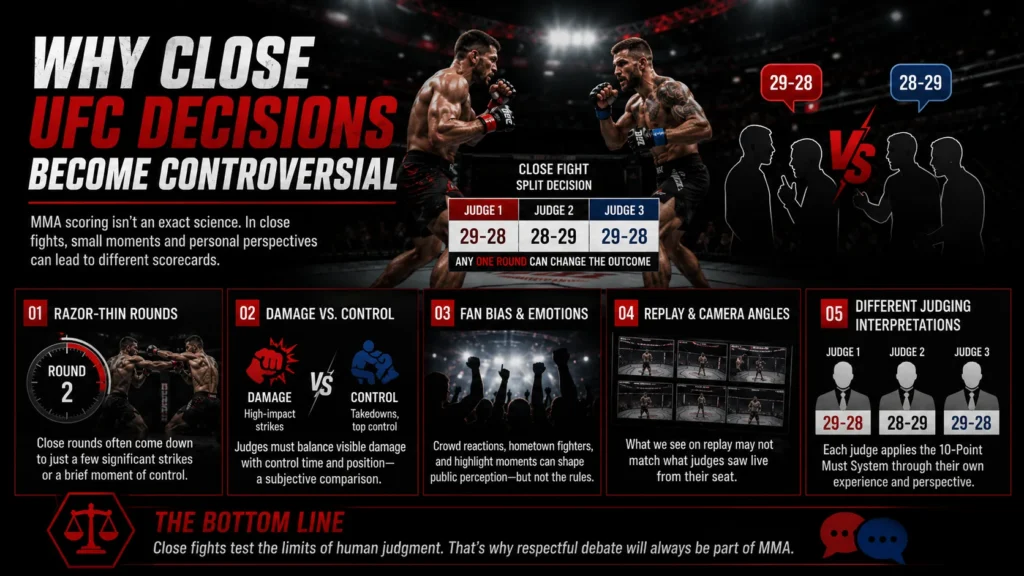
Judges sit in different positions around the cage. Each judge may have a slightly different angle on strikes, fence exchanges, and grappling scrambles. They are supposed to apply the same MMA judging criteria, but in close rounds, small differences in what they see can affect the score.
Another reason for debate is fan emotion. Fans often remember the biggest moment of a fight, not necessarily the full round-by-round picture. If a fighter almost gets a finish in round three but clearly lost rounds one and two, the fight may feel more dramatic than the scorecard suggests.
The best way to understand a controversial decision is to rewatch the fight one round at a time. Ask what happened in each round, what was effective, and whether the scoring criteria were clearly met. This approach is more reliable than reacting only to the final announcement. That approach makes UFC scoring explained more useful after a controversial decision.
- Which fighter had the cleaner, more effective offense in the round?
- Did either fighter badly hurt, threaten, or control the opponent with meaningful offense?
- Was aggression effective or just forward movement?
- Did cage control matter only because everything else was even?
- Was one round the real “swing round” that decided the fight?
How to Read UFC Scorecards After a Fight
After an event, fans can check official result pages and scorecard pages to see how judges scored the fight. If you already use our guide on how to check UFC results, this scoring article is the deeper follow-up that helps you understand why the result looked the way it did. Those UFC judges scorecards also help separate official scoring from instant fan reaction.
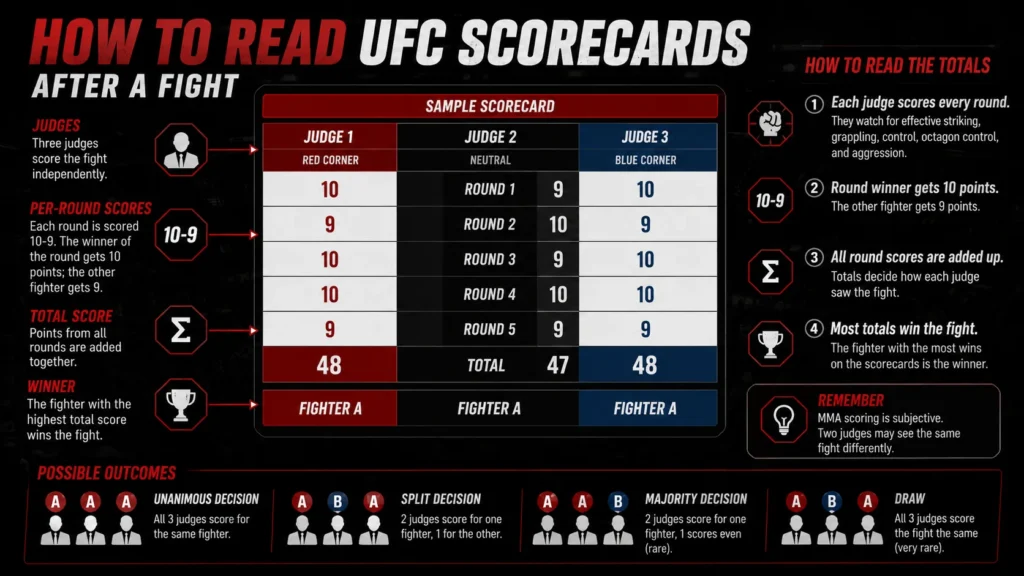
Start by checking the fight result. Was it unanimous, split, majority, or draw? Then look at each judge’s round-by-round scoring. If two judges gave the same close round to one fighter while the third gave it to the other, that round likely explains the controversy.
You can also compare official results with stats. The official UFC results page can confirm the outcome, while stats pages can help you review strike totals and grappling numbers. Just remember that stats support the analysis; they do not replace the judging criteria.
If rankings are affected, the official UFC rankings page may help you understand why a close decision matters for title shots, contender movement, or division momentum.
| Step | What to Check | Why It Helps |
| 1 | Official result | Confirms winner, method, and round or decision type. |
| 2 | Round-by-round scorecards | Shows which rounds each judge gave to each fighter. |
| 3 | Fight stats | Adds context such as strikes, takedowns, and control time. |
| 4 | Rankings impact | Shows how a win may affect contender placement. |
Common Beginner Mistakes About UFC Scoring
Beginners often make predictable mistakes when reading a decision. The first mistake is thinking a takedown automatically wins a round. A takedown matters more when it leads to offense, control with impact, submission danger, or a clear positional advantage that changes the round.
The second mistake is treating every strike equally. A jab that barely lands and a clean punch that badly hurts a fighter are not the same. When learning how UFC scoring works, fans should think about quality, impact, and effectiveness, not only totals. That is a core part of how UFC scoring works in close rounds.
The third mistake is scoring the fight as a whole. UFC fights are scored by round. A fighter can win two quiet rounds and survive a bad third round, then win 29-28. That result may feel strange if you remember only the most dramatic moment, but it can be correct under round-by-round scoring.
The fourth mistake is assuming a split decision means a robbery. Split decisions usually mean the fight had at least one close round. Sometimes the disagreement is understandable. Other times, fans and analysts may strongly disagree with a judge. The scorecard still needs to be reviewed round by round.
- Do not count a takedown without asking what happened after it.
- Do not treat light volume and damaging offense as equal.
- Do not let one huge moment erase earlier rounds.
- Do not assume a split decision is automatically wrong.
- Do not ignore point deductions, fouls, or unusual 10-8 rounds.
Quick Checklist for Watching UFC Decisions Like a Smarter Fan
Here is a simple checklist you can use during any close UFC fight. It keeps the scoring process simple without turning the fight into homework. Use it as a simple UFC scoring explained checklist when a fight is close.
After each round, ask yourself who landed the more effective offense. If the striking was close, ask who had the more meaningful grappling. If that is still close, ask who created more effective aggression. Only after that should you think about who controlled the space.
This checklist will not make every decision obvious. Some rounds are genuinely close. But it will help you understand UFC scoring explained from a judge-like perspective instead of a fan-only reaction.
- Step 1: Who landed the cleaner or more damaging legal strikes?
- Step 2: Who used grappling more effectively, not just longer?
- Step 3: Did either fighter create real submission or finish threats?
- Step 4: If offense was equal, who had effective aggression?
- Step 5: If everything else was equal, who controlled where the fight happened?
- Step 6: Did a point deduction, 10-8 round, or swing round change the result?
Conclusion
UFC scoring explained becomes much easier once you stop thinking of a decision as one big summary and start thinking round by round. Judges score each round with the 10-point must system UFC uses in regulated MMA. Their first priority is effective striking and grappling, with effective aggression and fighting-area control used only when the main scoring areas are very close.
For beginners, the most important lesson is simple: impact matters, context matters, and rounds matter. A fighter who lands the cleaner shots, creates the better grappling offense, or dominates a round with meaningful impact usually has the strongest scoring argument.
Use official scorecards, results, and stats after the fight to review close decisions calmly. The more you understand scoring, the more enjoyable UFC becomes because you can follow not only who won, but why the judges saw it that way.
Sources of Links –
| Source Name | Linked Topic / Purpose | Anchor Text Used | Clean URL | Publishing Note |
| Association of Boxing Commissions – Unified Rules of MMA | Official scoring system, 10-point must system, judging priorities, round scoring, fouls | Unified Rules of Mixed Martial Arts; 10-point must system; MMA judging criteria | https://www.abcboxing.com/wp-content/uploads/2020/02/unified-rules-mma-2019.pdf | Primary rules reference. Use for scoring definitions and judging criteria. |
| UFC Official Scorecards | Official scorecards after UFC events | UFC judges scorecards | https://www.ufc.com/scorecards | Use when explaining how fans can review round-by-round judging after a fight. |
| UFC Official Results | Official event results and methods of victory | official UFC results page | https://www.ufc.com/results | Use when explaining how to confirm the official result and method. |
| UFC Stats | Fight statistics such as strikes, takedowns, control time, and event data | UFC Stats | http://ufcstats.com/statistics/events/completed?page=all | Use as a supporting stats source, not as a replacement for judging criteria. |
| UFC Official Rankings | Current rankings and divisional context | official UFC rankings | https://www.ufc.com/rankings | Use for ranking impact and contender movement context. |
| ESPN MMA Fightcenter | Reliable fight cards, results, and event coverage | ESPN MMA Fightcenter | https://www.espn.com/mma/fightcenter | Use as a secondary reliable source for event context. |
| InfoJustify – What Is UFC? | Internal beginner explainer context | what UFC is | https://infojustify.com/what-is-ufc-a-simple-explainer-for-new-fans/ | Internal link for readers who need a broader UFC beginner guide. |
| InfoJustify – UFC Weight Classes Explained | Internal weight-class context | UFC weight classes | https://infojustify.com/ufc-weight-classes-explained-a-beginner-breakdown/ | Internal link for readers who want to understand divisions and weight limits. |
| InfoJustify – How to Check UFC Results | Internal results-checking guide | how to check UFC results | https://infojustify.com/how-to-check-ufc-results-simple-steps-for-fans/ | Internal link for readers who want to find official results after events. |
FAQ –
What does UFC scoring explained mean?
UFC scoring explained means understanding how judges score each round when a UFC fight does not end by knockout, submission, stoppage, or disqualification. Judges use a 10-point system and mainly value effective striking and grappling first.
How does the 10-point must system work in UFC?
In the 10-point must system, the winner of a round usually receives 10 points and the losing fighter receives 9 points or fewer. A close round is often 10-9, while a dominant round can be 10-8.
What do UFC judges look for first?
UFC judges look first at effective striking and effective grappling. This means legal offense that has real impact, creates danger, advances position, threatens a finish, or clearly helps a fighter win the round.
Does a takedown automatically win a UFC round?
No. A takedown does not automatically win a round. It becomes more valuable when it leads to offense, control with impact, submission threats, or a clear advantage that changes the round.
What is a split decision in UFC?
A split decision happens when two judges score the fight for one fighter and the third judge scores it for the other fighter. It often means at least one round was very close or debated.
Where can fans check UFC judges scorecards?
Fans can check UFC judges scorecards through official UFC scorecard pages and trusted event coverage after fight night. Scorecards help fans see which rounds each judge awarded to each fighter.
- UFC Scoring Explained: Easy Guide to How Judges Score MMA Fights
- UFC Fight Rules Explained: Rounds, Fouls & Ways to Win
- Protect Outlook OneDrive from Phishing: 9 Smart Safety Steps
- Clicked Phishing Link What to Do: 10 Recovery Steps
- How to Spot Phishing Emails: Red Flags & Examples
- FBI Alert Outlook OneDrive: Phishing Scam Explained
- What Is Phishing? Meaning, Examples & Safety Tips
- How to Improve Your Credit Score in the USA: Complete Guide
- Why Is Roland Garros So Hard to Win? Full Guide
- Roland Garros Winners List: Champions, Records & Legends
- Why Is Roland Garros Played on Clay? Court Guide
- French Open vs Roland Garros: Are They the Same Tournament?
- Roland Garros Meaning, History & Clay Court Explained
- Guzman y Gomez vs Chipotle: Menu, Taste, and Value Compared
- Chipotle Bowl vs Burrito: Which One Is Healthier?
- Chipotle Nutrition Guide: Calories, Protein & Smart Orders
- Healthiest Thing to Eat at Chipotle: Best Orders Explained
- Chipotle Mexican Grill Menu Explained: Best Items to Try
- Social Security Payment Schedule 2026: Dates by Birth Date
- Social Security COLA 2026 Explained: What Changed This Year
- Kyle Busch Pneumonia Sepsis: Cause of Death Explained
- Why Are Social Security Checks Late in May 2026? (The Real Truth)
- Antarctica From Space: 5 Climate Signals to Watch
- Ebola Outbreak 2026: Bundibugyo Virus Explained & Related Topic
- Robert Redfield: Biography, CDC Role, COVID-19 Legacy