

The best way to improve your credit score in the USA is to build a steady record of on-time payments, keep credit card balances low compared with your limits, check your credit reports often, dispute incorrect information, avoid unnecessary new applications, and keep older positive accounts in good standing. You usually cannot create a strong score overnight, but you can start building momentum in 30 to 90 days by focusing on the habits that most scoring models reward.
Finance note: This article is for educational purposes only and is not financial advice. Credit score rules, lender policies, and consumer reporting practices can change, so readers should verify important details with official sources or a qualified financial professional before making decisions.
- What a Credit Score Means in the USA
- How Credit Scores Are Usually Calculated
- Step 1: Check Your Credit Reports First
- Step 2: Pay Every Bill On Time
- Step 3: Lower Your Credit Utilization Ratio
- Step 4: Fix Credit Report Mistakes
- Step 5: Keep Good Accounts Open Strategically
- Step 6: Be Careful With New Credit Applications
- Step 7: Build Credit If You Are New to Credit
- Step 8: Handle Debt, Collections, and Late Payments Carefully
- 30/60/90-Day Credit Score Action Plan
- Credit Score Myths That Confuse Beginners
- How to Track Progress Without Obsessing Over the Number
- Common Mistakes That Keep Credit Scores Low
- When to Get Professional Help
- Source List –
- Conclusion
- FAQ –
What a Credit Score Means in the USA
A credit score is a number created from information in your credit reports. It helps businesses estimate how likely you are to repay borrowed money. The score is usually based on your history with credit cards, loans, payment records, account balances, collections, public records that may be legally reported, and other credit-related information.
Your credit score is not the same thing as your income. A person can have a high income and a weak credit score if they miss payments or carry high balances. Another person can have modest income and a stronger score if they use credit carefully, pay on time, and keep debt manageable.
This is why the phrase how to improve your credit score in the USA should be understood as a long-term behavior plan. You are not trying to trick a formula. You are trying to make your credit history look more consistent, accurate, and less risky.
A good score can matter when you apply for a credit card, auto loan, personal loan, mortgage, apartment lease, or sometimes a utility account. It may also affect the interest rate you receive. Even a small difference in loan pricing can become expensive over time, especially with mortgages and car loans.
At the same time, credit is only one part of financial health. A higher score is useful, but it should not push you into unnecessary debt. The goal is not to borrow more. The goal is to have better options when borrowing is necessary or helpful.
How Credit Scores Are Usually Calculated
Different companies create different scores, and lenders may use different scoring models. Still, most major credit scoring systems look at similar habits. The most common areas are payment history, amounts owed, length of credit history, credit mix, and new credit activity.
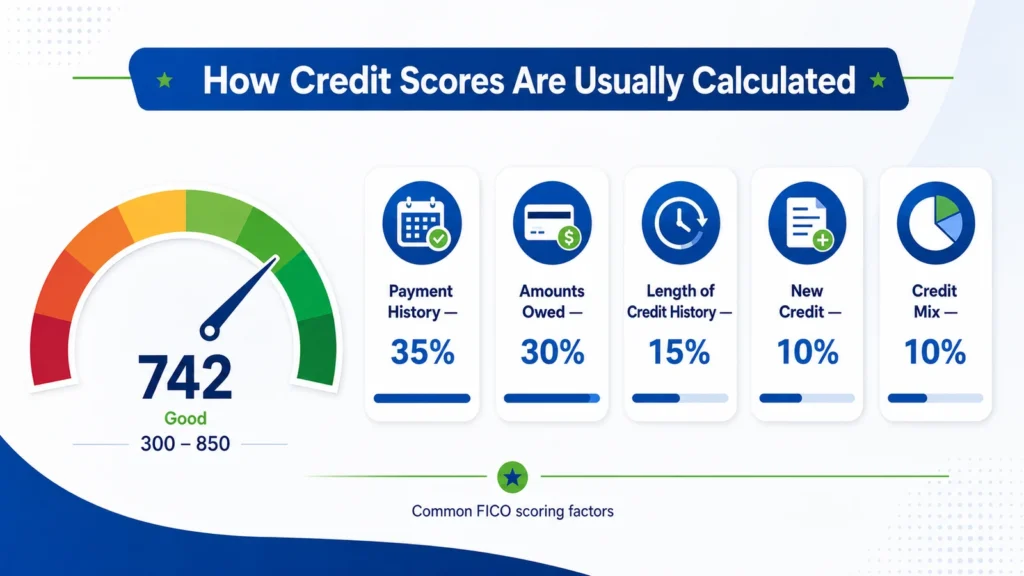
FICO explains that its scores use five major categories: payment history, amounts owed, length of credit history, new credit, and credit mix. FICO lists payment history as 35 percent of the score and amounts owed as 30 percent, which means those two areas deserve the most attention.
Payment history asks a simple question: have you paid your credit accounts as agreed? Late payments, collections, charge-offs, and similar negative events can hurt because they tell lenders there may be repayment risk.
Amounts owed looks at how much debt you are using. For credit cards, a key part of this area is the credit utilization ratio. This means how much of your available revolving credit you are using. A lower ratio often looks better than a maxed-out card.
Length of credit history looks at how long your accounts have been open and active. New credit looks at recent applications and newly opened accounts. Credit mix looks at whether you have experience with different types of credit, such as revolving cards and installment loans.
You do not need a perfect mix or a complicated strategy to start. Most people should focus first on the two biggest basics: pay on time and keep balances low. Those actions are simple, repeatable, and easier to control than the age of your oldest account.
- Ebola Outbreak 2026: Bundibugyo Virus Explained & Related Topic
- Robert Redfield: Biography, CDC Role, COVID-19 Legacy
- Types of Yoga: 30 Powerful Styles Explained
Step 1: Check Your Credit Reports First
Before you try any credit score improvement plan, check your credit reports. Your credit score is built from the information in those reports. If the reports contain incorrect balances, accounts you do not recognize, wrong payment history, duplicate collections, or identity theft activity, your score may be affected unfairly.
In the United States, you can request free weekly credit reports online from Equifax, Experian, and TransUnion through AnnualCreditReport.com. The Federal Trade Commission also warns that AnnualCreditReport.com is the authorized place to get the free credit reports you are entitled to by law.
When you review your reports, do not scan them casually. Check your name, current and past addresses, account names, account numbers, balances, credit limits, payment history, dates opened, collection accounts, and any hard inquiries. The goal is to find anything that does not match your records.
A beginner-friendly method is to download all three reports and compare them side by side. Some lenders may report to all three companies, while others may report to only one or two. That means your reports may not be identical, but the information should still be accurate.
Create a simple spreadsheet or note with four columns: account name, what looks wrong, which report shows it, and what proof you have. This makes the dispute process easier if you find an error.
Step 2: Pay Every Bill On Time
On-time payment is the foundation of credit score improvement. The CFPB says most credit scores consider repayment history the number one factor for building a strong credit score. If you want to know where to start, start here.
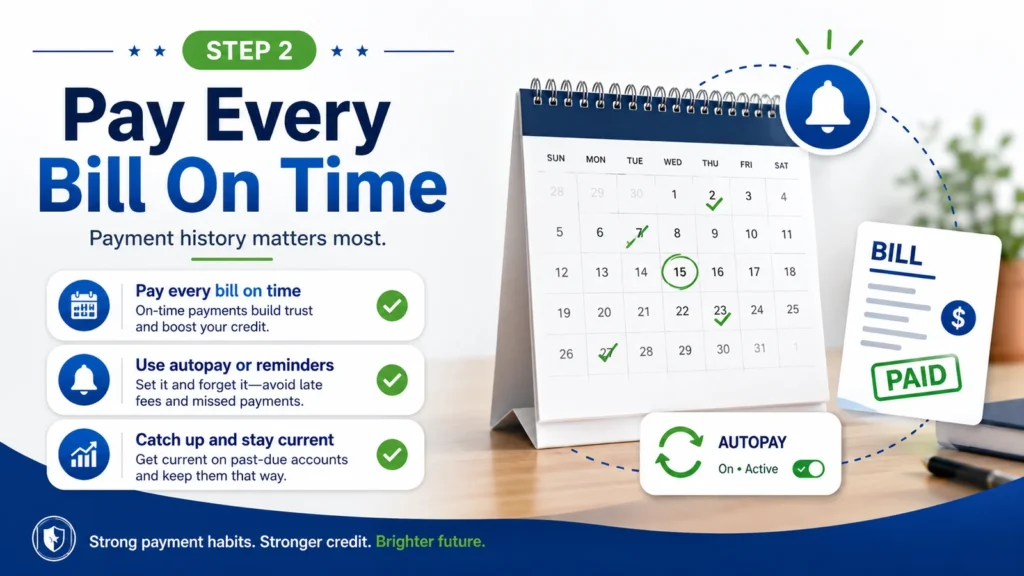
A single late payment can hurt because it suggests repayment risk. The damage can depend on how late the payment is, how recent it is, your previous credit history, and how the account is reported. A person with an otherwise clean report may feel a late payment more sharply because it stands out.
The practical solution is to remove as much human error as possible. Set up automatic minimum payments for every credit card and loan. Then add calendar reminders a few days before the due date so you can pay more than the minimum when possible.
If you are already behind, focus on getting current. Catching up does not erase the late payment immediately, but it can stop the account from getting worse. A 30-day late payment is bad; a 60-day or 90-day late payment is usually worse.
For people with irregular income, a bill calendar is powerful. Write down every due date, minimum payment, paycheck date, and rent or mortgage date. Then ask lenders whether they allow due-date changes. Moving a due date closer to your paycheck can make on-time payment easier.
Do not skip small bills. Medical bills, store cards, old subscriptions, utilities, and forgotten accounts can become a credit problem if they turn into collections. A strong score often comes from boring consistency, not dramatic financial moves.
Step 3: Lower Your Credit Utilization Ratio
After payment history, credit card balances are one of the most important areas to manage. Your utilization ratio compares how much revolving credit you are using with how much is available to you. The CFPB explains that companies may look at the balance you owe compared with your available credit when calculating scores.
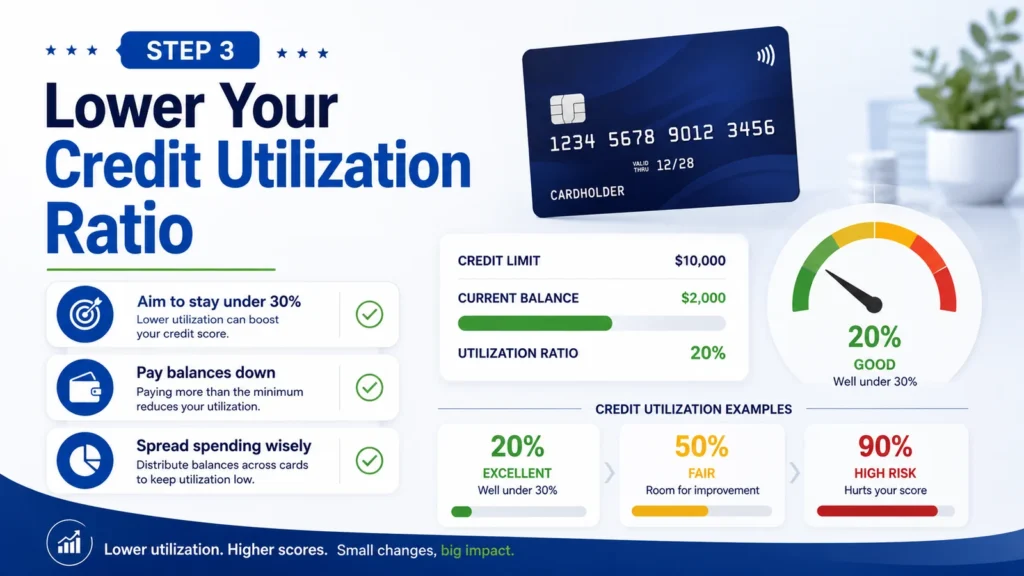
For example, if you have a credit card with a $1,000 limit and a $700 balance, your utilization on that card is 70 percent. If your total credit limits across all cards are $5,000 and your total balances are $1,000, your overall utilization is 20 percent.
Many credit educators suggest keeping utilization low, but the exact best number can vary by scoring model and profile. A simple rule for beginners is to avoid maxing out any card, try to stay below 30 percent, and aim lower if you are preparing for a major loan application.
One common mistake is paying the full statement balance after the issuer reports a high balance. You may avoid interest if you pay by the due date, but the reported balance could still look high. If your score matters this month, consider making an extra payment before the statement closing date.
There are several ways to lower utilization. You can pay down balances, make multiple payments during the month, request a credit limit increase if you can avoid overspending, or spread necessary charges across cards carefully. The safest method is paying down debt, because it reduces both risk and interest cost.
Do not use utilization strategy as an excuse to carry debt. Credit cards can become expensive quickly. If you carry a balance, a lower utilization ratio may help your score, but paying interest still hurts your wallet. The best long-term plan is to use credit lightly and pay in full whenever possible.
Step 4: Fix Credit Report Mistakes
If you find incorrect information, do not ignore it. The CFPB lists common credit report errors such as accounts that do not belong to you, incorrect account status, wrong balances, duplicate debt, and information that should no longer be reported.
To fix an error, you usually need to contact both the credit reporting company and the company that provided the information. The CFPB explains that consumers have the right to dispute errors on their credit reports.
A strong dispute is clear and organized. Identify the exact item, explain what is wrong, state what should be changed, and attach copies of supporting documents. Keep the original documents and send copies. Save confirmation numbers, dates, and screenshots.
Examples of useful proof include bank statements, payment confirmations, settlement letters, identity theft reports, account closure letters, court documents, or written lender correspondence. The more specific your proof is, the easier it is for the issue to be investigated.
Disputing accurate negative information usually will not remove it. The goal is accuracy, not deletion of true history. However, if an item is incorrect, duplicated, outdated, mixed with someone else’s file, or caused by identity theft, it deserves attention.
Credit report cleanup is not always instant. Be patient, track your disputes, and follow up. If a dispute is resolved in your favor, check all three reports again later to confirm the correction appears where it should.
Step 5: Keep Good Accounts Open Strategically
Length of credit history matters, so closing an old credit card can sometimes hurt more than it helps. If the card has no annual fee, a positive payment history, and a decent credit limit, keeping it open may support your credit profile.
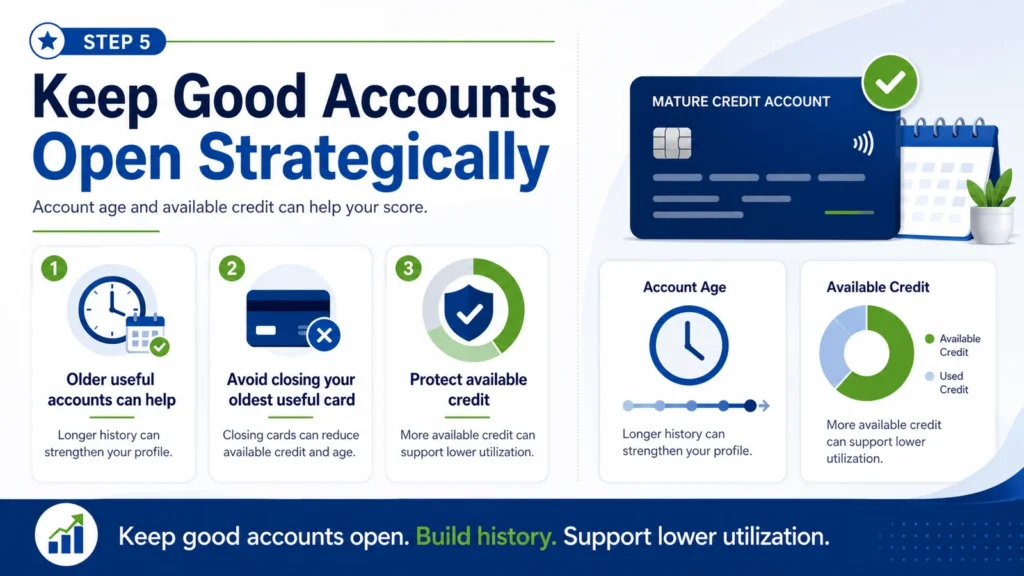
That does not mean you should keep every account forever. If a card has a high annual fee, poor terms, or causes overspending, closing it may be the right personal decision. Credit score improvement should never require you to keep a financial product that harms your budget.
The key is strategy. Before closing a card, ask three questions. Will this reduce my total available credit and raise my utilization? Is this one of my oldest accounts? Does this card have a fee or behavior risk that makes it worth closing anyway?
If you want to keep an old card active, use it lightly for a small recurring charge and set autopay. This helps prevent the issuer from closing it for inactivity while keeping the account simple.
For people rebuilding credit, positive account age is valuable. Over time, a long record of responsible behavior can help balance older mistakes. You cannot rush age, but you can protect it.
Step 6: Be Careful With New Credit Applications
Applying for new credit can create hard inquiries, and too many new accounts can make you look risky. One application usually is not a disaster, but repeated applications in a short period can be a problem, especially if your file is thin or already weak.
Before applying, ask whether you truly need the account. A store discount may not be worth a hard inquiry, a lower average account age, and the temptation to spend. A credit product should fit your plan, not just your checkout screen.
Rate shopping can work differently for some loans, such as mortgages, auto loans, or student loans, depending on the scoring model and timeframe. But for credit cards and personal loans, repeated applications can look like financial stress.
If you are preparing for a mortgage or auto loan, avoid opening new credit unless necessary. Lenders may review recent accounts, balances, and inquiries. Stability often matters when you are close to a major application.
A useful rule is to separate credit-building from credit-shopping. Build your score first. Then apply when your reports are clean, balances are low, and your approval odds are stronger.
Step 7: Build Credit If You Are New to Credit
If you are searching for how to build credit for the first time, the goal is not to open many accounts quickly. The goal is to create a small, steady record of responsible activity that lenders and scoring models can evaluate over time.
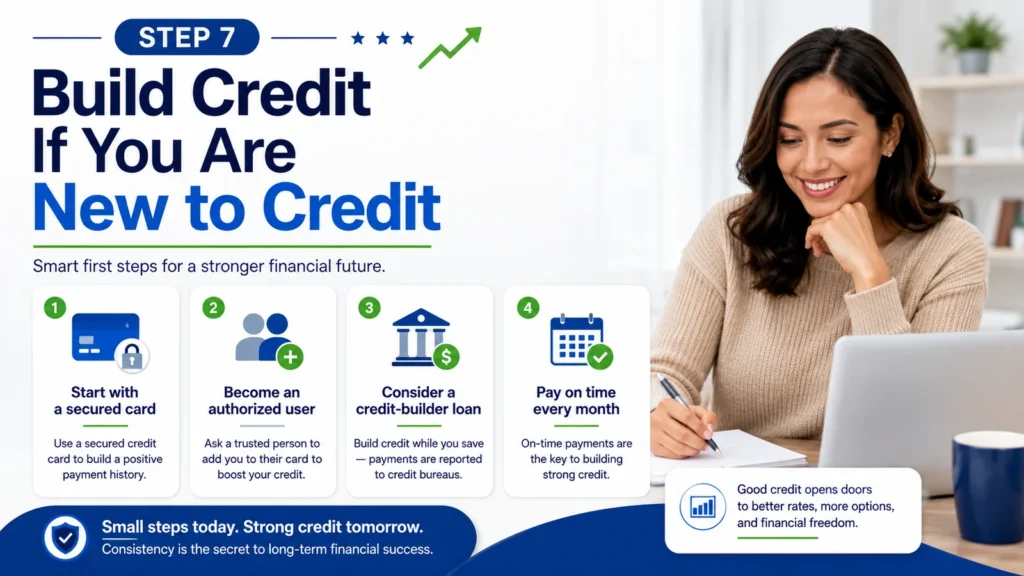
If you have no credit history or a thin file, your challenge is different. You may not have bad credit. You may simply have too little information for a strong score. This is common for young adults, new immigrants, people who always used cash, and people who avoided loans for years.
The safest first step is often a secured credit card from a reputable bank or credit union. A secured card usually requires a refundable deposit, and the credit limit may be tied to that deposit. Used carefully, it can help you build payment history.
Another option is a credit-builder loan through a credit union or community bank. Instead of receiving money upfront, the lender may place the loan amount in a locked account while you make payments. When the loan is paid, you receive the funds. The value is the payment record.
Authorized user status can help some people, but it requires trust. If a family member or partner adds you to an older card with perfect history and low utilization, it may help. But if that account becomes late or maxed out, it can hurt.
Rent and utility reporting services may help in some situations, but you should read terms carefully. Make sure the service reports to the bureaus you care about and does not cost more than the benefit is worth.
The beginner goal is simple: open one starter account, use it lightly, pay on time, and repeat for at least six to twelve months. Credit building is a long game.
Step 8: Handle Debt, Collections, and Late Payments Carefully
If your score is low because of debt, collections, or late payments, your first priority should be damage control. A score can recover over time, but new negative events can keep pushing recovery farther away.
Start with accounts that are currently late or at risk of becoming late. Getting current can prevent the situation from getting worse. Then create a plan for high-interest credit card debt, because interest charges can keep balances high and utilization elevated.
For collection accounts, verify the debt before paying. Confirm the collector, amount, original creditor, age of debt, and whether the information is accurate. Do not give payment information to a company you have not verified.
Negative information can remain on reports for a long time. The CFPB says credit reporting companies can generally report negative credit account payment history for up to seven years, while positive information may be reported longer. That is why preventing new damage is so important.
If you negotiate a settlement, get the agreement in writing before paying. Ask how the account will be reported. A paid collection may still appear on a report, but resolving debt can help your broader financial position and may matter to some lenders.
Do not pay a credit repair company simply because it promises fast deletion. Accurate negative information usually cannot be magically removed. A legitimate improvement plan focuses on accuracy, current payments, lower balances, and better habits.
30/60/90-Day Credit Score Action Plan
| Timeline | Action Steps |
|---|---|
| First 30 days | Pull credit reports, list all accounts, confirm due dates, set autopay, pay down the easiest high-utilization balance, and identify errors. |
| Days 31-60 | Submit disputes with proof, lower utilization further, avoid new applications, and keep all bills current. |
| Days 61-90 | Review updated reports, follow up on disputes, create a debt payoff order, and prepare a clean application plan if you need a loan. |
| After 90 days | Keep utilization low, build account age, review reports regularly, and avoid score-chasing habits that create debt. |
This 30/60/90-day plan is not a guarantee of a specific score increase. Credit scores depend on your starting profile. Someone with one high balance may see faster movement after paying it down. Someone with several recent late payments may need more time.
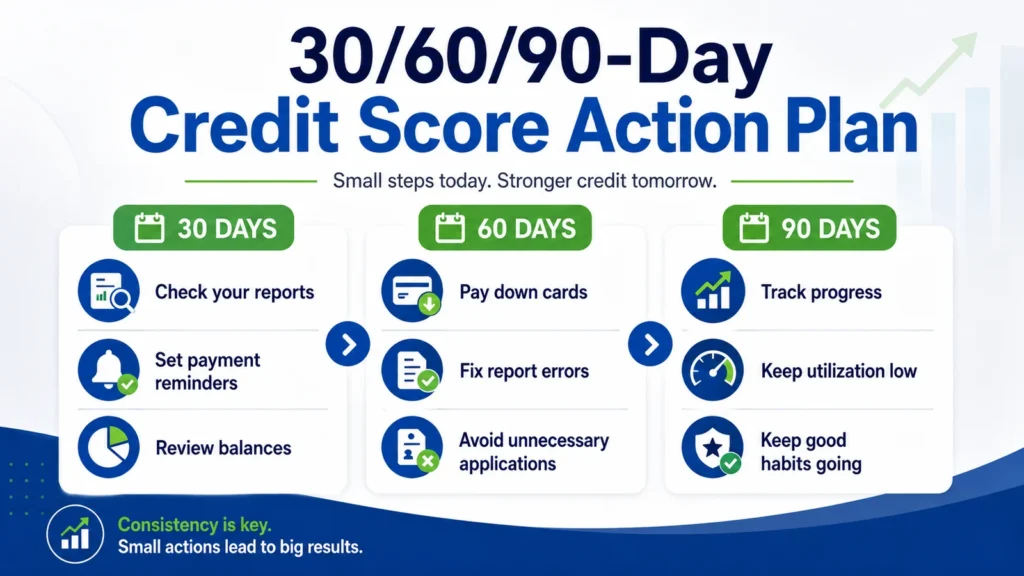
The plan works because it focuses on what you can control. You can control payment reminders. You can reduce balances. You can check reports. You can dispute incorrect information. You can stop applying for unnecessary accounts. Those habits make your profile cleaner over time.
If you have a major purchase coming, such as a mortgage or car loan, start earlier than 90 days if possible. Credit improvement is easier when you are not rushed. Give yourself time to fix reports, lower balances, and let updated account information appear.
Credit Score Myths That Confuse Beginners
Credit advice online can be confusing because some of it is outdated, incomplete, or designed to sell products. The CFPB has also warned about credit score myths that can hold people back from improving their credit.
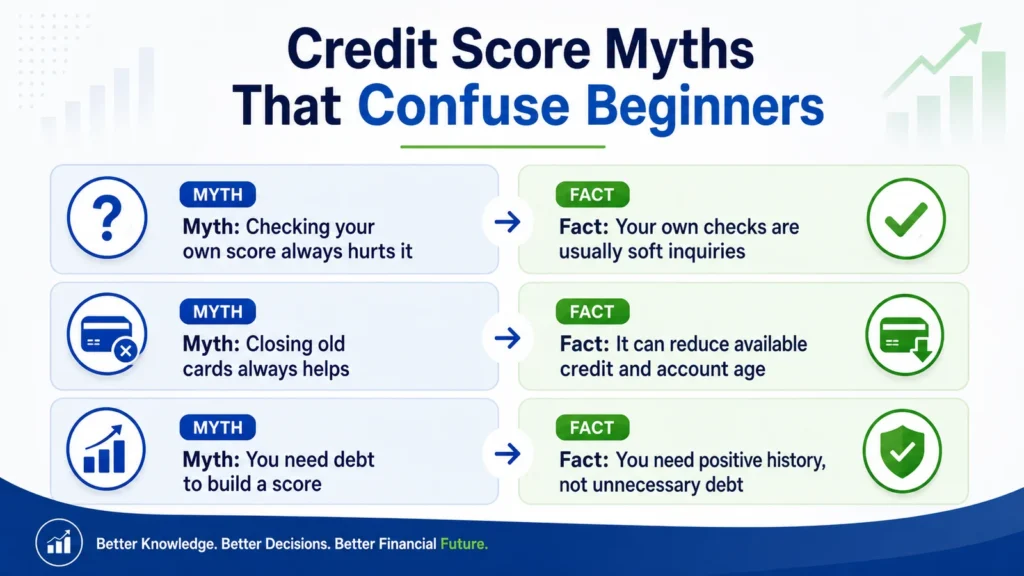
Myth one: checking your own credit report hurts your score. This is false when you check your own report. Personal review is a soft inquiry and is part of responsible credit management.
Myth two: carrying a credit card balance helps your score. You do not need to pay interest to build credit. Using a card lightly and paying it on time can build history without carrying expensive debt.
Myth three: closing every credit card helps. Closing accounts can reduce available credit and may affect the age of your credit profile. Sometimes closing is right, but it should be a strategic decision.
Myth four: income is part of your credit score. Your income can matter to lenders when deciding whether you can afford a loan, but it is not usually a direct item in standard credit scores.
Myth five: credit repair companies have secret powers. They do not. You can dispute inaccurate information yourself. Be cautious with anyone promising guaranteed score jumps or deletion of accurate history.
How to Track Progress Without Obsessing Over the Number
Credit score improvement is easier when you track progress, but it can become stressful if you check the number every day and react emotionally to every small movement. Scores can change because of timing, reported balances, model differences, new account data, or lender updates. A small monthly change does not always mean you did something wrong.
A better system is to track the behaviors that influence the score. Did you pay every account on time this month? Did you lower your revolving balances? Did your statement balances report lower than last month? Did you avoid unnecessary applications? Did you check whether disputed items were updated correctly? These actions matter more than daily score watching.
Choose one review day each month. On that day, write down your total credit card balances, total credit limits, utilization estimate, payment status, new inquiries, and any report changes. Then compare the pattern over three months instead of one week. This gives you a clearer view of whether your credit profile is becoming stronger.
Also remember that different apps may show different scores. A bank app, credit card dashboard, mortgage lender, and auto lender may not all use the same model. Use free scores as educational signals, not as the only truth. For major borrowing, the lender’s score model matters most.
The healthiest goal is not to hit a perfect number. The goal is to build a profile that says: this person pays on time, uses credit carefully, checks reports, corrects mistakes, and avoids unnecessary risk. When those habits become normal, the score usually has a better foundation to improve over time.
Common Mistakes That Keep Credit Scores Low
| Area | Problem | Better Move |
|---|---|---|
| Mistake | Why it hurts | Better habit |
| Paying late | Late payments weaken repayment history. | Use autopay, reminders, and due-date changes. |
| Maxing out cards | High utilization makes you look financially stretched. | Pay before statement close and reduce balances. |
| Ignoring reports | Errors or fraud may stay unnoticed. | Check all three reports regularly. |
| Opening too many accounts | New credit activity can look risky. | Apply only when the account fits your plan. |
| Closing old cards without thinking | It can reduce available credit and account age strength. | Review fees, utilization, and account age first. |
| Falling for instant repair claims | You may waste money and delay real fixes. | Use official dispute processes and steady habits. |
The biggest mistake is trying to improve a credit score while ignoring the budget. If your monthly cash flow is weak, payments become harder, balances rise, and stress increases. A strong score depends on a financial routine that you can actually maintain.
A second mistake is focusing only on the score and not the report. The report is the source data. If the data is wrong or risky, the score will reflect that. A good credit routine always includes report review.
A third mistake is using new debt to solve old debt without a plan. Balance transfers and consolidation loans can help in some cases, but they can also create a bigger problem if you keep spending on the old cards.
- Why Is Roland Garros So Hard to Win? Full Guide
- Roland Garros Winners List: Champions, Records & Legends
- French Open vs Roland Garros: Are They the Same Tournament?
- Why Is Roland Garros Played on Clay? Court Guide
- Why Are Social Security Checks Late in May 2026? (The Real Truth)
When to Get Professional Help
Some credit problems are simple enough to manage alone. Others may require help. Consider professional guidance if you are facing lawsuits, wage garnishment, identity theft, overwhelming debt, repeated collection calls, or housing insecurity because of credit issues.
A nonprofit credit counselor can help you review your budget, organize debts, and understand repayment options. If identity theft is involved, use official identity theft recovery resources and document everything carefully.
If bankruptcy is being considered, speak with a qualified professional. Bankruptcy can be the right legal tool for some people, but it has serious consequences and should not be treated like a quick score strategy.
The important thing is not to hide from the problem. Credit issues usually become worse when ignored. Open the statements, read the reports, answer verified notices, and create a plan.
Source List –
| Source | Use in Article | Clean URL |
|---|---|---|
| CFPB – Understand your credit score | Used for credit score meaning, score range context, and lender-use explanation. | https://www.consumerfinance.gov/consumer-tools/credit-reports-and-scores/understand-your-credit-score/ |
| CFPB – Get and keep a good credit score | Used for on-time payment and good credit behavior guidance. | https://www.consumerfinance.gov/ask-cfpb/how-do-i-get-and-keep-a-good-credit-score-en-318/ |
| CFPB – Paying off credit card balance | Used for balance-to-available-credit and credit card balance explanation. | https://www.consumerfinance.gov/ask-cfpb/will-paying-off-my-credit-card-balance-every-month-improve-my-score-en-1293/ |
| AnnualCreditReport.com | Used for free weekly online credit report availability. | https://www.annualcreditreport.com/index.action |
| FTC – Free credit reports | Used for authorized free credit report source warning. | https://consumer.ftc.gov/articles/free-credit-reports |
| CFPB – Common credit report errors | Used for credit report error examples and review guidance. | https://www.consumerfinance.gov/ask-cfpb/what-are-common-credit-report-errors-that-i-should-look-for-on-my-credit-report-en-313/ |
| CFPB – Dispute an error | Used for dispute rights and correction process guidance. | https://www.consumerfinance.gov/ask-cfpb/how-do-i-dispute-an-error-on-my-credit-report-en-314/ |
| myFICO – What is in your FICO Scores | Used for FICO score factor percentages. | https://www.myfico.com/credit-education/whats-in-your-credit-score |
| CFPB – How long information stays on credit reports | Used for seven-year negative information context. | https://www.consumerfinance.gov/ask-cfpb/how-long-does-information-stay-on-my-credit-report-en-323/ |
| CFPB – Credit score myths | Used for myth-busting guidance. | https://www.consumerfinance.gov/about-us/blog/credit-score-myths-might-be-holding-you-back-improving-your-credit/ |
Conclusion
Learning how to improve your credit score in the USA is really about learning how to build a reliable credit profile. The strongest steps are simple: pay on time, keep balances low, check reports, dispute inaccurate information, protect older good accounts, and avoid unnecessary new applications.
You do not need tricks. You need consistency. Credit score improvement happens when the information in your credit reports becomes cleaner, more stable, and less risky over time.
Start with your reports. Then build a system for payments and balances. If you are new to credit, begin with one safe starter account. If you are rebuilding, focus on stopping new damage and correcting inaccurate data.
A strong credit score can help you qualify for better financial opportunities, but the real win is control. When your credit routine is organized, your money decisions become less stressful and more strategic.
FAQ –
1. What is the fastest way to improve your credit score in the USA?
The fastest practical steps are to pay every bill on time, lower high credit card balances, avoid new unnecessary applications, and dispute any incorrect information on your credit reports.
2. How long does credit score improvement usually take?
It depends on your starting profile. Lowering high balances may help sooner, while recovering from late payments or collections can take longer because credit history changes over time.
3. Does checking my own credit report hurt my score?
No. Checking your own credit report is a soft inquiry and does not hurt your credit score.
4. What is a good credit utilization ratio?
Lower utilization is generally better. Many beginners try to stay below 30 percent, but aiming lower can be useful before applying for a major loan.
5. Can I improve my score without a credit card?
Yes, but a responsibly used credit card can make building credit easier. Other options may include credit-builder loans, installment loans, or reported payment accounts.
6. Should I close old credit cards after paying them off?
Not automatically. Closing an old card can reduce available credit and may affect your credit history. Review the fee, age, limit, and your spending risk before closing it.
7. Can credit repair companies remove accurate negative information?
No legitimate company can guarantee removal of accurate negative information. You can dispute inaccurate information yourself through the credit reporting companies.
8. Where can I get my free credit reports?
You can get free weekly online credit reports from Equifax, Experian, and TransUnion through AnnualCreditReport.com.
- How to Improve Your Credit Score in the USA: Complete Guide
- Social Security Payment Schedule 2026: Dates by Birth Date
- Kyle Busch Pneumonia Sepsis: Cause of Death Explained
- Why Are Social Security Checks Late in May 2026? (The Real Truth)
- Ebola Outbreak 2026: Bundibugyo Virus Explained & Related Topic
- Robert Redfield: Biography, CDC Role, COVID-19 Legacy
- Are AI voices safe for YouTube monetization
- Realistic Indian Accent AI Voices for Free: 3 Best Tools
- ElevenLabs Free Alternatives for Emotional Voices: 3 Picks
- Best Free AI Voice Generators for Faceless YouTube Shorts
- Top 5 Free AI Voice Generator Realistic Tools
- Free AI Video Generators Without Watermark: 2026 Truth
- AI vs Machine Learning: Powerful 2026 Career Truth
- Generative AI Uses and Risks: 11 Real-Life Lessons for Beginners
- What is Generative AI? 12 Powerful Basics for Beginners
One point that often gets overlooked is how much credit utilization can affect your score, even when you never miss a payment. Checking your credit reports regularly and correcting errors early can make a real difference, especially if you’re planning to apply for a mortgage or auto loan in the near future. Thanks for breaking down the steps in a practical, easy-to-follow way.