
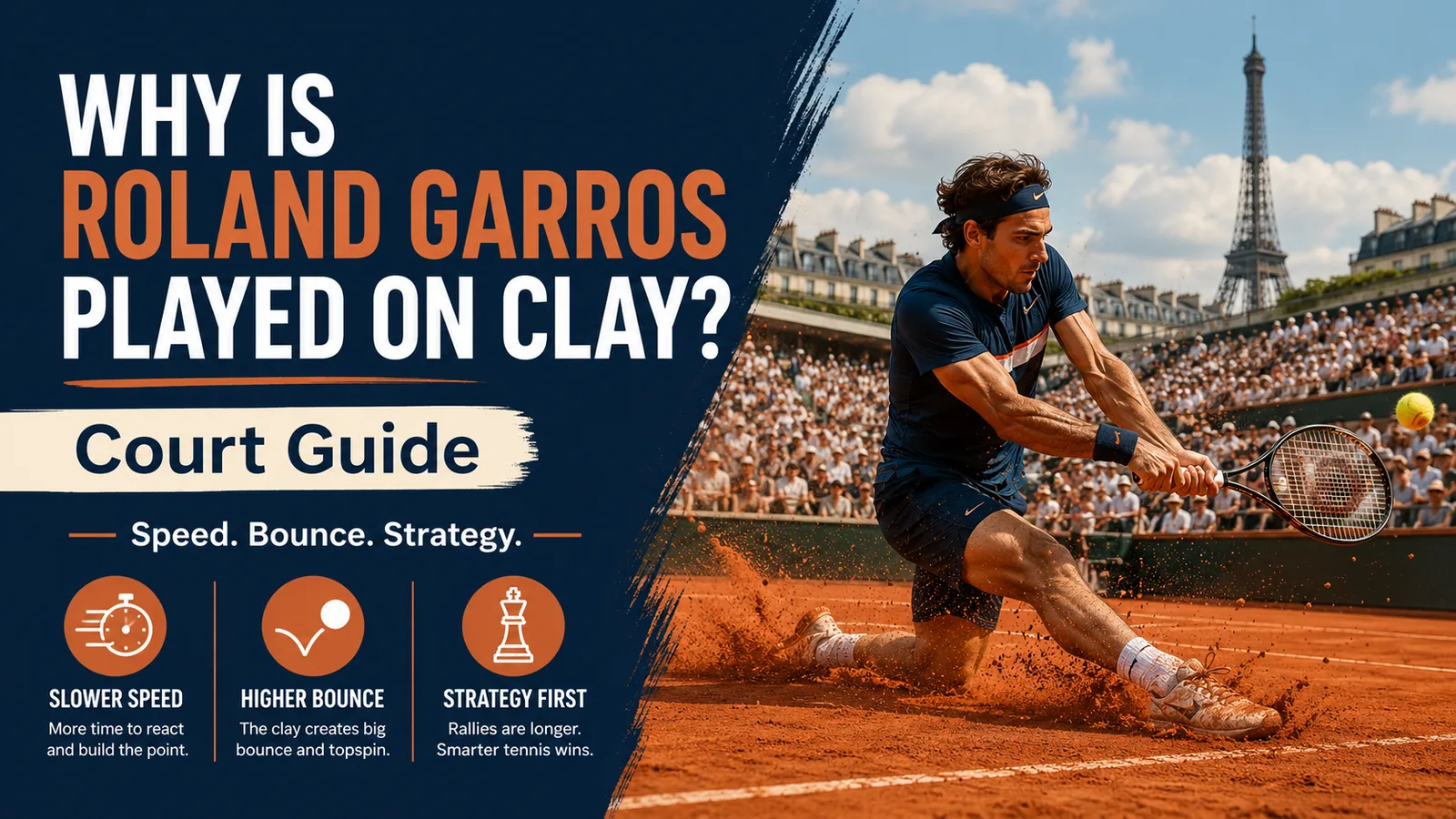
Roland Garros is played on clay because clay is part of the French Open’s original identity, French tennis tradition, and long-term tournament character. Clay slows the ball down, creates a higher bounce, extends rallies, and rewards patience, movement, topspin, and endurance. That is why Roland Garros feels different from the hard courts of the US Open and Australian Open or the grass courts of Wimbledon.
- Why Is Roland Garros Played on Clay?
- Why Clay Is Part of Roland Garros Identity
- What Is a Clay Court Made Of?
- Why Clay Slows the Ball Down
- Why the Bounce Is Higher on Clay
- How Clay Changes Player Movement
- How Clay Changes Tennis Strategy
- Why Clay Creates Longer Rallies
- Why Some Players Dominate on Clay
- Clay vs Hard Court vs Grass
- Why Roland Garros Feels Different From the US Open
- How New Fans Should Watch Clay-Court Tennis
- Source List –
- Conclusion
- FAQ –
Why Is Roland Garros Played on Clay?
Roland Garros is played on clay because clay is the surface that shaped the tournament’s history and identity. The event grew as the French clay-court championship and kept that surface as it became one of tennis’s four Grand Slam tournaments. Today, the clay is not just a court material. It is the reason the French Open has its own personality.
For a United States reader who mostly watches the US Open or college tennis on hard courts, Roland Garros can look and feel slower at first. Points last longer. Players slide into shots. The ball jumps higher. A rally that might end quickly on a fast hard court can turn into a careful chess match in Paris.
That is exactly the point. Clay asks different questions from players. It rewards patience, balance, topspin, recovery, and point construction. A player with a huge serve still has an advantage, but the serve is not always enough. The surface gives returners more time and forces both players to earn points over several shots.
So the short answer to why is Roland Garros played on clay is this: clay is the traditional French Open surface, and it creates the event’s signature style. Without clay, Roland Garros would not feel like Roland Garros.
Why Clay Is Part of Roland Garros Identity
Every Grand Slam has a surface personality. Wimbledon is linked with grass. The US Open and Australian Open are linked with hard courts. Roland Garros is linked with clay. That clay identity is one of the easiest ways to understand why the tournament stands apart from the rest of the tennis calendar.
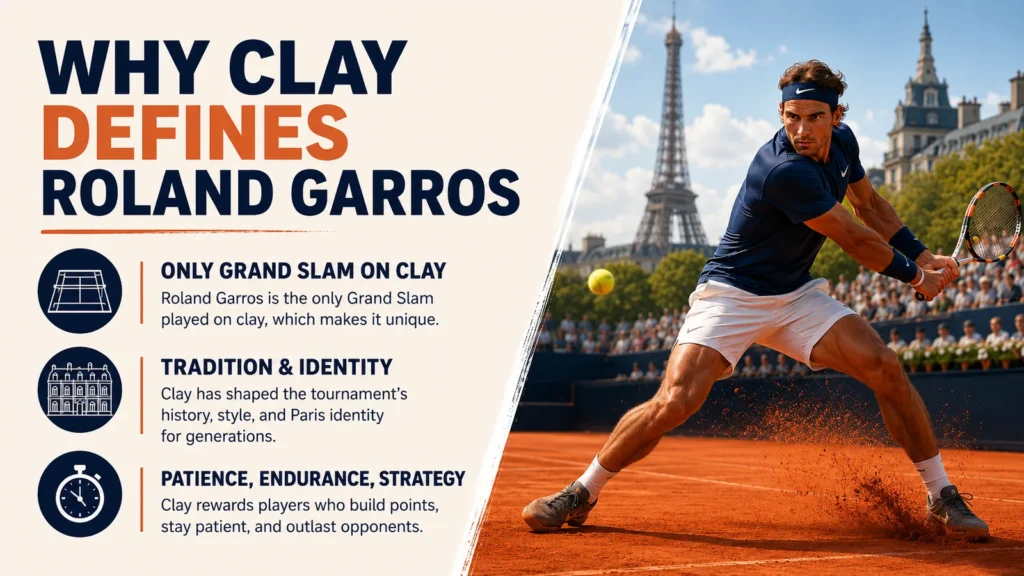
The WTA overview notes that the French Open, also known as Roland Garros, has been contested on the outdoor clay courts of Stade Roland Garros in Paris since 1928 and is currently the only Grand Slam played on clay. This makes the tournament the sport’s biggest annual test on that surface.
Because Roland Garros is the only clay-court major, winning it carries a special meaning. A champion in Paris has proven they can handle long rallies, changing court conditions, sliding movement, heavy topspin, and the mental grind of clay. The tournament is not only about who hits hardest. It is about who can solve problems repeatedly over two weeks.
This is why clay should not be treated as a small detail in a Roland Garros article. It is the center of the story. It affects the way matches look, the way players train, the way tactics develop, and the way fans remember great champions.
What Is a Clay Court Made Of?
A clay court is not simply a layer of loose dirt placed over the ground. It is a carefully built tennis surface with layers that support drainage, stability, bounce, and playability. The visible red-orange top layer gives Roland Garros its famous look, but the court structure underneath is what makes the surface playable at a professional level.
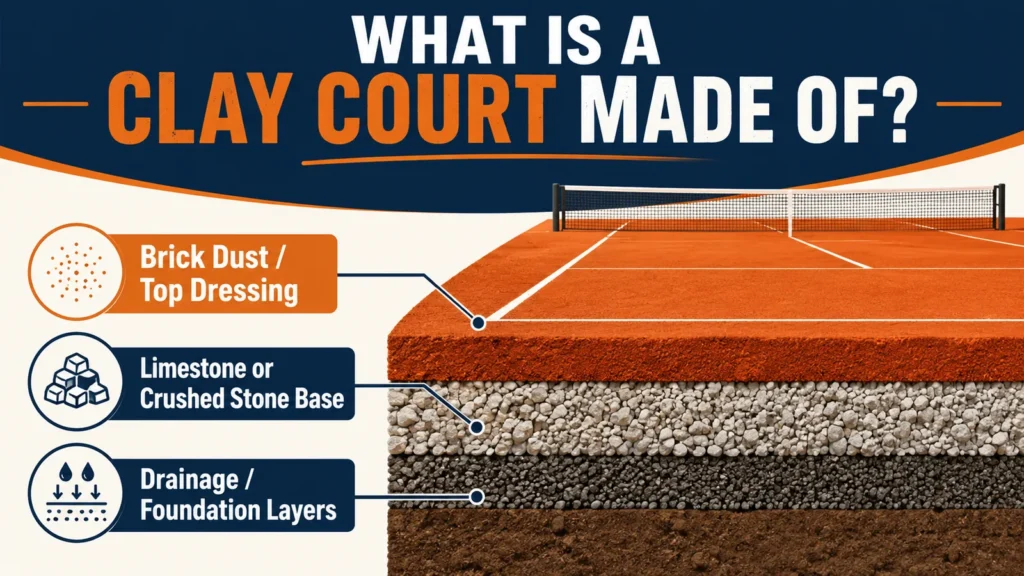
The ITF tennis glossary explains that clay courts are generally made with a limestone base or similar material and covered with brick dust or shale. That top dressing creates the loose surface that players slide on and that the ball interacts with during rallies.
The common phrase “red clay” is useful for fans, but the surface is more technical than the phrase suggests. Court maintenance matters a lot. The surface must be watered, swept, rolled, and prepared so the bounce stays fair and the court remains safe. If the court is too dry, it can become dusty and faster. If it is too damp, it can feel heavier and slower.
That maintenance is part of the French Open’s rhythm. Viewers may notice line sweeping, court brushing, or players looking at ball marks. These things are not random. They are part of clay-court tennis and part of the sport’s relationship with the surface.
- Chipotle Bowl vs Burrito: Which One Is Healthier?
- Chipotle Nutrition Guide: Calories, Protein & Smart Orders
- Types of Yoga: 30 Powerful Styles Explained
Why Clay Slows the Ball Down
Clay is slower because the surface absorbs more of the ball’s energy after contact. When a tennis ball hits clay, the loose top layer creates more friction than many hard courts or grass courts. The ball loses some speed, giving the opponent more time to react.
The 2026 ITF Rules of Tennis court pace classification lists court surfaces with an ITF Court Pace Rating of 0 to 29 as Category 1, or slow pace, and notes that most clay courts fall into that category. This supports what fans can see with their own eyes: clay does not usually reward quick, one-shot tennis as strongly as faster surfaces do.
That slower pace changes the value of every shot. A powerful serve may still be useful, but it is less likely to end the point immediately. A heavy forehand may push an opponent back, but the opponent often has time to defend. A player has to think in patterns rather than single strikes.
This is one reason Roland Garros can be difficult for players who dominate on faster courts. Their normal weapons still matter, but they need more patience. They must be willing to hit one more ball, defend one more corner, and build one more opening before taking a risk.
Why the Bounce Is Higher on Clay
Clay often creates a higher bounce than grass and many hard courts. For beginners, this is one of the most important things to notice. The ball does not just slow down. It can also jump up after landing, especially when the shot has heavy topspin.
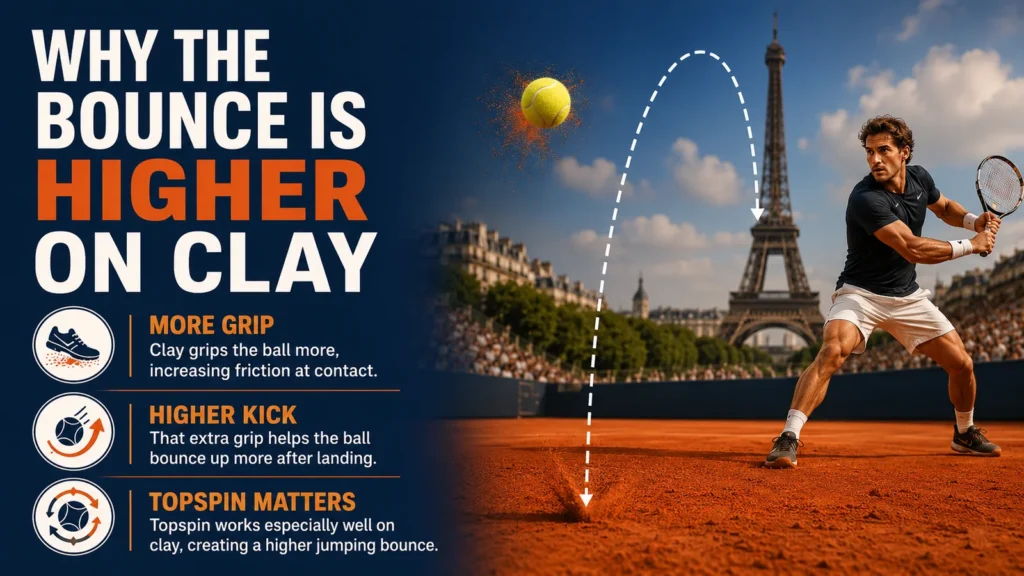
Topspin makes the ball rotate forward. On clay, that spin grips the surface and helps the ball kick up. A topspin forehand that lands deep can rise near shoulder height, making it uncomfortable for the opponent to attack. Instead of hitting from a comfortable strike zone, the player may have to defend from above the waist or shoulder.
This is why heavy topspin is such a valuable weapon at Roland Garros. It pushes opponents behind the baseline, opens angles, and creates time for recovery. It can also wear down an opponent physically because every reply becomes more demanding.
For viewers, the higher bounce explains why rallies can look different in Paris. Players stand farther back. They use more looping shots. They wait for short balls. They look for angles instead of only flat winners. The bounce changes the entire conversation between the players.
How Clay Changes Player Movement
Movement is one of the biggest differences between clay-court tennis and hard-court tennis. On hard courts, players often stop sharply and push off with a firm base. On clay, players slide into shots because the top surface is loose. Great clay-court movement looks smooth, but it requires timing, strength, balance, and confidence.
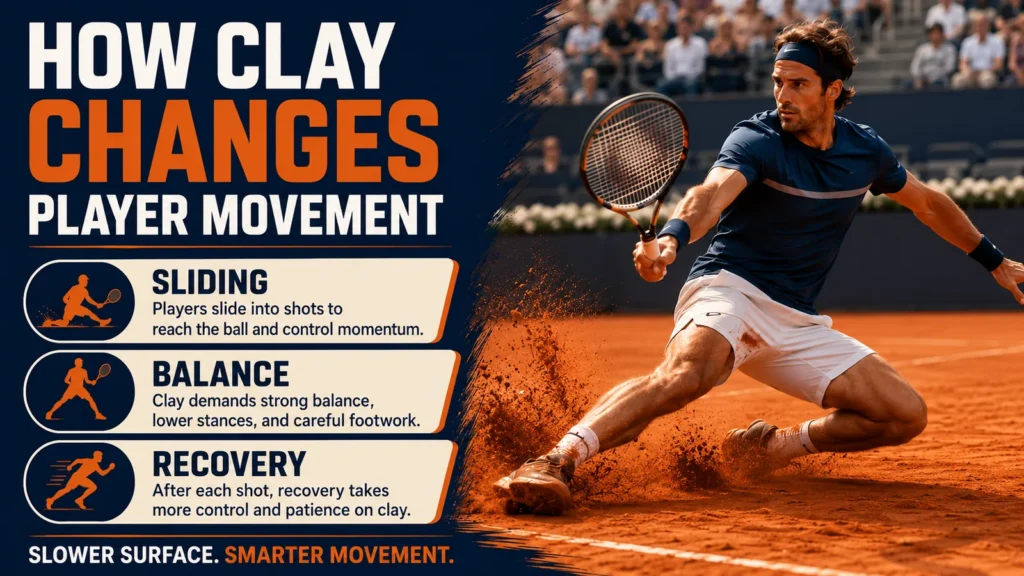
The ITF glossary notes that play on clay courts is distinguished by the need to slide on the loose surface. That single detail explains why some excellent players need time to adjust when they arrive in Europe for the clay season.
Sliding helps a player reach wide balls without losing all momentum. A good slide allows the player to arrive, hit, recover, and prepare for the next shot. A poor slide can leave the player off balance, late, or exposed to the next ball.
Clay movement also affects defense. Because the surface slows the ball, a fast defender can retrieve shots that might be winners elsewhere. This forces attackers to be more precise. They often need to create an opening over several shots instead of expecting one big strike to end the rally.
For casual fans, watching the feet is one of the best ways to understand clay. If a player looks comfortable sliding, recovering, and changing direction, they usually have a better chance to compete well at Roland Garros.
How Clay Changes Tennis Strategy
Clay court tennis strategy is about patience and construction. A player usually cannot expect to win every point with one big serve or one flat forehand. Instead, the best clay players use patterns. They move the opponent wide. They hit heavy topspin. They change height. They use drop shots. They wait for the right ball.
A simple clay-court pattern is heavy crosscourt topspin followed by a change down the line. Another pattern is a deep shot to push the opponent back, then a drop shot to bring them forward. Because the surface gives players more time, tactics become easier to see if you watch carefully.
The slower surface also changes risk management. On a faster court, an aggressive player may be rewarded for going for a quick winner. On clay, that same shot may come back. If the player takes too many low-percentage risks, errors can build quickly. Smart clay tennis often means attacking with purpose rather than rushing.
This is why clay rewards complete players. A strong serve helps. A big forehand helps. But movement, defense, fitness, patience, spin, and emotional control matter just as much. Roland Garros often exposes weaknesses because opponents have more chances to keep the ball in play and test every part of a player’s game.
Why Clay Creates Longer Rallies
Clay creates longer rallies because the ball slows down after the bounce, and players have more time to recover. More time means more balls come back. More balls coming back means a player has to hit several quality shots to win a point.
The ITF glossary describes clay as the slowest surface in tennis and notes that it often leads to longer rallies. That is the fan-friendly explanation of why Roland Garros can feel more physical than many other tournaments.
Long rallies change momentum. A player may hit two or three excellent shots and still not win the point. The opponent may defend, reset, and eventually turn the rally around. This creates drama because the point is not over until someone truly finishes it or makes an error.
Long rallies also test fitness. Clay-court matches can demand repeated acceleration, sliding, recovery, and balance. Over several hours, that physical load matters. A player who looks sharp in the first set may struggle later if their legs fade or their patience breaks.
For viewers, longer rallies make Roland Garros more tactical. You can see players probe for weaknesses. You can see them target a backhand, drag an opponent wide, or use a drop shot after pushing them far behind the baseline. The surface gives the story time to develop.
Why Some Players Dominate on Clay
Some players dominate on clay because their natural strengths match the surface. Heavy topspin, strong legs, patient defense, high fitness, and tactical discipline all translate well to clay. A player who can create shape on the ball and recover quickly has a major advantage.
Clay specialists often know how to win points without rushing. They are comfortable hitting one extra shot. They can slide into defense and still recover. They understand when to attack and when to wait. These small decisions add up over a match.
The surface can also help players who return well. Since clay slows the serve after the bounce, returners may have a little more time to get into points. That does not make serving unimportant, but it reduces the number of completely free points compared with some faster surfaces.
At Roland Garros, champions often combine physical endurance with tactical intelligence. They do not just hit hard. They manage space, height, spin, and rhythm. They are willing to win ugly points, survive long games, and reset mentally after exhausting rallies.
That is why clay greatness feels different. It is not only about highlight winners. It is about control over time. The best clay players make opponents feel as if there is no easy way through them.
Clay vs Hard Court vs Grass
The easiest way for US readers to understand why clay is different is to compare it with hard court and grass. Hard courts, like those used at the US Open and Australian Open, often create a more balanced style. They can reward power, movement, clean ball striking, and athletic defense. Grass, like Wimbledon, is usually faster and lower bouncing.
Clay sits at the slower end of the surface spectrum. It creates higher bounce, longer rallies, more sliding, and more time for defensive recovery. This does not mean clay is easy. It means players need different tools.
On grass, a strong serve and quick first strike can be extremely valuable. On hard courts, players often combine offense and defense. On clay, patience becomes more important. A player may need to win the point three times mentally before the scoreboard gives them the point once.
This comparison also explains why winning across all surfaces is so respected in tennis. A player who can succeed at the US Open, Wimbledon, and Roland Garros has shown adaptability. They can adjust to speed, bounce, movement, and strategy. Roland Garros is the clay test inside that larger Grand Slam challenge.
Why Roland Garros Feels Different From the US Open
For many United States fans, the US Open is the most familiar Grand Slam. It is loud, fast, energetic, and played on hard courts in New York. Roland Garros feels different immediately because the clay changes both the look and the rhythm of the matches.
The red-orange court gives Paris a visual identity. The ball leaves marks. Players slide. Points build slowly. The crowd reacts to long rallies and clever shot-making as much as raw power. Even the way players celebrate can feel different because a clay-court point often takes so much work to finish.
The tactical pace is also different. At the US Open, a player may attack quickly and end points with flatter shots. At Roland Garros, that same approach may need adjustment. The ball comes back more often, so players must be prepared for a second, third, or fourth attack.
This contrast makes tennis more interesting. The sport is not one-dimensional. Surface variety forces players to become more complete and gives fans different styles to enjoy during the year.
- French Open vs Roland Garros: Are They the Same Tournament?
- Roland Garros Meaning, History & Clay Court Explained
- Guzman y Gomez vs Chipotle: Menu, Taste, and Value Compared
How New Fans Should Watch Clay-Court Tennis
If you are new to Roland Garros, do not watch clay-court tennis only for winners. Watch the patterns. Notice where players stand on returns. Notice how much topspin they use. Notice when they slide into the shot and how quickly they recover to the center of the court.
Also watch the height of the ball. On clay, many players use higher net clearance and heavier spin to push opponents back. A rally may look slow, but it is often full of tactical pressure. One player may be slowly moving the other into a weaker position.
Drop shots are another important clay-court tool. Because opponents often stand far behind the baseline to handle high-bouncing shots, a well-timed drop shot can pull them forward suddenly. This creates a physical and tactical test at the same time.
Finally, watch body language. Clay can frustrate players. A great shot may come back. A long rally may end with a small mistake. The best clay players stay patient. They do not panic when the first attack fails. They keep building the point until the right chance appears.
Source List –
- Official Roland-Garros clay explainer – Official Roland-Garros page for the tournament’s clay-court identity.
- WTA Roland Garros overview – Confirms Roland Garros/French Open identity, Paris location, clay surface, and only Grand Slam on clay context.
- ITF tennis glossary – Explains clay as a slow surface that often creates longer rallies, with brick dust/shale and sliding context.
- 2026 ITF Rules of Tennis – Provides official court pace classification and explains that most clay courts are slow pace surfaces.
- ATP Roland Garros overview – Official ATP tournament profile for Roland Garros.
- Official Roland-Garros history page – Tournament history and broader official context.
Conclusion
Roland Garros is played on clay because clay is the heart of the French Open’s identity. The surface connects the tournament to its history, separates it from the other Grand Slams, and creates the physical, tactical style that fans associate with Paris.
Clay slows the ball down, creates a higher bounce, rewards topspin, encourages sliding, and stretches rallies. That combination makes the tournament more than a test of power. It becomes a test of patience, endurance, movement, problem-solving, and emotional control.
For new fans, the simplest takeaway is this: Roland Garros feels different because clay makes tennis different. Once you understand the surface, the matches become easier to read and much more exciting to watch.
Source check: The WTA Roland Garros overview describes Roland Garros as the only Grand Slam currently played on clay, while the ITF tennis glossary describes clay as the slowest major tennis surface, often producing longer rallies and sliding movement.
FAQ –
1. Why is Roland Garros played on clay?
Roland Garros is played on clay because clay is part of the French Open’s history, tradition, and tournament identity. It also creates the slower, more tactical style that makes the event unique.
2. Is Roland Garros the only Grand Slam played on clay?
Yes. Roland Garros is currently the only Grand Slam tournament played on clay.
3. How does clay change tennis at Roland Garros?
Clay slows the ball down, creates a higher bounce, extends rallies, encourages sliding movement, and rewards topspin, patience, and endurance.
4. What is the Roland Garros clay court made of?
Clay courts are generally built with a base such as limestone and covered with brick dust or shale. The visible red-orange surface gives Roland Garros its famous look.
5. Why do tennis players slide on clay?
Players slide on clay because the loose top surface allows controlled sliding into shots. Good sliding helps players reach wide balls and recover for the next shot.
6. Why is clay court tennis harder for some players?
Clay court tennis can be harder because points last longer, the ball bounces higher, movement requires sliding, and players must build points patiently instead of relying only on quick power.
- Why Is Roland Garros So Hard to Win? Full Guide
- Roland Garros Winners List: Champions, Records & Legends
- Why Is Roland Garros Played on Clay? Court Guide
- French Open vs Roland Garros: Are They the Same Tournament?
- Roland Garros Meaning, History & Clay Court Explained
- Are AI voices safe for YouTube monetization
- Realistic Indian Accent AI Voices for Free: 3 Best Tools
- ElevenLabs Free Alternatives for Emotional Voices: 3 Picks
- Best Free AI Voice Generators for Faceless YouTube Shorts
- Top 5 Free AI Voice Generator Realistic Tools
- Free AI Video Generators Without Watermark: 2026 Truth
- AI vs Machine Learning: Powerful 2026 Career Truth
- Generative AI Uses and Risks: 11 Real-Life Lessons for Beginners
- What is Generative AI? 12 Powerful Basics for Beginners
- What is AI? 11 Powerful Basics Every Beginner Should Know
3 thoughts on “Why Is Roland Garros Played on Clay? Court Guide”