
Roland Garros is the French Open, one of tennis’s four Grand Slam tournaments. It is played every year in Paris at Stade Roland-Garros and is famous for being the only Grand Slam played on clay. The tournament name comes from Roland Garros, a French aviation pioneer and World War I hero, not from a tennis player.
- What Is Roland Garros?
- Is Roland Garros the Same as the French Open?
- Why Is It Called Roland Garros?
- A Short History of Roland Garros
- Why Roland Garros Is Played on Clay
- How Clay Changes the Game
- Why Roland Garros Is So Hard to Win
- Famous Roland Garros Champions and Moments
- Roland Garros vs Other Grand Slams
- How New Fans Should Watch Roland Garros
- Why Roland Garros Matters Today
- Source List –
- Conclusion
- FAQ –
What Is Roland Garros?
Roland Garros is the name most tennis fans use for the French Open, the major tennis tournament held in Paris, France. It is one of the four Grand Slam tournaments, along with the Australian Open, Wimbledon, and the US Open. For many casual fans in the United States, the name can feel confusing because it sounds like a person, a stadium, and a tournament at the same time. In real tennis language, all three ideas are connected.
When people say Roland Garros, they are usually talking about the French Open tournament. When they say Stade Roland-Garros, they are talking about the venue in Paris where the tournament is played. The stadium complex was opened in 1928 to host the French international tennis championship, and it later became one of the most recognizable venues in global tennis.
The tournament is famous because it is the only Grand Slam played on clay. That one detail changes the entire personality of the event. Clay slows the ball down, makes it bounce higher, extends rallies, and forces players to win points with patience rather than just power. This is why Roland Garros often feels more tactical and physically demanding than many other tennis events.
For a new viewer, the easiest way to remember it is simple: Roland Garros is the French Open, and the French Open is tennis’s clay-court Grand Slam. Once you understand that, the tournament becomes much easier to follow. The red court is not just a background color; it is the reason the matches look, feel, and unfold differently.
Is Roland Garros the Same as the French Open?
Yes, Roland Garros and the French Open refer to the same tournament. The difference is mostly about language, branding, and audience familiarity. In English-speaking countries, especially the United States, many casual sports fans say French Open. In official tournament branding and in much of global tennis coverage, the event is commonly called Roland-Garros.
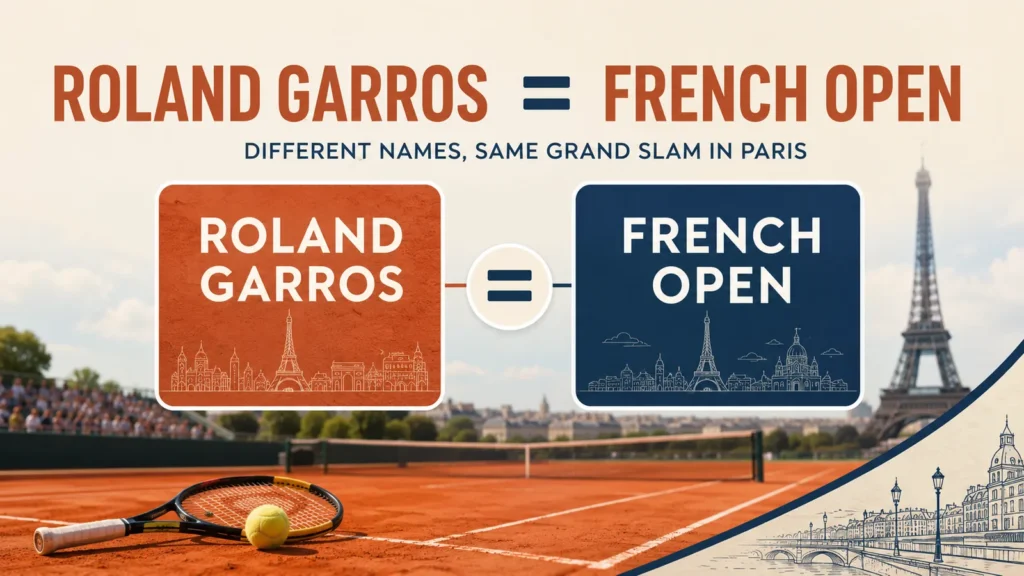
This is similar to how Wimbledon is both a place name and a tournament name. The French Open is the broader English label, while Roland-Garros is the official identity tied to the Paris venue and the historical figure behind the name. If a fan searches for Roland Garros schedule, Roland Garros results, Roland Garros draw, or Roland Garros champions, they are searching for French Open information.
This naming difference is one reason beginner-friendly content needs to explain both terms. A reader may arrive with the question “What is Roland Garros?” but the real search intent is usually bigger. They want to know whether it is the French Open, why it has a different name, why it is played on clay, and why tennis fans treat it as such a special event.
For an evergreen article, using both names naturally helps the reader and the search engine. “Roland Garros” captures the official and tennis-fan search behavior. “French Open” captures the casual sports audience. A helpful article should not force one term only; it should connect both terms clearly and naturally.
- Ebola Outbreak 2026: Bundibugyo Virus Explained & Related Topic
- How to Check UFC Results: Simple Steps for Fans
- UFC Fight Card Explained: How Fight Night Works
- What is UFC? A Simple Explainer for New Fans
Why Is It Called Roland Garros?
Roland Garros is named after a real person, but here is the surprising part: he was not a tennis champion. Roland Garros the aviator was a French aviation pioneer and World War I hero. The stadium in Paris was named in his honor, and because the French Open is played at that stadium, the tournament became strongly associated with his name.
This detail makes Roland Garros one of the most interesting tournament names in sports. A new fan may assume the event was named after a legendary player. Instead, the story reaches outside tennis and into French aviation history. That gives the tournament a cultural identity that is different from the Australian Open, US Open, or Wimbledon.
Roland Garros was known for his daring aviation achievements and his service during World War I. The official tournament history frames him as a trailblazer and a national figure worthy of remembrance. That is why his name appears not only on the stadium but also across the tournament’s global identity.
For readers, this is a memorable fact. It helps explain why the name is unusual and why the tournament feels connected to French heritage. Roland Garros is not just a tennis brand. It carries a story of place, history, memory, and national pride.
A Short History of Roland Garros
The story of Roland Garros begins long before the modern global tennis calendar. The official Roland-Garros history explains that the tournament’s roots go back to 1891, when the French Clay-Court Championships were created. At first, the event was reserved for players who were members of French clubs. That early version was much smaller and more local than the tournament fans know today.
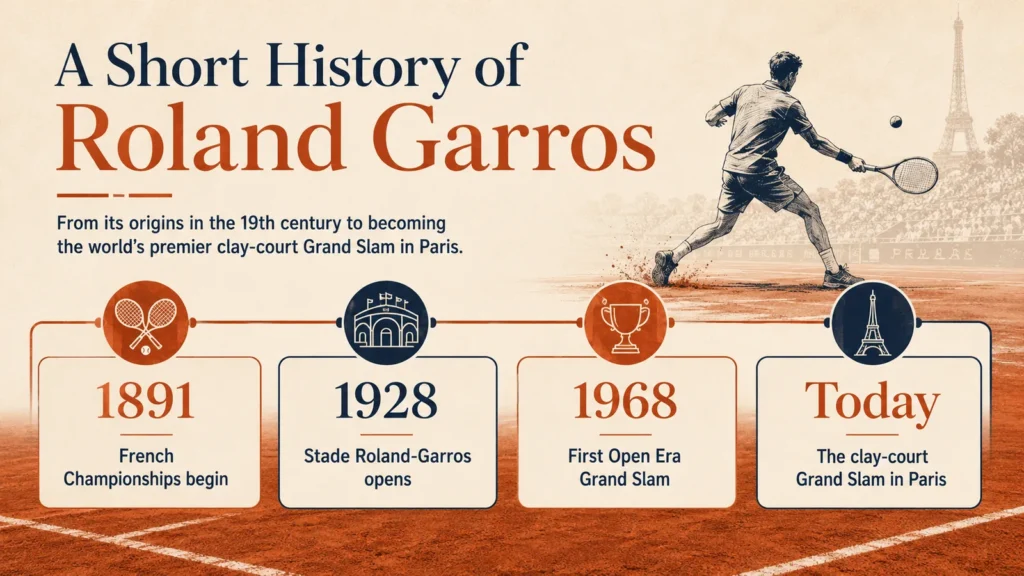
Over time, the championship became more international and more important. The tournament’s growth reflected the growth of tennis itself, moving from a club-based event into one of the sport’s most prestigious competitions. In 1928, the stadium complex opened in Paris, giving the event a permanent and symbolic home.
The stadium was created after France’s famous Davis Cup success, and it quickly became part of the country’s tennis identity. The venue gave the tournament a recognizable setting, and the red clay courts became part of its image. Today, when fans see the color of the court, they immediately think of Paris and Roland Garros.
Another major milestone came in 1968. The WTA Roland Garros overview notes that Roland Garros became the first Grand Slam tournament of the Open Era, allowing both amateurs and professionals to compete. That change helped shape modern professional tennis because it opened the door to the best players competing on the same major stage.
This history matters because it shows why Roland Garros is not a temporary trend topic. It is an evergreen sports subject. The year changes, the champions change, and the draw changes, but the meaning of Roland Garros, its clay-court identity, and its place in tennis history remain useful for readers every season.
Why Roland Garros Is Played on Clay
Roland Garros is played on clay because clay is part of the tournament’s original identity and French tennis tradition. The event developed around clay-court tennis, and that surface remained central as the tournament became a Grand Slam. Today, the clay is not just a surface choice; it is the tournament’s defining feature.
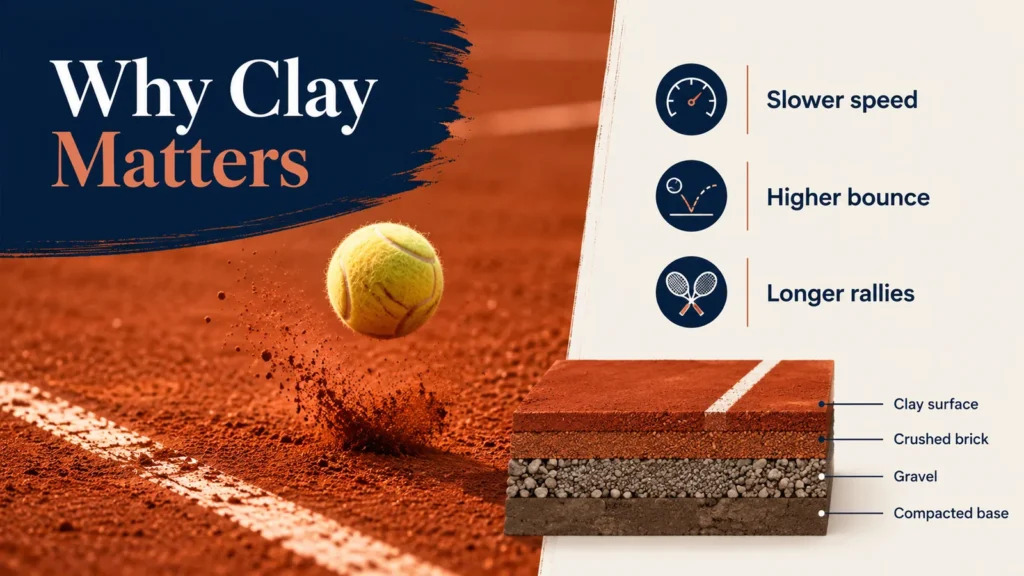
The visible court color often gets described as red clay, but the playing surface is a carefully prepared layered court. The top layer gives the court its famous red-orange look. Underneath, the structure helps with bounce, drainage, stability, and maintenance. This creates a surface that plays very differently from grass or hard court.
Clay slows the ball after it hits the ground. It also creates a higher bounce. That means a player usually has more time to reach the ball, but points also become longer and more demanding. A serve that might be almost untouchable on grass can come back more often on clay. A quick winner on a hard court may require two or three extra shots in Paris.
This is why the Roland Garros clay court favors patience, movement, endurance, and spin. Players must know how to slide, recover, build points, and stay calm during long rallies. Clay rewards players who can solve problems over time rather than players who depend only on one-shot power.
For fans, clay makes Roland Garros more dramatic. Momentum can shift slowly. A player who looks in control can be dragged into long physical rallies. A defender can turn a point around. A smart tactician can expose an opponent’s weakness again and again. The surface shapes the story of almost every match.
How Clay Changes the Game
Clay changes tennis in several important ways. First, it slows down the ball. When the ball lands on clay, it loses speed and often sits up higher. This makes it harder for players to win points quickly with a single serve or flat groundstroke. The opponent usually gets more time to defend.
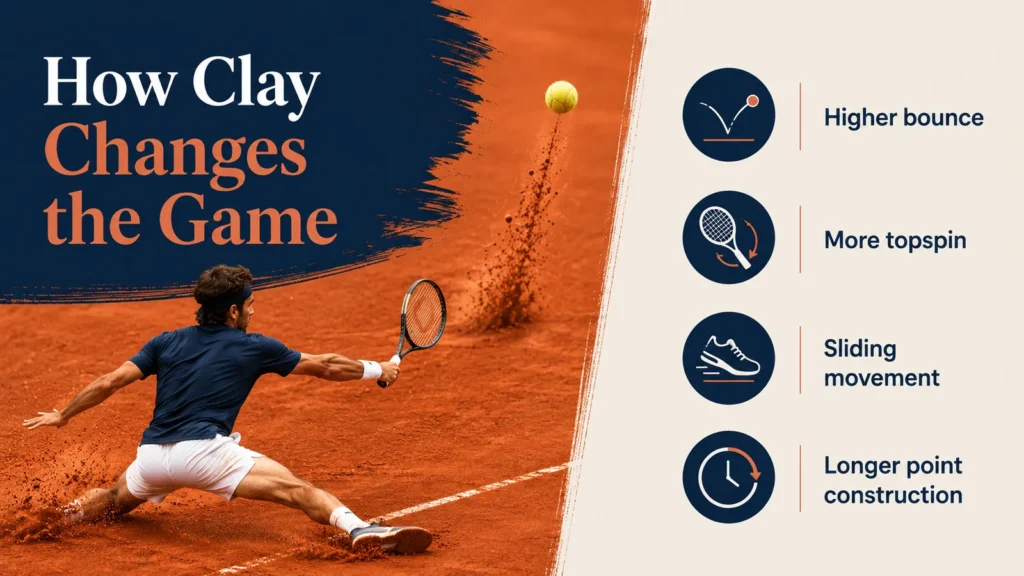
Second, clay rewards heavy topspin. Topspin makes the ball dip into the court and jump up after the bounce. On clay, that high bounce can push opponents behind the baseline or force them to hit uncomfortable shots near shoulder height. This is one reason players with strong topspin games often succeed at Roland Garros.
Third, movement on clay is unique. Players slide into shots instead of stopping sharply. Sliding looks simple when a great clay-court player does it, but it requires timing, balance, confidence, and practice. A player who cannot move well on clay may feel late to the ball even when their overall athletic ability is excellent.
Fourth, clay rewards point construction. A player often has to build the point step by step: move the opponent wide, open the court, change direction, use a drop shot, or wait for a shorter ball. This makes clay-court tennis feel like a mix of fitness test, chess match, and emotional battle.
Finally, clay exposes weaknesses. If a player has poor endurance, weak footwork, or an unreliable backhand, the opponent can keep attacking that weakness. Because points last longer, there is less opportunity to hide behind a serve or a single powerful shot. Roland Garros asks players to be complete, patient, and resilient.
Why Roland Garros Is So Hard to Win
Roland Garros is one of the hardest tournaments to win because it combines Grand Slam pressure with the unique demands of clay. To win the singles title, a player must survive seven rounds against elite competition. On the men’s side, Grand Slam matches can be best-of-five sets, which makes the physical challenge even bigger.
The court surface makes that challenge more intense. Long rallies create fatigue. Sliding puts stress on the legs. High-bouncing shots force repeated physical effort. Slow conditions make it harder to finish points quickly. A player must be fit enough to compete for several hours and smart enough to adjust tactics during the match.
The mental challenge is just as important. On clay, an opponent can return shot after shot. A player may hit three excellent balls and still lose the point. That can create frustration. Champions in Paris usually have a rare ability to stay patient, reset emotionally, and keep making good decisions under pressure.
Weather can also influence the tournament. Clay can feel different when it is damp, dry, cool, or hot. The ball may bounce differently, the surface may play slower or faster, and players have to adapt. That is another reason Roland Garros favors problem-solvers.
The ATP Roland Garros overview highlights the tournament’s famous clay courts and its Open Era importance. Those clay courts are the reason a Roland Garros title carries such weight. Winning in Paris shows that a player can handle endurance, strategy, pressure, and uncomfortable conditions at the same time.
Famous Roland Garros Champions and Moments
Roland Garros has produced some of the most iconic champions in tennis history. The tournament rewards a special mix of athleticism, patience, shot-making, and emotional strength. That is why many of its greatest champions are remembered not only for winning but for mastering the surface in a way that changed how fans understood clay-court tennis.
Rafael Nadal is the most famous modern example. His heavy left-handed topspin, explosive movement, defense, and mental toughness made him the symbol of Roland Garros dominance. For many fans, his career in Paris is the clearest example of how clay can magnify a player’s strengths.
Chris Evert is another essential name in Roland Garros history. Her control, consistency, and calm baseline play made her one of the greatest clay-court champions on the women’s side. Her success showed how precision and patience can be just as powerful as raw speed or force.
Bjorn Borg also became closely tied to the tournament’s identity. His stamina, topspin, and cool emotional style helped define clay-court excellence before the modern era of advanced rackets and power-heavy baseline tennis. He showed that Roland Garros could be conquered through rhythm, discipline, and physical resilience.
More recently, Iga Swiatek has built a powerful Roland Garros connection. Her aggressive movement, heavy forehand, and ability to control rallies on clay have made her one of the central figures of the modern women’s game in Paris. Her success helps newer fans see why the tournament continues to produce distinctive champions.
For American fans, Roland Garros also carries memories of champions and contenders from different generations, including Chris Evert, Serena Williams, Andre Agassi, and others who made meaningful runs in Paris. The tournament may be French, but its history belongs to global tennis.
Roland Garros vs Other Grand Slams
Roland Garros is different from the other Grand Slams because of its clay surface. The Australian Open and US Open are played on hard courts, which generally support cleaner ball striking and a more balanced mix of offense and defense. Wimbledon is played on grass, where the ball often stays lower and points can move quickly. Roland Garros asks different questions.
On clay, players have more time to defend, but they also need more energy to win. A powerful serve matters, but it may not dominate as easily. A strong forehand matters, but it may need to be repeated many times. Movement matters more because players must slide and recover. Strategy matters because the easiest shot is not always the smartest shot.
This is why some great players who succeed elsewhere struggle in Paris. Their game may be built for faster conditions. They may prefer shorter points, lower bounces, or more direct attacks. Roland Garros can force them to play extra shots, defend longer, and adapt to a slower rhythm.
The opposite can also happen. A clay specialist may become extremely dangerous at Roland Garros even if they are less dominant on other surfaces. Their movement, patience, and tactical instincts can become more valuable in Paris than on faster courts. This surface contrast is one of the reasons the Grand Slam calendar is so interesting.
The ITF describes the four Grand Slam tournaments as the most prestigious individual competitions in tennis. Among them, Roland Garros stands out because it preserves the clay-court test at the highest level. That makes it essential for any player who wants to be remembered as a complete champion.
How New Fans Should Watch Roland Garros
If you are new to Roland Garros, do not watch it exactly the same way you watch a fast hard-court match. Clay-court tennis has its own rhythm. Points may take longer to develop, and winners may come after several setup shots. Instead of only looking for powerful shots, watch how players create openings.
A good first step is to watch court position. Is one player standing far behind the baseline? Is the other player using angles to pull them wide? Is someone changing direction to attack a weaker side? Clay makes these patterns easier to see because rallies last long enough for strategy to unfold.
Next, watch movement. Great clay-court players slide into shots smoothly and recover quickly. They do not panic when they are pushed wide. They use the slide to stay balanced and prepare for the next shot. Once you notice this skill, Roland Garros becomes more interesting.
Also watch how players use drop shots and high topspin. A drop shot can punish an opponent standing too far back. A heavy topspin ball can push an opponent deep and create space. These patterns are part of what makes Roland Garros feel tactical rather than random.
Finally, pay attention to patience. A player who wins on clay often accepts that not every good shot will end the point. They keep building pressure until the opponent gives them a shorter ball or makes an error. That patience is one of the hidden skills of Roland Garros tennis.
- Chipotle Bowl vs Burrito: Which One Is Healthier?
- Healthiest Thing to Eat at Chipotle: Best Orders Explained
- Social Security Payment Schedule 2026: Dates by Birth Date
- Kyle Busch Pneumonia Sepsis: Cause of Death Explained
Why Roland Garros Matters Today
Roland Garros matters because it gives tennis a unique annual identity. In a sports world where many events can look similar, the French Open still looks and feels different. The red clay, the Paris venue, the spring timing, and the long rallies make it instantly recognizable.
For fans, the tournament is a chance to see tennis under pressure. It tests stamina, problem-solving, and emotional control. For players, it is one of the sport’s ultimate achievements. A Roland Garros title tells the world that a champion can handle the most demanding clay-court stage in tennis.
For new American viewers, Roland Garros is also a bridge into global tennis culture. The US Open has New York energy. Wimbledon has grass-court tradition. The Australian Open has a bright summer hard-court identity. Roland Garros brings French history, clay-court strategy, and Paris atmosphere into the Grand Slam calendar.
For educational sports content, Roland Garros is an excellent evergreen topic because people search for its meaning, name origin, clay-court rules, famous champions, and Grand Slam status every year. Results and player storylines change, but the core questions remain relevant.
That is why this topic is valuable for InfoJustify readers. It explains a major sports event in simple language, gives context for beginners, and stays useful beyond one tournament season. Readers who enjoy sports explainers can also explore more latest posts for simple guides on trending and evergreen topics.
Source List –
- Official Roland-Garros history – tournament origin and historical background.
- Stade Roland-Garros – stadium opening, venue identity, and location context.
- Roland Garros the aviator – name origin and aviation/war hero background.
- WTA Roland Garros overview – clay Grand Slam, Open Era, and tournament overview details.
- ATP Roland Garros overview – ATP tournament context and clay-court identity.
- ITF Grand Slam tournaments – Grand Slam tournament context.
Conclusion
Roland Garros is more than another name for the French Open. It is a Grand Slam tournament, a historic Paris venue, a clay-court tradition, and one of the toughest tests in tennis. The name comes from a French aviation pioneer and World War I hero, while the tournament itself grew from French clay-court tennis history into a global sporting event.
The most important thing for new fans to remember is simple: Roland Garros is the French Open, and it is the only Grand Slam played on clay. That clay surface changes the game by slowing the ball, increasing the bounce, extending rallies, and demanding more patience, stamina, and strategy from players.
Understanding Roland Garros makes the tournament more enjoyable to watch. You begin to see why movement matters, why topspin is powerful, why rallies last longer, and why winning in Paris means so much. The red clay is not just part of the scenery. It is the heart of the tournament’s identity.
That is why Roland Garros remains one of tennis’s most important evergreen stories. Every year brings new champions and new matches, but the meaning, history, and clay-court challenge of Roland Garros continue to matter to fans around the world.
FAQ –
1. Is Roland Garros the same as the French Open?
Yes. Roland Garros and the French Open refer to the same Grand Slam tennis tournament held in Paris, France. “French Open” is common in English, while “Roland-Garros” is the official tournament and stadium identity.
2. Why is the French Open called Roland Garros?
The French Open is called Roland Garros because it is played at Stade Roland-Garros, a stadium named after Roland Garros, a French aviation pioneer and World War I hero.
3. Was Roland Garros a tennis player?
No. Roland Garros was not a tennis champion. He was a French aviator and war hero. The stadium and tournament carry his name in his honor.
4. Why is Roland Garros played on clay?
Roland Garros is played on clay because the tournament developed from French clay-court tennis tradition. Clay is now one of the tournament’s defining features and makes it different from every other Grand Slam.
5. Why is Roland Garros hard to win?
Roland Garros is hard to win because clay courts create slower, longer, and more physical rallies. Players need endurance, patience, sliding movement, tactical control, and mental strength to win in Paris.
6. What makes Roland Garros different from Wimbledon and the US Open?
Roland Garros is different because it is played on clay. Wimbledon is played on grass, while the US Open is played on hard courts. Clay changes the bounce, speed, rallies, movement, and strategy of the match.
- Kyle Busch Pneumonia Sepsis: Cause of Death Explained
- Ebola Outbreak 2026: Bundibugyo Virus Explained & Related Topic
- Robert Redfield: Biography, CDC Role, COVID-19 Legacy
- Are AI voices safe for YouTube monetization
- Realistic Indian Accent AI Voices for Free: 3 Best Tools
- ElevenLabs Free Alternatives for Emotional Voices: 3 Picks
- Best Free AI Voice Generators for Faceless YouTube Shorts
- Top 5 Free AI Voice Generator Realistic Tools
- Free AI Video Generators Without Watermark: 2026 Truth
- AI vs Machine Learning: Powerful 2026 Career Truth
- Generative AI Uses and Risks: 11 Real-Life Lessons for Beginners
- What is Generative AI? 12 Powerful Basics for Beginners
- What is AI? 11 Powerful Basics Every Beginner Should Know
- How to Check UFC Results: Simple Steps for Fans
- UFC Weight Classes Explained: A Beginner Breakdown
- UFC Fight Card Explained: How Fight Night Works
- What is UFC? A Simple Explainer for New Fans
One thought on “Roland Garros Meaning, History & Clay Court Explained”