
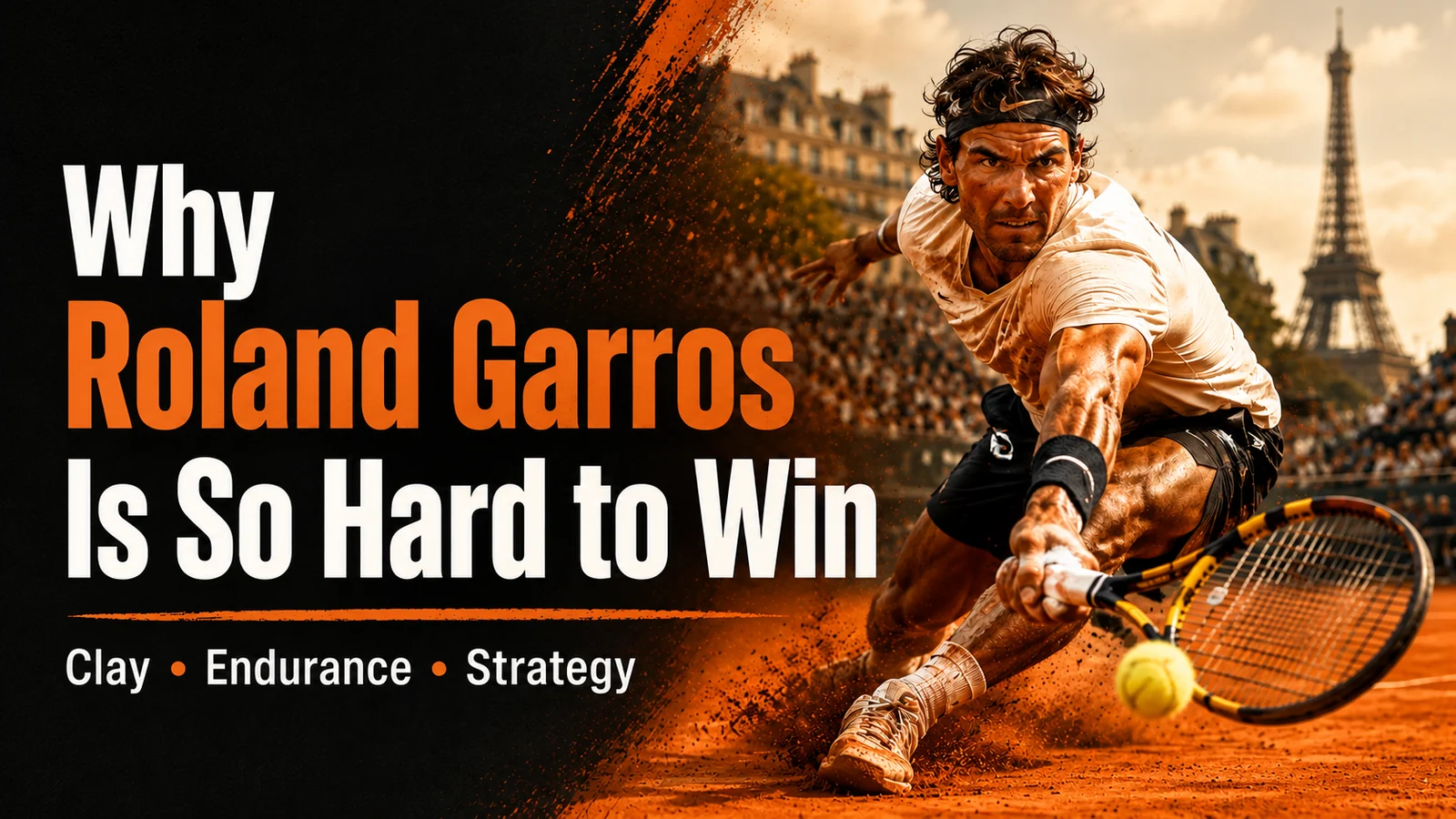
Roland Garros is so hard to win because it combines the pressure of a Grand Slam with the most demanding surface in major tennis: clay. The clay slows the ball down, creates higher bounce, extends rallies, forces players to slide, and rewards patience more than quick power. In men’s singles, the best-of-five format can turn one difficult match into a physical marathon. That is why many fans and players see Roland Garros as the toughest Grand Slam challenge.
- Why Is Roland Garros So Hard to Win? Quick Answer
- Clay Is the Main Reason Roland Garros Feels Harder
- Long Rallies Make Every Match More Physical
- Best-of-Five Matches Can Become a Marathon
- Sliding on Clay Changes the Footwork Battle
- Mental Patience Matters More in Paris
- Weather and Court Conditions Can Change the Match
- Clay Specialists Create Dangerous Matchups
- Why Big Servers Cannot Rely Only on Power
- Why Roland Garros Records Feel So Special
- Roland Garros vs Other Grand Slams
- What New Fans Should Watch During a Clay Match
- Roland Garros Difficulty Comparison Table
- Conclusion
- FAQ –
Why Is Roland Garros So Hard to Win? Quick Answer
Roland Garros is hard to win because it does not let players hide from weakness. A player who wins in Paris must handle clay, rallies, movement, pressure, recovery, and tactical problem-solving for two full weeks. It is not enough to have a huge serve, one explosive forehand, or a great return. Those weapons help, but clay asks for more.
The French Open is played at Roland Garros in Paris and is the only Grand Slam currently played on clay. The WTA Roland Garros overview lists the event as a Grand Slam in Paris with clay as the surface, which is the foundation of its unique difficulty. Clay does not simply change the color of the court. It changes the rhythm of the sport.
On faster courts, a player can sometimes rush through service games with quick points. On clay, the ball slows after contact with the surface and often bounces higher. That gives opponents more time to defend and forces attackers to build points more carefully. A player may hit two or three excellent shots and still not finish the rally.
That is why the focus keyword question, why is Roland Garros so hard to win, has a clear answer: it is the combination of surface, match length, physical endurance, mental patience, and tactical depth. Each factor is difficult alone. In Paris, they arrive together.
Clay Is the Main Reason Roland Garros Feels Harder
The first reason Roland Garros feels harder is clay. Every Grand Slam has its own surface personality. The Australian Open and US Open are played on hard courts. Wimbledon is played on grass. Roland Garros is played on clay, and that makes it feel like a different sport at times.
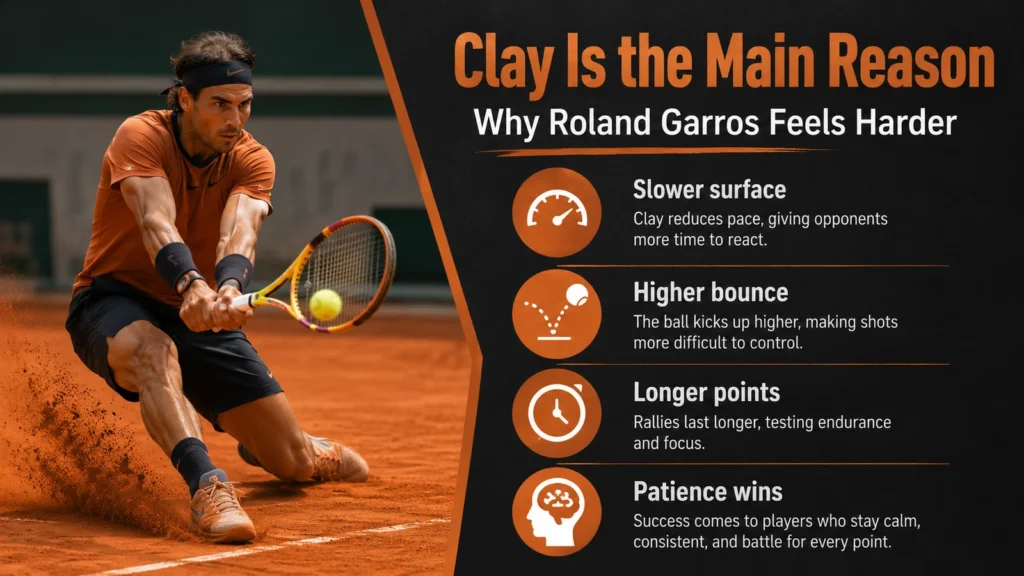
The official Roland-Garros clay explainer describes clay as central to the tournament’s identity. For beginners, the simplest way to understand clay is to think of it as a surface that gives players more time but asks them to work harder. The ball often slows down after landing, but that does not make the match easier. It makes the point longer.
Longer points mean a player must hit more balls, recover more often, and make more decisions. Instead of one clean strike ending the rally, players often have to move the opponent from side to side, push them back, open the court, and then finish when the opportunity is truly there.
Clay also rewards heavy topspin. Topspin can make the ball jump high after the bounce, especially on red clay. A deep topspin shot can push an opponent behind the baseline and force an uncomfortable reply. This is one reason clay specialists often look so comfortable in Paris. They are not just hitting hard. They are shaping the ball, using height, and controlling time.
For a United States reader used to watching hard-court tennis, Roland Garros may look slower at first. But slower does not mean easier. It usually means more physically and tactically demanding. The player must win the same point several times before it actually ends.
Long Rallies Make Every Match More Physical
Roland Garros long rallies are one of the biggest reasons the tournament is difficult. Clay gives defenders more time to reach balls that might be winners on other surfaces. That means attackers must hit with more patience and precision.
A long rally is not only about running. It is also about breathing, balance, shot selection, and emotional control. After twenty or thirty shots, the player is not just asking, “Can I hit the ball?” The real question becomes, “Can I still make the right decision while tired?”
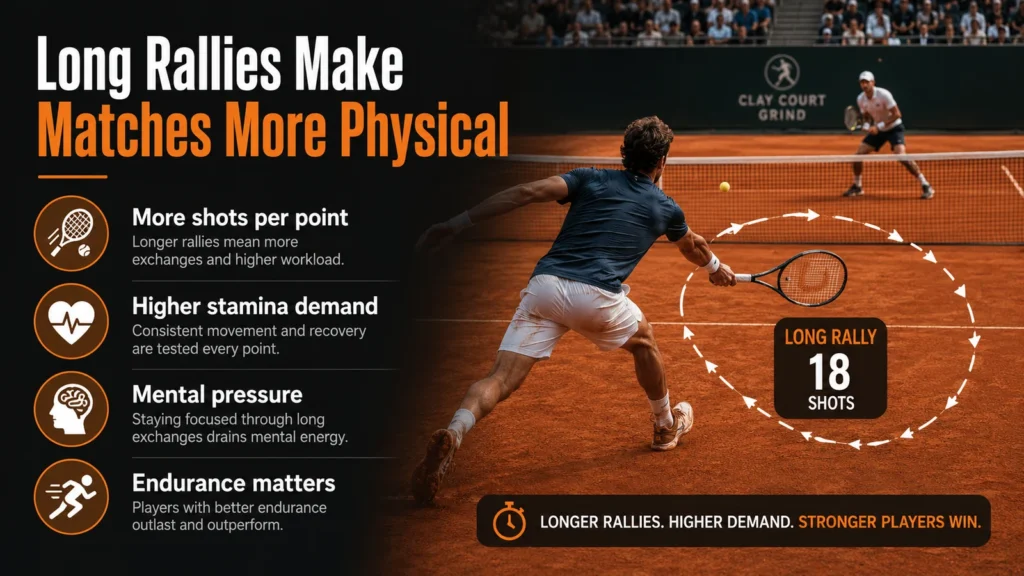
This is where French Open difficulty becomes visible. A player may dominate on a hard court by taking the ball early and finishing points quickly. At Roland Garros, that same player may be dragged into repeated exchanges. The legs get heavier. The arms tighten. The mind starts looking for shortcuts. That is when errors appear.
Clay court endurance is different from normal fitness. A player must recover after sliding, defend wide corners, handle high balls, and stay ready for the next shot even after the rally feels won. This repeated stress adds up over a match, then over a tournament.
For fans, long rallies create drama. A rally can swing from defense to attack and back again. A player who looks beaten can reset the point. A player who looks in control can miss because the rally lasted one shot too long. That uncertainty is part of why Roland Garros produces such memorable matches.
- Roland Garros Winners List: Champions, Records & Legends
- French Open vs Roland Garros: Are They the Same Tournament?
- Roland Garros Meaning, History & Clay Court Explained
- UFC Weight Classes Explained: A Beginner Breakdown
Best-of-Five Matches Can Become a Marathon
Another reason Roland Garros is so hard to win is match length, especially in men’s singles. The 2026 Grand Slam Rule Book states that men’s singles main-draw matches in Grand Slam tournaments are best of five sets. On clay, that format can become a severe endurance test.
A best-of-five match does not only ask a player to play well for one hour. It may ask them to solve problems for three, four, or even five hours. A player can win the first two sets and still be pulled into a battle if the opponent adjusts. On clay, because rallies are longer and service holds can be more difficult, momentum can change slowly but powerfully.
This creates a unique mental challenge. A player must manage energy without becoming passive. They must attack without rushing. They must accept that a match can have several emotional chapters. One poor service game may not decide everything, but one careless stretch can drain the body and open the door for a comeback.
The physical cost also matters beyond one match. To win Roland Garros, a singles champion must survive seven rounds. Even if a player wins, a long clay-court battle can affect the next match. Heavy legs, sore hips, and reduced recovery time can become tournament factors.
This is why the phrase toughest Grand Slam often appears in discussions about Paris. The hard part is not just one difficult opponent. It is the accumulation of effort over two weeks.
Sliding on Clay Changes the Footwork Battle
Clay movement is one of the clearest differences between Roland Garros and hard-court tennis. On hard courts, players usually plant and push off. On clay, players slide. That slide is not decoration; it is survival.
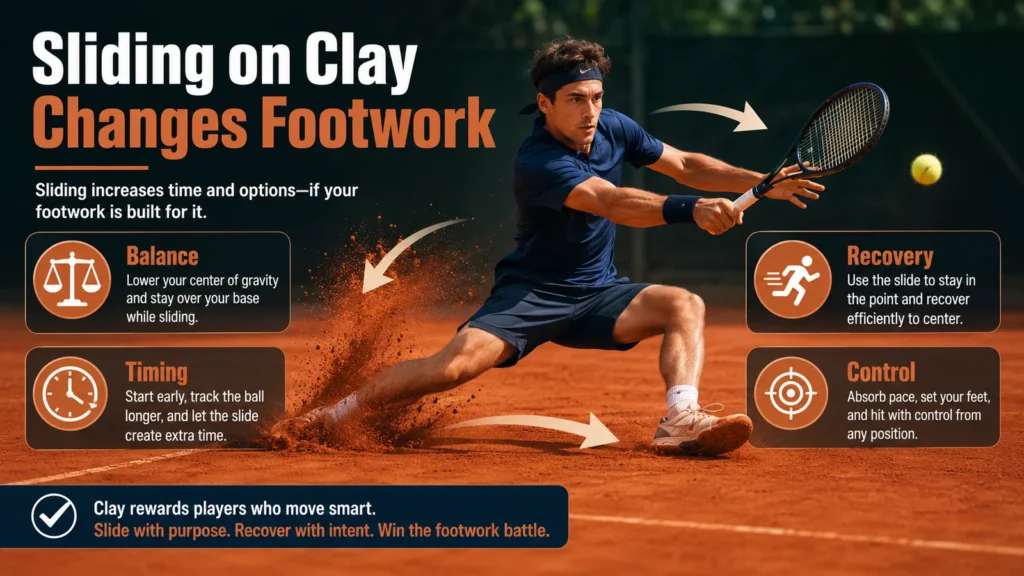
A good clay-court player slides into shots with control, strikes the ball, and then recovers for the next movement. A poor slide can leave the player off balance or late. Over a long match, inefficient movement becomes expensive. Every extra step costs energy.
Sliding also changes defense. A player who is comfortable on clay can cover wide angles and keep rallies alive. This makes it harder for opponents to finish points. A shot that would be a winner on a hard court may come back on clay, forcing the attacker to hit one more ball.
Footwork on clay is also about trust. Players must trust the surface, trust their balance, and trust that their body can recover after each slide. A player who hesitates loses time. A player who over-slides loses position. The margin is small.
This is one reason some top players need years to fully adapt to Paris. Overall athletic ability is not enough. Clay asks for specific movement skills, and those skills are built through repetition. Roland Garros rewards players who look calm even when their shoes, socks, and legs are covered in red clay.
Mental Patience Matters More in Paris
The mental side of Roland Garros may be even more important than the physical side. Clay tests patience because points do not end quickly. A player can hit a strong shot and still have to defend the next ball. That can be frustrating.
On faster courts, aggressive players may feel rewarded quickly. At Roland Garros, the same aggression must be managed carefully. Attack too early, and the error count rises. Wait too long, and the opponent takes control. The best clay players know how to stay between those two extremes.
Mental patience also means accepting momentum shifts. On clay, a set can turn around gradually. A player might lose a long rally, then another, then start forcing the issue. Suddenly the match feels different. Champions in Paris must remain emotionally steady when the court seems to refuse easy points.
This is where clay becomes almost psychological. It keeps asking the same question: can you do it again? Can you hit another heavy ball? Can you defend another corner? Can you choose the right shot when tired? Can you stay calm when the opponent brings back a ball that looked finished?
That repeated pressure is why Roland Garros does not always reward the most explosive player. It rewards the player who can combine aggression with discipline. Winning in Paris requires intensity, but it also requires restraint.
Weather and Court Conditions Can Change the Match
Roland Garros is played outdoors, so conditions can change the way the clay behaves. Moisture, heat, wind, and court maintenance all matter. A damp clay court can feel heavier and slower. A hot, dry court can play faster and create a different bounce.
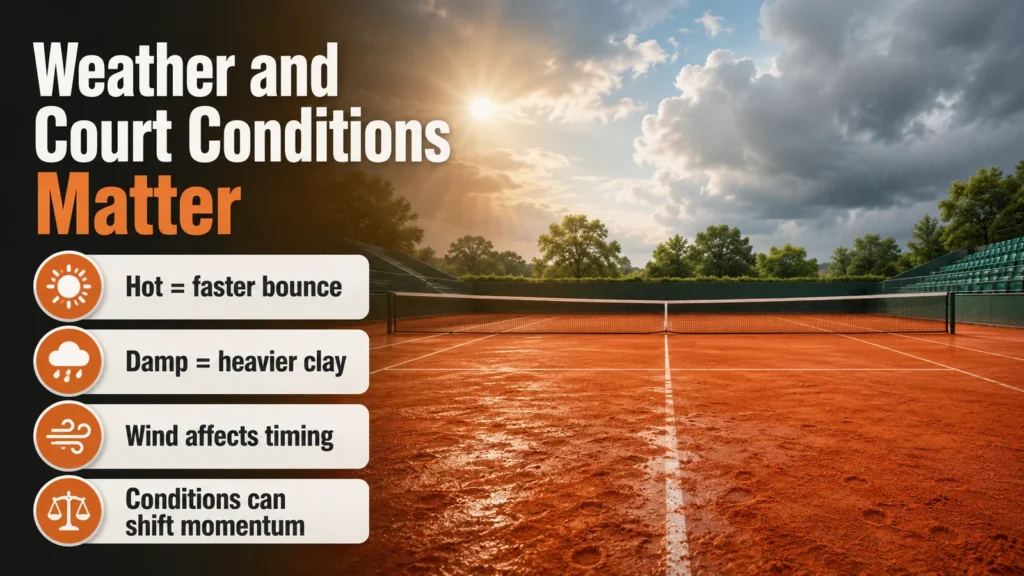
This is why conditions are part of the French Open difficulty. Players are not competing on a fixed indoor surface. They must adjust to the day. They may face a slower court in one round and a livelier court in another. They may play in cool air, heavy conditions, bright sun, or wind.
Recent reporting has also shown how heat can affect the playing surface and physical demand. An AP report on French Open heat described how hot conditions can affect the clay courts and the players at Roland Garros. The point for an evergreen reader is simple: clay is sensitive, and changing conditions can make the tournament feel different from match to match.
This adds another layer to strategy. A player must decide whether to stand closer to the baseline or farther back, whether to use heavier topspin, whether to come forward more often, and how much risk to take. The right answer may change with the weather.
For new fans, this is a fun detail to watch. If the court looks dry and the ball is jumping quickly, the match may favor different tactics than a heavy, damp day. Roland Garros is not only player vs player. It is also player vs surface, conditions, and time.
Clay Specialists Create Dangerous Matchups
Roland Garros is difficult because rankings do not tell the whole story. A high-ranked player may be excellent overall but less comfortable on clay. A lower-ranked opponent may have grown up on clay and understand the surface naturally. That creates dangerous matchups.
Clay specialists are often patient, physical, and smart with spin. They may not have the biggest serve or the flashiest highlights, but they know how to make opponents uncomfortable. They can stretch rallies, change height, use drop shots, and attack a weaker wing repeatedly.
This is why early rounds in Paris can be tricky. A favorite may face an opponent who is not famous to casual fans but is very dangerous on clay. If the favorite is impatient, the match can become stressful quickly. The opponent may not need to overpower them. They only need to make every point difficult.
Clay specialists also understand the emotional rhythm of the surface. They do not panic when a rally lasts longer. They are comfortable sliding. They know when to defend and when to counterattack. These small advantages matter at Roland Garros.
The difficulty of Paris is not only that the best players are there. It is that many players become more dangerous because the surface fits them. That makes the draw feel deeper and more complicated.
Why Big Servers Cannot Rely Only on Power
Big serves are valuable in tennis, but Roland Garros reduces the advantage of serving alone. Clay slows the ball after the bounce and gives returners more time. A huge first serve can still win points, but it may not create the same easy rhythm that it can on grass or faster hard courts.
This changes the identity of the match. A server must be ready to play after the serve. They may need to hit a strong first ball, then another, then another. If their movement or patience is weaker, the returner can pull them into uncomfortable rallies.
Serve-plus-one tennis still works on clay, but it must be more precise. The server needs to use angles, spin, placement, and patience. Power alone may not be enough. A player who depends mainly on quick points can become frustrated when the opponent keeps returning.
This is one reason Roland Garros can expose incomplete games. A player cannot simply serve through every problem. They must defend, rally, slide, construct points, and recover physically. Clay takes away some shortcuts.
For fans, this makes Paris interesting. It shows the complete version of a player. You see who can solve problems when the first plan does not work. That is why Roland Garros champions often feel especially respected.
Why Roland Garros Records Feel So Special
Roland Garros records feel special because the tournament is so difficult to repeat. Winning one title in Paris is hard. Winning multiple titles requires an extraordinary combination of skill, durability, and surface mastery.
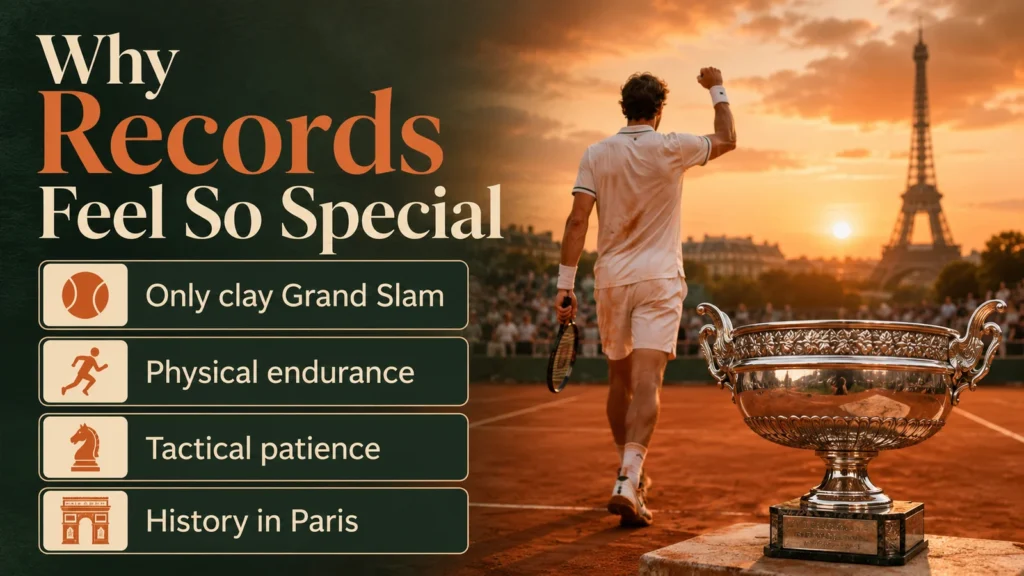
The official Roland-Garros champions page shows how rare long-term dominance is. Rafael Nadal’s record at Roland Garros became legendary because he mastered the exact things the tournament demands: heavy topspin, movement, defense, attack, patience, and mental strength. His success did not come from one weapon. It came from a complete clay-court system.
Other champions also show why the winners list matters. Players like Bjorn Borg, Chris Evert, Justine Henin, Iga Swiatek, Novak Djokovic, and Carlos Alcaraz are connected to Paris through different styles, but each had to handle the clay-court test. Their wins are not just trophies; they are proof of adaptation.
Novak Djokovic has also spoken about the challenge of Paris. Reuters reported that after his 2023 French Open title, Djokovic said the French Open had always been his toughest Grand Slam to win. That comment matters because it came from one of the most successful all-surface players in tennis history. The Reuters Djokovic report supports the idea that even great champions see Paris as uniquely demanding.
This is why records in Paris carry emotional weight. They represent not only talent, but survival across difficult conditions and styles.
Roland Garros vs Other Grand Slams
Comparing Roland Garros with the other Grand Slams helps explain the difficulty. The ITF Grand Slam tournaments page identifies the Australian Open, Roland Garros, Wimbledon, and US Open as the sport’s most prestigious individual competitions. Each major matters, but they test players differently.
The Australian Open and US Open are hard-court events. Hard courts usually create a more balanced bounce and a familiar rhythm for many modern players. Wimbledon is grass, where the ball stays lower and points can be shorter. Roland Garros is clay, where the ball slows, jumps, and asks for extended physical work.
This does not mean the other majors are easy. Wimbledon has its own pressure and unique grass movement. The US Open has noise, speed, and late-night intensity. The Australian Open can be brutally hot and physically demanding. But Roland Garros is different because the surface changes so many parts of the game at once.
A player can win on hard courts with first-strike tennis. A player can win on grass with low, fast patterns. In Paris, they usually need to build points through spin, patience, and recovery. The court keeps giving the opponent chances.
That is why the phrase toughest Grand Slam is not just hype. It reflects a real tennis argument. Roland Garros tests endurance and strategy in a way that is easy to see once you understand clay.
What New Fans Should Watch During a Clay Match
New fans can enjoy Roland Garros more by watching a few specific details. First, watch how far players stand behind the baseline. On clay, players often move back to handle high-bouncing topspin. That court position changes the rhythm of the rally.
Second, watch the feet. Sliding is one of the most important clay-court skills. A player who slides smoothly usually has more time and balance. A player who looks uncomfortable may start hitting late or making errors.
Third, watch rally patterns. Clay players often build points gradually. They may hit heavy crosscourt shots, wait for a shorter ball, and then change direction. They may use a drop shot after pushing the opponent far behind the baseline. These patterns are like a chess game.
Fourth, watch body language after long rallies. Roland Garros can be emotionally exhausting. Players must accept that the opponent will bring balls back. The strongest players reset quickly and do not let frustration control the next point.
Finally, watch how the match changes over time. A player may start aggressively, then become tired. Another may defend early, then attack later. On clay, matches often evolve slowly. That evolution is one of the best parts of watching Paris.
- Roland Garros Winners List: Champions, Records & Legends
- Why Is Roland Garros Played on Clay? Court Guide
- UFC Fight Card Explained: How Fight Night Works
Roland Garros Difficulty Comparison Table
| Factor | Roland Garros | Why It Feels Hard |
|---|---|---|
| Surface | Clay | Slower ball speed, higher bounce, and long rallies. |
| Movement | Sliding required | Players need balance, timing, and clay-specific footwork. |
| Tactics | Point construction | One big shot often is not enough to finish points. |
| Endurance | Very high | Repeated long rallies and recovery demands add up. |
| Mental pressure | Very high | Players must stay patient when points do not end quickly. |
| Conditions | Variable | Heat, moisture, and wind can change court speed and bounce. |
Conclusion
Roland Garros is so hard to win because it is the Grand Slam where the surface refuses to give easy answers. Clay slows the ball, raises the bounce, stretches rallies, and forces players to move, think, and recover again and again.
A champion in Paris must do more than hit hard. They must slide well, defend smartly, attack patiently, handle pressure, manage changing conditions, and survive the physical cost of multiple rounds. In men’s singles, best-of-five matches make that challenge even greater.
That is why Roland Garros has such a special place in tennis. It does not only reward talent. It rewards completeness. The player who wins in Paris has usually solved one of the toughest puzzles in the sport.
For fans, that difficulty is exactly what makes the tournament beautiful. Every long rally, every slide, every comeback, and every clay-covered celebration adds to the feeling that a Roland Garros title must be earned the hard way.
FAQ –
1. Why is Roland Garros so hard to win?
Roland Garros is hard to win because clay slows the ball, creates higher bounce, extends rallies, and forces players to rely on endurance, patience, movement, and strategy rather than quick power alone.
2. Is Roland Garros the toughest Grand Slam?
Many players and fans consider Roland Garros one of the toughest Grand Slams because it combines clay-court endurance, long rallies, physical movement, mental patience, and two weeks of Grand Slam pressure.
3. Why does clay make Roland Garros harder?
Clay makes Roland Garros harder because it slows the ball after the bounce, gives defenders more time, creates longer rallies, and forces players to slide and build points carefully.
4. Do big servers struggle more at Roland Garros?
Big servers can still succeed at Roland Garros, but clay reduces the number of easy points they get from serving alone. They usually need strong rally skills, movement, and patience as well.
5. Why are rallies longer at Roland Garros?
Rallies are longer at Roland Garros because the clay surface slows the ball and gives players more time to defend. This forces attackers to hit more shots before finishing points.
6. What type of player does Roland Garros favor?
Roland Garros often favors players with endurance, topspin, balance, patience, defensive skills, and strong clay-court movement. Complete players usually have the best chance in Paris.
- Why Is Roland Garros So Hard to Win? Full Guide
- Roland Garros Winners List: Champions, Records & Legends
- Why Is Roland Garros Played on Clay? Court Guide
- French Open vs Roland Garros: Are They the Same Tournament?
- Roland Garros Meaning, History & Clay Court Explained
- Are AI voices safe for YouTube monetization
- Realistic Indian Accent AI Voices for Free: 3 Best Tools
- ElevenLabs Free Alternatives for Emotional Voices: 3 Picks
- Best Free AI Voice Generators for Faceless YouTube Shorts
- Top 5 Free AI Voice Generator Realistic Tools
- Free AI Video Generators Without Watermark: 2026 Truth
- AI vs Machine Learning: Powerful 2026 Career Truth
- Generative AI Uses and Risks: 11 Real-Life Lessons for Beginners
- What is Generative AI? 12 Powerful Basics for Beginners
- What is AI? 11 Powerful Basics Every Beginner Should Know
3 thoughts on “Why Is Roland Garros So Hard to Win? Full Guide”