

UFC rankings explained simply means understanding how fighters are ordered inside each weight division and how those positions can affect big opportunities. The UFC rankings system usually shows the champion, top contenders, and the fighters closest to a possible UFC title shot. Rankings can move after wins, losses, activity, opponent quality, and major performances. They are useful for new fans because they make fight cards easier to follow, but they are not a perfect promise that one fighter will definitely get the next championship fight. For beginners, UFC rankings explained works best as a map of the division, not a promise of the next matchup.
Introduction –
If you are new to UFC, rankings can feel confusing at first. One fighter wins a big fight and jumps several spots. Another fighter stays ranked even after a loss. A champion may defend the belt against a No. 2 contender while the No. 1 contender waits. That is why this UFC rankings explained guide is built for beginners who want the system to make sense without needing years of MMA knowledge.
The simple idea is this: rankings are a public map of where fighters stand inside a division. They help fans understand which athletes are rising, which athletes are close to a title fight, and why certain matchups feel more important than others. For full context on the sport itself, you can also read what UFC is.
This guide avoids hype and fake promises. It will not claim that rankings always create perfect matchmaking, because they do not. Instead, it explains how UFC rankings work, why UFC contenders move up or down, and what usually makes a fighter attractive for a UFC title shot. That is why how UFC rankings work should be read as context, not a guaranteed schedule.
- Introduction –
- What Are UFC Rankings?
- UFC Rankings Explained: How the System Works
- Division Rankings vs. Pound-for-Pound Rankings
- What Helps Fighters Move Up the Rankings?
- What Can Make Fighters Drop in the Rankings?
- UFC Contenders: What a Ranking Really Means
- How Fighters Earn a UFC Title Shot
- Why UFC Rankings Are Not Always Perfect
- How to Read Official UFC Rankings Like a Smart Fan
- Beginner Examples That Make Rankings Easier
- Common Mistakes New Fans Make About Rankings
- How This Topic Connects With Other UFC Guides
- Conclusion
- Sources of Links –
- FAQ –
What Are UFC Rankings?
UFC rankings are ordered lists that show where fighters stand in their division. A division is a weight class, such as lightweight, welterweight, bantamweight, or flyweight. The champion sits at the top of the division, and ranked fighters usually appear below the champion as contenders. You can compare this idea with the full UFC weight classes guide if you want to understand how divisions are separated by body weight.
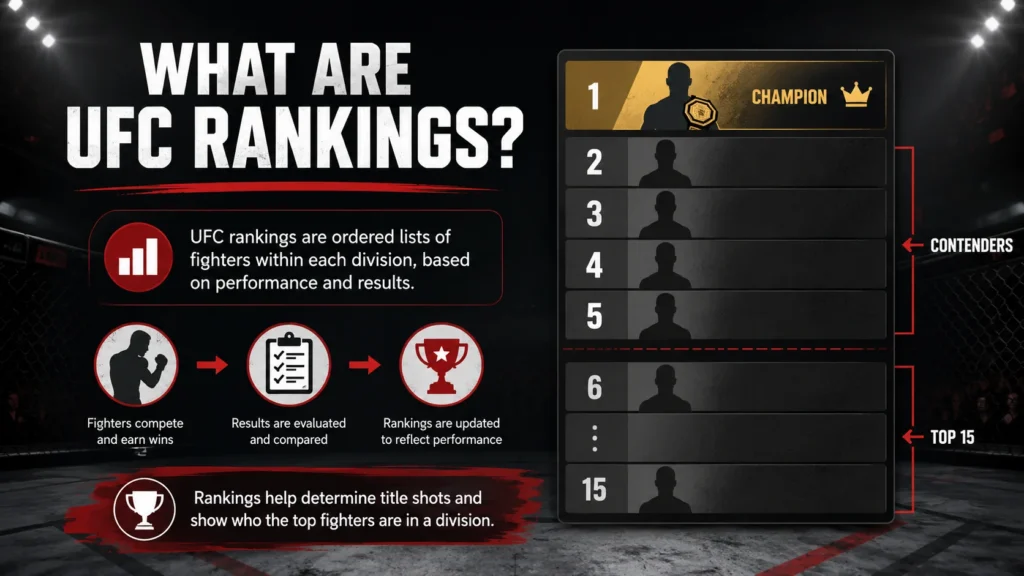
For a beginner, the rankings answer one key question: Who matters most in this division right now? A fighter ranked No. 3 is usually closer to a major fight than an unranked fighter. A fighter ranked No. 10 may still be dangerous, but they usually need more wins to move into the title conversation.
That is why UFC rankings explained content is so useful for new fans. Rankings are not just names on a page. They are a guide to future matchups, contender fights, title eliminators, and championship storylines. In simple terms, UFC rankings explained this way helps readers connect numbers with real contender movement.
The official UFC rankings page is the main place fans can check the current division rankings and pound-for-pound lists. Because rankings update over time, evergreen articles should explain the system instead of relying too heavily on current fighter names that may change.
UFC Rankings Explained: How the System Works
Here is the beginner version of the UFC rankings system: media panel voters rank active fighters by division and pound-for-pound status. Fighters generally move based on recent results, level of competition, activity, and how convincing their performances look. Champions and interim champions are treated differently from regular ranked contenders in their own divisions. This UFC rankings system gives the list structure, but it still leaves room for debate.
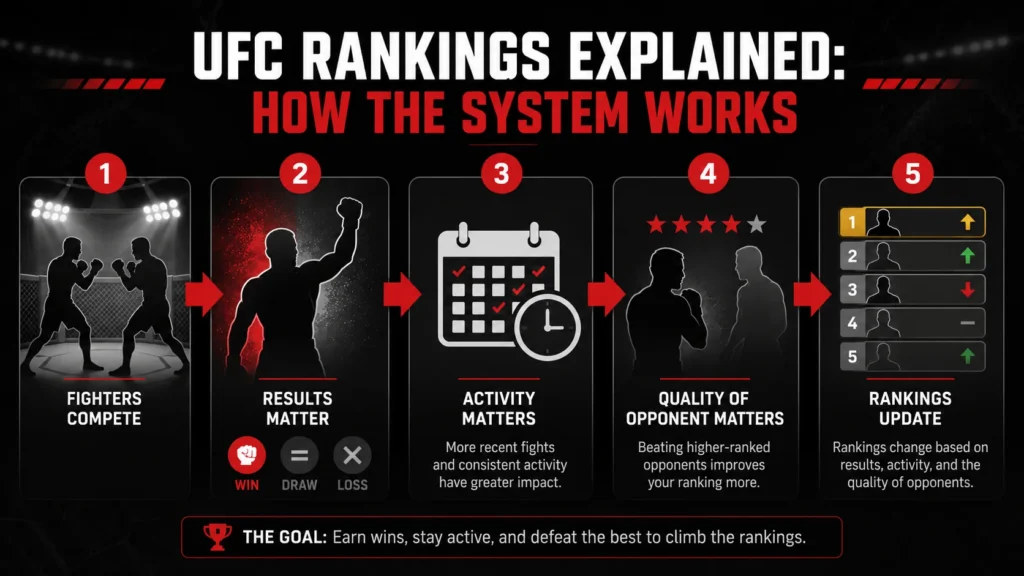
This does not mean rankings are a math formula. A fighter does not automatically move exactly three spots for beating the No. 6 fighter. Voters evaluate context. A close decision, dominant finish, short-notice fight, injury layoff, or controversial result can all affect how the rankings feel after an event. This is the core of how UFC rankings work for fans who want more than just a number beside a name.
A practical way to understand how UFC rankings work is to think of them as a weekly or event-based opinion snapshot. The list is informed by real results, but it is still a voted ranking, not an automatic computer table. Once you see how UFC rankings work, ranking updates start to feel easier to follow after major events.
| Ranking Element | Simple Meaning for New Fans | Why It Matters |
| Champion | The title holder in the division | Usually the fighter every contender is chasing |
| Top 5 contender | A fighter near title-shot range | Often one win away from a major fight |
| Top 10 contender | A proven ranked fighter | Usually matched against other serious names |
| Top 15 contender | A ranked athlete in the division | Can move up fast with the right win |
| Unranked fighter | Not currently in the visible rankings | May need a ranked win to enter the list |
Quick takeaway: UFC rankings explained in one line means rankings show division position, not a guaranteed future schedule. For new readers, UFC rankings explained clearly should always separate position from guarantee.
Division Rankings vs. Pound-for-Pound Rankings
UFC rankings are usually discussed in two main ways: division rankings and pound-for-pound rankings. Division rankings compare fighters inside the same weight class. Pound-for-pound rankings try to compare elite fighters across different divisions by asking who is the best overall when size differences are removed from the discussion.
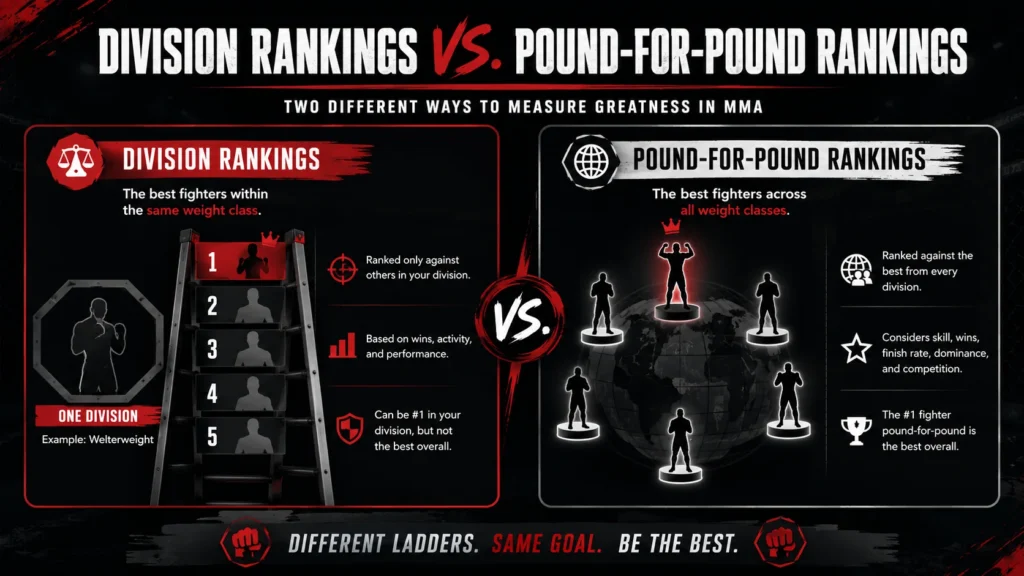
For most new fans, division rankings are more practical. If you want to know who might fight for the lightweight title, you should focus on the lightweight rankings. If you want to compare top stars from different weight classes, pound-for-pound rankings become more relevant.
The important point is that pound-for-pound rankings are more subjective. A flyweight and a heavyweight will never meet under normal UFC rules, so voters are comparing skill, dominance, achievement, and resume rather than preparing a real matchup.
| Ranking Type | What It Compares | Best Use |
| Division ranking | Fighters in the same weight class | Finding likely contenders and title challengers |
| Pound-for-pound ranking | Elite fighters across weight classes | Discussing overall greatness and dominance |
| Champion status | The belt holder in a division | Understanding who the division is built around |
| Interim champion status | A temporary title situation in a division | Understanding title complications when the undisputed champion is unavailable |
What Helps Fighters Move Up the Rankings?
A fighter moves up the rankings by doing more than simply winning. Winning matters most, but the type of win and the opponent’s position can make the difference. A narrow win over an unranked opponent may help less than a clear win over a top-five fighter.
This is where UFC contenders become interesting. A contender is not just a fighter with a number beside their name. A true contender is a fighter whose recent work makes fans, matchmakers, and voters believe they belong near the top of the division.
You can track results after events through the official UFC results page, then compare those results with ranking movement over the next update. That simple habit helps new fans understand how UFC rankings work after fight night.
Ranking Movement Factors
- Quality of opponent: Beating a higher-ranked fighter usually matters more than beating a lower-ranked fighter.
- Recent form: Multiple wins in a row often make a fighter look like a stronger contender.
- Performance style: A dominant finish can create more ranking pressure than a close decision.
- Activity: Active fighters may stay more visible than fighters who sit out for long periods.
- Division depth: In a crowded division, even a strong win may not move a fighter very far.
- Availability: If a fighter is injured or unavailable, another contender may pass them in the title-shot race.
What Can Make Fighters Drop in the Rankings?
Fighters can drop after losses, inactivity, injuries, losing to lower-ranked opponents, or being passed by hotter contenders. A loss to the champion may not hurt as much as a loss to an unranked fighter, because context matters. Similarly, a fighter who loses a close split decision may not fall as far as a fighter who is dominated from start to finish.
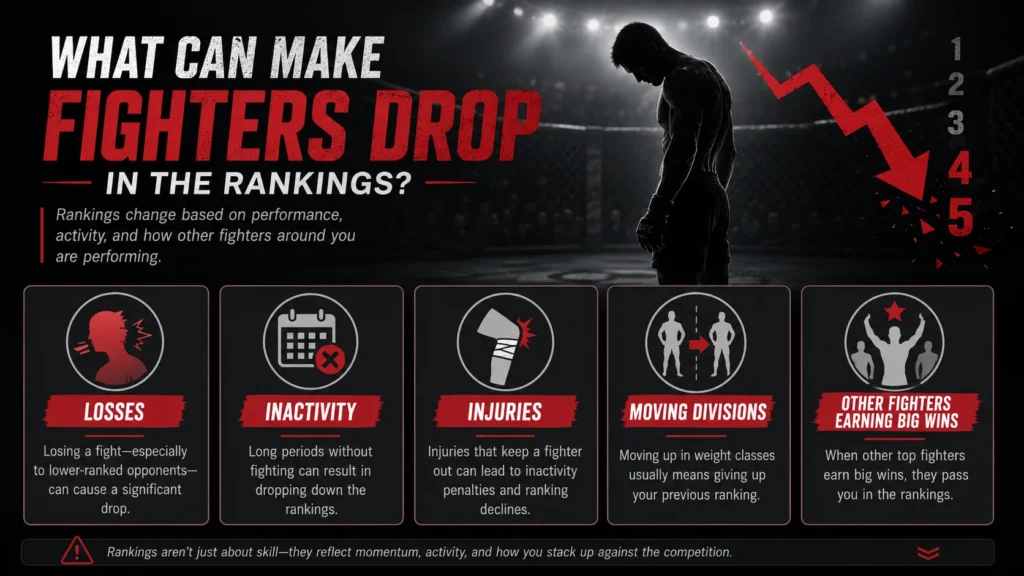
The UFC rankings system also reacts to momentum. If a previously lower-ranked athlete beats two ranked opponents quickly, voters may push that fighter upward. That can force another fighter down even if they did not fight that week. That is another reason the UFC rankings system should be treated as a living picture of the division.
Rankings are also affected by movement between weight classes. A fighter moving up or down may appear in a new division, leave an old division, or temporarily exist in more than one rankings discussion depending on activity and eligibility.
UFC Contenders: What a Ranking Really Means
The word contender gets used a lot in UFC coverage, but it has levels. A No. 14 ranked fighter is a ranked contender, but a No. 2 ranked fighter is usually a serious title contender. A top-five fighter may be close to a UFC title shot, while a top-15 fighter may still need a breakout win. Among UFC contenders, the difference between being ranked and being title-ready can be very important.
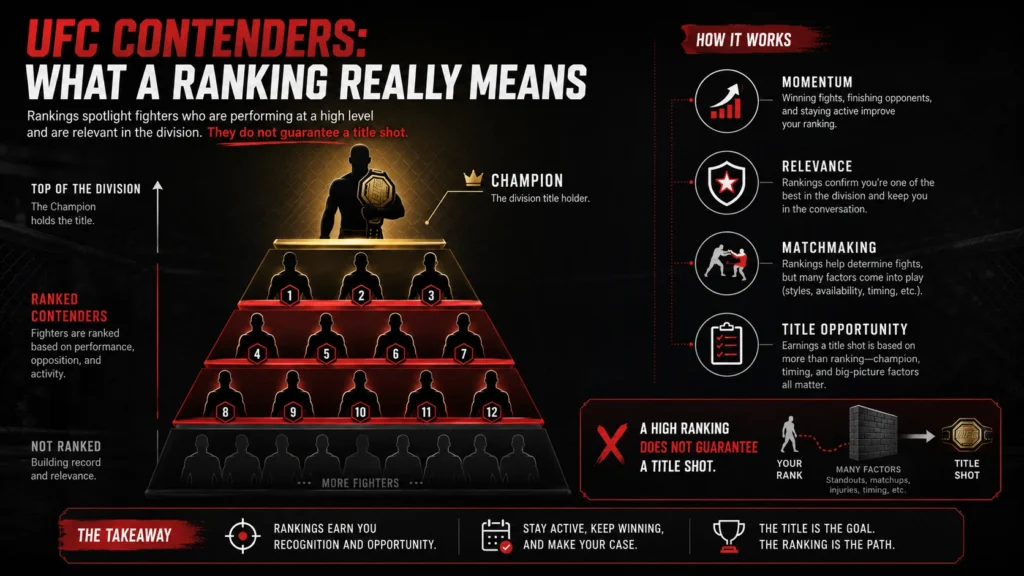
This is why a ranking number should be read with context. A fighter ranked No. 5 in a thin division may be closer to a title shot than a fighter ranked No. 5 in a division packed with former champions, undefeated prospects, and active veterans. UFC contenders should be judged by recent results, available matchups, and the strength of the division around them.
A good fan does not only ask, “What number is this fighter?” A better question is, Who have they beaten recently, how did they win, and who is available above them? That is the smarter way to understand UFC contenders. The best UFC contenders build a case through wins, timing, and performances that voters and matchmakers cannot ignore.
| Contender Level | Typical Meaning | Common Next Step |
| Top 15 | Ranked and relevant | Fight another ranked opponent |
| Top 10 | Proven division threat | Face a higher-ranked contender |
| Top 5 | Close to title conversation | Title eliminator or high-stakes bout |
| No. 1 contender | Often closest to the champion | Possible title fight, but not guaranteed |
| Former champion | May return to title talk quickly | Depends on recent form and division needs |
How Fighters Earn a UFC Title Shot
A UFC title shot is usually earned through a mix of ranking position, recent wins, fan interest, opponent quality, and timing. The No. 1 contender often has the strongest argument, but the UFC may choose another fighter if that fighter is more active, has a bigger recent win, or is available when the champion is ready to fight. A UFC title shot is strongest when the fighter has both a high ranking and a recent win that feels meaningful.

This is why rankings help explain title shots, but they do not control them completely. Matchmaking also considers injuries, rematches, market demand, event timing, and whether a matchup feels fresh. New fans should see rankings as a major clue, not a legal contract. That is why a UFC title shot can look obvious to one fan and debatable to another.
The best way to follow possible title-shot movement is to watch upcoming UFC events, check the ranking positions before and after major fights, and read official fight announcements when they are released. When a major fight is announced, it can quickly change the UFC title shot conversation in that division. UFC contenders who win at the right moment can suddenly become central to the next title discussion.
Common Paths to a Title Shot
- Beat a top contender: A clear win over a top-five opponent can make a fighter hard to ignore. A win like this can immediately strengthen a UFC title shot argument.
- Win a title eliminator: Some matchups are unofficially treated as “winner gets next” fights. This is often the clearest path toward a UFC title shot when the champion needs a fresh challenger.
- Build a long winning streak: Several strong wins can outweigh one single ranking number.
- Step in when another contender is unavailable: Timing sometimes opens a title opportunity. Short-notice timing can suddenly create a UFC title shot opening.
- Move divisions successfully: A former champion or major star may enter a new title race faster than a normal contender.
Why UFC Rankings Are Not Always Perfect
UFC rankings are useful, but they are not perfect. A voted system can create debate because different voters may value different things. One voter may reward recent wins. Another may value resume. Another may punish inactivity more strongly. That is why two fans can look at the same list and disagree.
Some ranking debates happen because MMA is not a league with a fixed season. Fighters do not all face the same schedule. Injuries, short-notice replacements, contract situations, and weight-class changes can make direct comparisons difficult.
This does not make rankings useless. It means rankings should be read with context. The smartest approach is to combine rankings with results, scorecards, activity, and opponent quality. If a fight goes to the judges, the UFC scorecards page can also help fans understand how close a result was.
How to Read Official UFC Rankings Like a Smart Fan
When you open the rankings page, do not just look at the number beside a fighter’s name. Look at the division, the champion, recent movement, and what fights are already scheduled. The rankings are more useful when you read them together with the calendar and recent results.
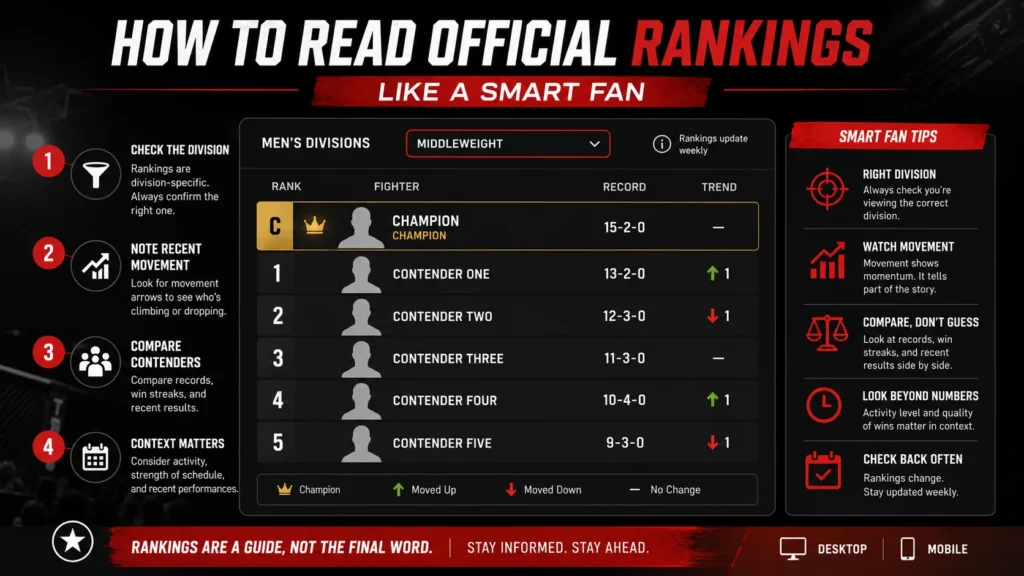
A simple fan workflow is: check the division ranking, check the fighter’s last result, check whether they have an upcoming fight, and then compare their momentum with other UFC contenders in the same division. If you want deeper fight data, UFC Stats can help you review performance numbers from completed events.
If a ranked fighter is booked against another ranked fighter, that matchup often carries extra importance. It may decide who enters the top five, who stays in the title race, or who loses momentum after a bad result.
Smart Fan Ranking Checklist
- Check the fighter’s current ranking and division.
- Look at whether the fighter is moving up, down, or staying the same.
- Review the fighter’s recent win or loss through reliable result sources.
- Compare the fighter with the names above and below them.
- Check whether the champion already has a scheduled opponent.
- Ask whether the fighter’s next matchup could create a UFC title shot case. Check whether that matchup can realistically strengthen a UFC title shot case.
Beginner Examples That Make Rankings Easier
Example 1: A No. 11 fighter beats the No. 7 fighter by a clear finish. In that case, the lower-ranked fighter may jump into or near the top 10 because they proved they can beat someone ahead of them. The defeated fighter may drop because they lost to someone below them.
Example 2: A No. 2 fighter beats a No. 4 fighter in a close decision. That may keep the No. 2 fighter in title-shot range, but it may not automatically guarantee the next UFC title shot if another top contender has a stronger streak or a more exciting recent win. In that situation, the UFC title shot debate may depend on whether another contender has a clearer claim.
Example 3: A former champion returns and beats a ranked opponent. Even if that former champion was outside the immediate title picture, their resume and name value may push them into a major fight faster than a newer contender. That is not always popular, but it is part of how UFC matchmaking can work.
Common Mistakes New Fans Make About Rankings
- Mistake 1: Thinking No. 1 always gets the next title shot. The No. 1 ranking helps, but timing, injuries, and matchmaking still matter.
- Mistake 2: Ignoring weight classes. A fighter’s ranking only makes sense inside the correct division unless you are discussing pound-for-pound lists.
- Mistake 3: Treating rankings like official predictions. Rankings show position, not guaranteed results.
- Mistake 4: Overreacting to one update. A single ranking change may not tell the full story of a division.
- Mistake 5: Forgetting activity. A fighter who does not compete for a long time can lose momentum even if they are very skilled.
How This Topic Connects With Other UFC Guides
Rankings become easier when you connect them with other beginner topics. Fight cards show who is fighting. Results show who won. Scorecards and stats show how the fight played out. Rankings show what that result may mean next. This is where UFC rankings explained as part of a full beginner cluster becomes more useful than a standalone list.
If you are building a full beginner understanding, start with what UFC is, then study weight classes, fight cards, results, scoring, and rankings. For results after fight night, this how to check UFC results guide can help fans follow winners, methods, and scorecards. For fight-card structure, this UFC fight card explained guide connects rankings with main events and prelims. These guides also help compare UFC contenders across results, schedules, and rankings without confusing one topic for another.
Conclusion
UFC rankings explained is not just about memorizing names and numbers. It is about understanding how divisions move. Rankings help fans see which fighters are rising, which UFC contenders are close to the top, and why a matchup may matter even before the opening bell. When UFC rankings explained content is written correctly, it helps fans understand opportunity, not just order.
The key is to read rankings with context. Wins, opponent quality, activity, weight class, performance level, and timing all matter. A ranking can help a fighter’s case for a UFC title shot, but it does not guarantee one. Once you understand that, UFC matchmaking becomes much easier and more enjoyable to follow.
Sources of Links –
| Source Name | Clean URL |
| UFC Rankings | https://www.ufc.com/rankings |
| UFC Events | https://www.ufc.com/events |
| UFC Results | https://www.ufc.com/results |
| UFC Scorecards | https://www.ufc.com/scorecards |
| UFC Stats | http://ufcstats.com/statistics/events/completed?page=all |
| ABC Unified Rules of MMA | https://www.abcboxing.com/wp-content/uploads/2020/02/unified-rules-mma-2019.pdf |
| InfoJustify: What Is UFC? | https://infojustify.com/what-is-ufc-a-simple-explainer-for-new-fans/ |
| InfoJustify: UFC Weight Classes | https://infojustify.com/ufc-weight-classes-explained-a-beginner-breakdown/ |
| InfoJustify: How to Check UFC Results | https://infojustify.com/how-to-check-ufc-results-simple-steps-for-fans/ |
| InfoJustify: UFC Fight Card Explained | https://infojustify.com/ufc-fight-card-explained-how-fight-night-works/ |
FAQ –
What do UFC rankings mean?
UFC rankings show where fighters stand inside a weight division or on a pound-for-pound list. They help fans understand who the top contenders are and which fighters may be close to bigger matchups.
How UFC rankings work after a fight?
After major events, ranking movement can happen when a fighter wins, loses, stays active, beats a strong opponent, or delivers a standout performance. The exact movement is based on voter judgment, not a fixed math formula.
Does the No. 1 contender always get the UFC title shot?
No. The No. 1 contender often has a strong case, but a UFC title shot can also depend on timing, injuries, activity, rematches, market interest, and the champion’s schedule.
What is the difference between division rankings and pound-for-pound rankings?
Division rankings compare fighters in the same weight class. Pound-for-pound rankings compare elite fighters across different weight classes in a more subjective overall ranking.
Can a fighter be ranked in more than one UFC division?
A fighter may appear in more than one division discussion when they are active across weight classes, but eligibility and ranking position depend on activity, performance, and how voters view their status.
Are UFC rankings always accurate?
UFC rankings are useful, but they are not perfect. They are shaped by results, activity, context, and voter judgment, so close cases and controversial ranking spots can happen.
- UFC Stats Explained: 7 Powerful Fight Numbers Every Fan Should Know
- UFC Champions Explained: Easy Guide to Belts & Title Defenses
- UFC Rankings Explained: Easy Guide to Title Shots
- UFC Scoring Explained: Easy Guide to How Judges Score MMA Fights
- UFC Fight Rules Explained: Rounds, Fouls & Ways to Win
- Protect Outlook OneDrive from Phishing: 9 Smart Safety Steps
- Clicked Phishing Link What to Do: 10 Recovery Steps
- How to Spot Phishing Emails: Red Flags & Examples
- FBI Alert Outlook OneDrive: Phishing Scam Explained
- What Is Phishing? Meaning, Examples & Safety Tips
- How to Improve Your Credit Score in the USA: Complete Guide
- Why Is Roland Garros So Hard to Win? Full Guide
- Roland Garros Winners List: Champions, Records & Legends
- Why Is Roland Garros Played on Clay? Court Guide
- French Open vs Roland Garros: Are They the Same Tournament?
- Roland Garros Meaning, History & Clay Court Explained
- Guzman y Gomez vs Chipotle: Menu, Taste, and Value Compared
- Chipotle Bowl vs Burrito: Which One Is Healthier?
- Chipotle Nutrition Guide: Calories, Protein & Smart Orders
- Healthiest Thing to Eat at Chipotle: Best Orders Explained
- Chipotle Mexican Grill Menu Explained: Best Items to Try
- Social Security Payment Schedule 2026: Dates by Birth Date
- Social Security COLA 2026 Explained: What Changed This Year
- Kyle Busch Pneumonia Sepsis: Cause of Death Explained
- Why Are Social Security Checks Late in May 2026? (The Real Truth)