

UFC stats explained in simple words means learning what fight numbers show after a bout: strikes landed, significant strikes, takedowns, submission attempts, control time, accuracy, and round-by-round activity. These numbers help fans understand how a fight played out, but they do not replace the official winner, judge scorecards, or round-by-round scoring criteria. For beginners, the best approach is to check the official result first, read the scorecards if the fight went to decision, and then use UFC Stats to understand the action behind the result.
Introduction
UFC fight stats can make a close fight easier to understand, but they can also confuse new fans when the numbers are read without context. A fighter may land more total strikes but still lose a round. Another fighter may have more control time but create very little damage. A grappler may finish with fewer strikes but threaten submissions, win positions, and slow the opponent’s offense.
That is why this guide focuses on meaning, not just numbers. It explains significant strikes, total strikes, takedowns, takedown defense, control time, submission attempts, accuracy, pace, and round-by-round stats in beginner-friendly language.
This UFC stats explained guide keeps the focus on verified post-fight data, not predictions, betting angles, or hype, so readers can learn the sport with safer context.
Use this article after reading InfoJustify’s guide on How to Check UFC Results if you want to move beyond the winner’s name and understand what happened inside the cage. If a fight goes to the judges, pair the stats with UFC Scoring Explained so you do not treat raw numbers as automatic round winners.
- Introduction
- UFC Stats Explained in Simple Words
- What UFC Stats Actually Show
- Significant Strikes vs Total Strikes
- UFC Takedowns and Takedown Defense
- UFC Control Time: What It Shows and What It Does Not Prove
- Submission Attempts and Grappling Numbers
- Accuracy, Pace, and Round-by-Round Stats
- How Stats Connect to UFC Scoring
- How to Read a UFC Stats Page After a Fight
- Common Mistakes Fans Make With UFC Fight Stats
- Quick UFC Stats Checklist
- Conclusion
- Sources of Links –
- FAQs –
UFC Stats Explained in Simple Words
UFC stats explained should start with one basic idea: fight stats are a support tool. They help you understand the action, but they are not the same thing as the official result.
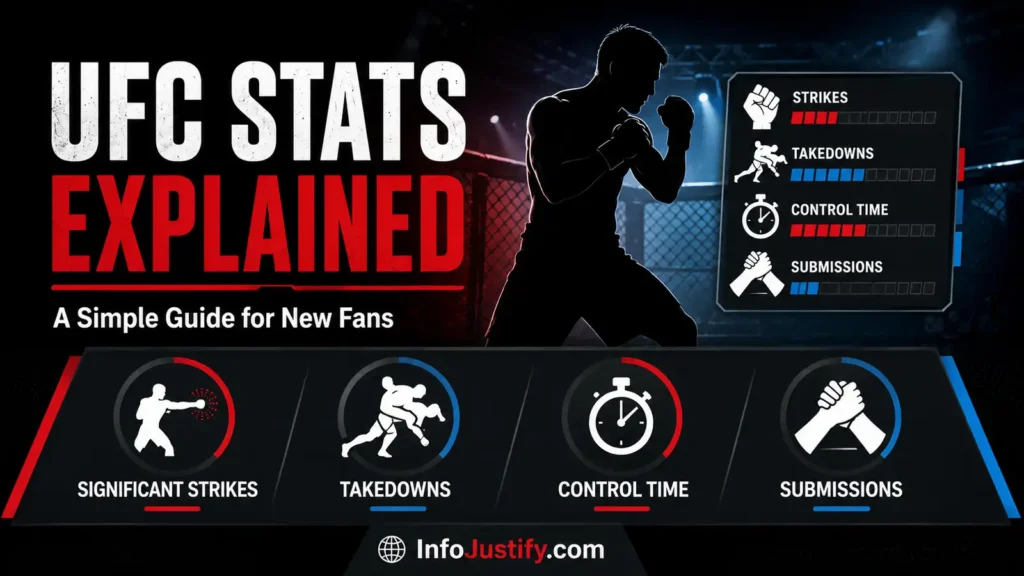
In other words, UFC stats explained properly should make a fan more careful, not more overconfident, because numbers need round context, official outcomes, and fight flow.
The official winner comes from the bout outcome. A fight can end by knockout, technical knockout, submission, decision, disqualification, draw, or no contest. If the bout reaches the final horn, judges score it round by round. Stats can help explain the story, but they do not independently choose the winner.
For example, suppose Fighter A lands more total strikes across the whole fight. That sounds important, but MMA is usually scored round by round. Fighter B could still win two close rounds and lose one big round. The total strike number may look better for Fighter A, while the scorecards still favor Fighter B.
The official UFC Stats completed events page is useful because it lets fans open completed cards and study fight numbers after the action is finished. For official winners and methods, fans should still start with UFC results before digging into deeper numbers.
Quick recap: stats show activity, accuracy, grappling attempts, and control patterns. They do not replace judges, referees, official results, or the actual scoring criteria.
What UFC Stats Actually Show
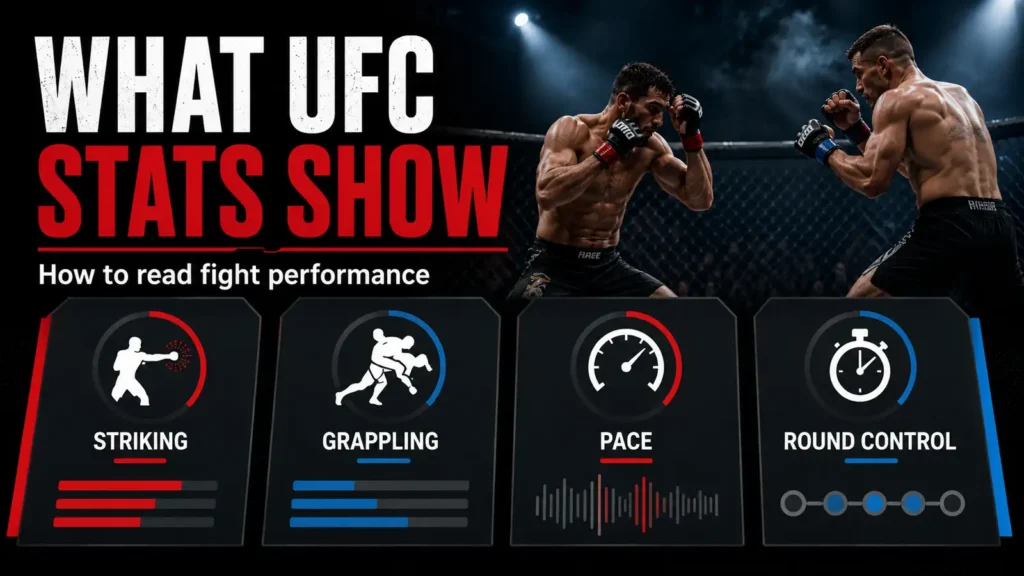
UFC stats usually organize a fight into several categories. The exact layout can vary by event page, but beginners should focus on a few core numbers first: significant strikes, total strikes, takedowns, submission attempts, reversals, and control time.
These numbers answer different questions. Strike numbers tell you about stand-up and ground offense. Takedown numbers show wrestling success. Submission attempts show grappling danger. Control time shows how long a fighter held a controlling position. Round-by-round stats show when the work happened.
Quick UFC Stats Glossary
Simple UFC Stats Reading
- Significant strikes:
These are legal strikes counted as meaningful offense at distance, in the clinch, or on the ground.
Beginner tip: Significant strikes are usually more meaningful than light touches, but they still need context. - Total strikes:
This includes all counted strikes, including less damaging strikes from control positions.
Beginner tip: Total strikes are useful, but they can sometimes exaggerate low-impact activity. - Takedowns:
These are successful attempts to bring the opponent to the mat.
Beginner tip: A takedown becomes more valuable when it leads to offense, control, damage, or submission pressure. - Takedown defense:
This shows how often a fighter stops the opponent’s takedown attempts.
Beginner tip: Strong takedown defense can explain why a grappling plan failed. - Control time:
This shows how much time a fighter spends controlling position, often in clinch or grappling exchanges.
Beginner tip: Control time matters, but it is not always more valuable than damage or clear offense. - Submission attempts:
These are serious grappling attacks that threaten a tap or force the opponent to defend.
Beginner tip: Submission attempts show danger and pressure, even if the fight does not end.
Quick recap: UFC stats are helpful when you read them together. Significant strikes show offense, takedowns show grappling success, control time shows position, and submission attempts show danger—but no single stat tells the full fight story alone.
A good fan does not ask, “Who had the bigger number?” A better question is: which numbers actually changed the fight?
Significant Strikes vs Total Strikes
The phrase significant strikes UFC fans see after a fight can be confusing because it sounds like every significant strike is equally damaging. That is not true. A significant strike is a counted category, not a perfect damage meter.

A useful way to remember significant strikes UFC tracking is this: it is a stat category, not a guarantee that every landed strike caused the same level of damage.
Significant strikes usually matter more than total strikes because they separate more meaningful offense from every small counted strike. A clean jab, hard kick, elbow, knee, or ground strike may appear in the significant strike category depending on the official stat tracking. Total strikes may include smaller punches from a controlling position, short clinch strikes, and other lower-impact activity.
Simple Example
Imagine Fighter A lands 55 total strikes, but many are short body taps while holding the opponent against the fence. Fighter B lands 32 significant strikes, including clean punches and kicks that visibly affect Fighter A. If the fight is close, the smaller number may still tell the stronger story.
This is why the UFC record book separates categories like total strikes, takedowns, control time, and submission attempts. Each stat describes one part of performance, not the entire fight.
For readers, the practical lesson is simple: significant strikes are helpful, but they are still not a complete scoring answer. Damage, timing, round context, location, defense, and grappling all matter.
Where Significant Strikes Can Mislead Fans
Significant strike totals can mislead fans in three common ways:
- A fighter may win the first two rounds narrowly, then lose the third round badly.
- A fighter may land fewer strikes but land the cleaner, more damaging shots.
- A fighter may build numbers late after already losing earlier rounds.
So when reading significant strikes, do not stop at the final total. Check the round-by-round pattern and compare it with the official scorecards if the fight went to decision.
UFC Takedowns and Takedown Defense
UFC takedowns are among the most important grappling stats because they show when a fighter successfully brings the opponent to the mat. But a takedown alone does not automatically win a round.
When reading UFC takedowns, always look for the next action: pass, strike, submission threat, back take, or quick stand-up.
A takedown becomes more valuable when it leads to meaningful offense. That can include ground strikes, dominant positions, submission threats, back control, mount, or enough control to clearly limit the opponent’s offense. A takedown with no follow-up may matter less than a takedown that changes the direction of the round.
Takedown defense is also important. If a wrestler attempts eight takedowns and lands only one, the defender may be doing strong hidden work. New fans sometimes miss this because a defended takedown does not look as dramatic as a knockdown or submission attempt.
Takedown Reading
Simple Takedown Reading
- Many takedown attempts, but only a few landed:
The grappler is trying hard, but the defender is stopping most entries.
Simple reading: The defender may be winning an important part of the fight because they are stopping the takedown game. - Few takedowns, but strong control after each one:
The fighter may not land many takedowns, but the successful ones are useful because they lead to control.
Simple reading: Quality can matter more than quantity. - Takedown followed by damage:
The takedown becomes more valuable when the fighter uses it to land ground strikes or create real offense.
Simple reading: This has strong scoring value because the takedown created more than just position. - Takedown with an instant stand-up:
The fighter lands the takedown, but the opponent gets back up quickly.
Simple reading: This has limited value because the opponent neutralized the grappling fast.
Quick recap: A takedown is more meaningful when it leads to control, damage, submission pressure, or clear offense. A takedown that ends quickly may not tell the full story by itself.
For a beginner, the best question is not simply, “Who landed more takedowns?” The better question is: what did the fighter do after the takedown?
UFC Control Time: What It Shows and What It Does Not Prove
UFC control time shows how long a fighter controls the opponent in certain positions. This can include clinch control, top control, or other grappling situations where one fighter is limiting the other’s movement.
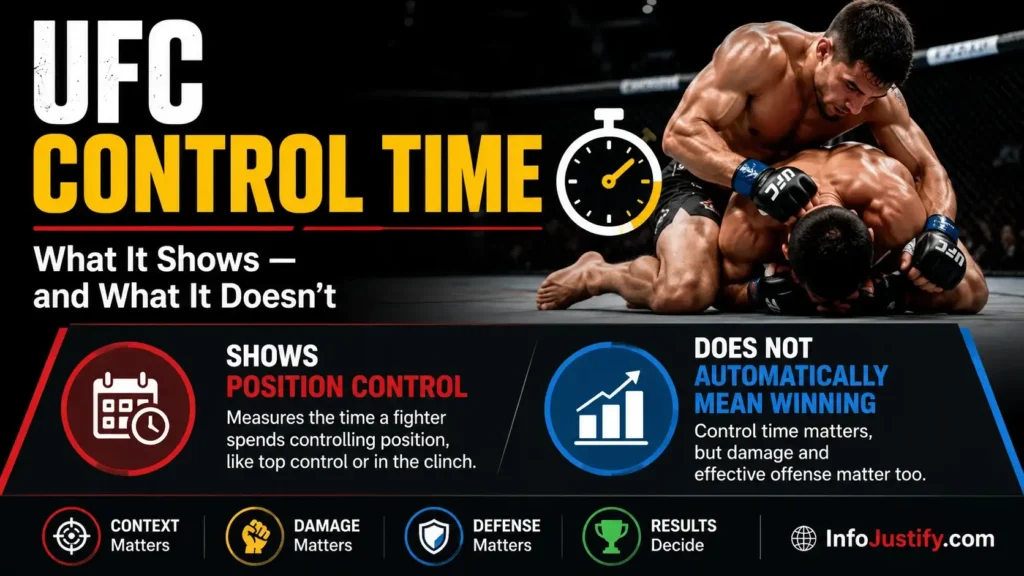
When reading UFC control time, ask whether the fighter used that control to build real offense or only held position.
Control time can be extremely useful because it shows whether a fighter was able to impose a grappling plan. If one fighter spends several minutes keeping the opponent on the mat while landing strikes or threatening submissions, that number supports the visual story.
But control time does not always prove a fighter won the round. If a fighter controls position without damage, submission threat, or meaningful advancement, judges may give more weight to the opponent’s cleaner damaging moments. This is one reason fans and judges sometimes disagree after close fights.
The Unified Rules are helpful for understanding why effective striking and grappling matter before simple activity or position. Control can support a round, but it is strongest when connected to offense.
What This Means for Readers
If a fighter has four minutes of control time, do not immediately assume they dominated. Ask these questions:
- Did the control create damage?
- Did it lead to submission threats?
- Did the opponent escape and land the better strikes?
- Did the control happen in the round that matters for the scorecard?
- Was the control active, or mostly neutral?
Control time is context. It is powerful context, but it should not be read like a scoreboard by itself.
Submission Attempts and Grappling Numbers
Submission attempts help fans understand grappling danger. A fighter may not finish the submission, but a serious attempt can force the opponent to defend, stop attacking, change position, or survive a dangerous moment.
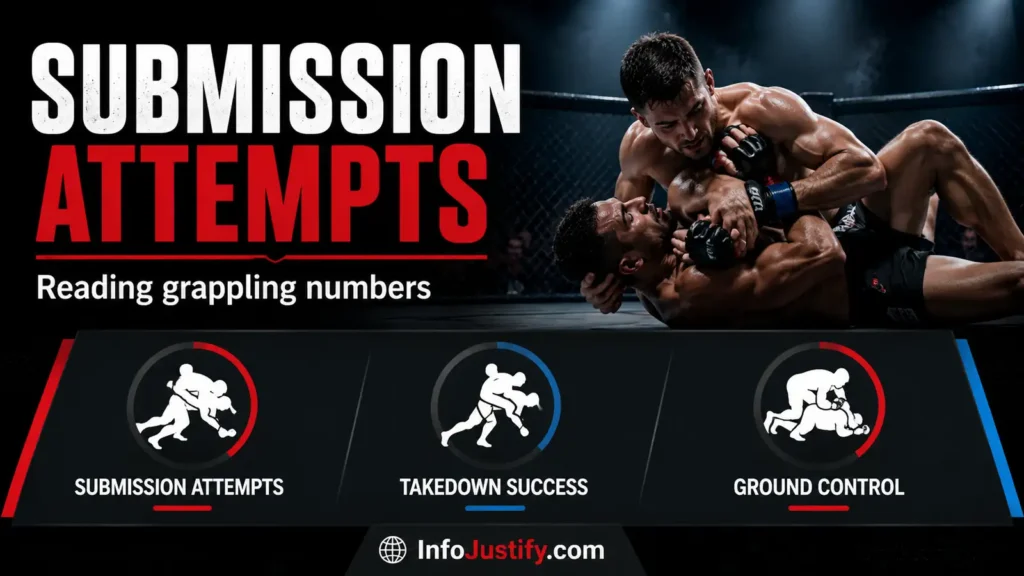
Not every grip or setup becomes a counted submission attempt. The important idea for beginners is that submission stats point toward threat. If a fighter repeatedly attacks chokes, armbars, leg locks, or other submissions, the opponent may spend more energy defending than attacking.
Submission attempts matter most when they create visible danger. A tight choke that forces a desperate escape tells a stronger story than a loose attempt with no real control. Like significant strikes, the stat is useful, but the quality of the moment matters.
For readers who are new to the sport, InfoJustify’s What is UFC? guide can help explain why MMA includes striking, wrestling, and submission grappling together. UFC stats become easier to read when you understand that the sport is not only a stand-up striking contest.
Grappling Numbers to Watch Together
When studying grappling, do not read one number alone. Combine:
- Takedown attempts and takedowns landed
- Control time
- Submission attempts
- Reversals or sweeps when available
- Ground significant strikes
- Round-by-round position changes
Together, those numbers show whether grappling was just movement, or whether it actually shaped the fight.
Accuracy, Pace, and Round-by-Round Stats
Accuracy tells you how efficiently a fighter lands. Pace tells you how active they are. Round-by-round stats tell you when the work happened. These three ideas can change how you understand a fight.
A fighter with high accuracy may be landing cleanly but throwing less often. A fighter with high pace may be active but missing more. Neither number is automatically better. The question is whether the fighter is creating effective offense inside each round.
Round-by-round stats are especially important because MMA decisions are not normally scored by total fight numbers. A fighter can lose the first two rounds and dominate the third. The final totals may look close or even favor the late-surging fighter, but the official decision can still go the other way.
Simple Round-by-Round Example
Suppose a three-round fight has this pattern:
Simple Round-by-Round Reading
- Round 1: Fighter A lands slightly cleaner strikes, while Fighter B shows good defense but lands fewer clean shots.
Simple reading: Fighter A may edge the round. - Round 2: Fighter A scores a takedown, keeps control, and adds some ground strikes. Fighter B has limited offense in this round.
Simple reading: Fighter A may win this round again. - Round 3: Fighter A gets hurt and is outlanded badly, while Fighter B makes a strong comeback.
Simple reading: Fighter B may win Round 3 only.
Quick recap: In this example, Fighter A may still win the fight overall because they likely took the first two rounds, even if Fighter B had the stronger final round.
In that example, final strike totals might make the fight look close, but Fighter A may still win two rounds to one. This is why UFC scorecards matter after decision fights.
How Stats Connect to UFC Scoring
Stats and scoring are connected, but they are not identical. Judges do not simply add strike totals and choose the bigger number. They evaluate what happened in each round under the judging criteria.
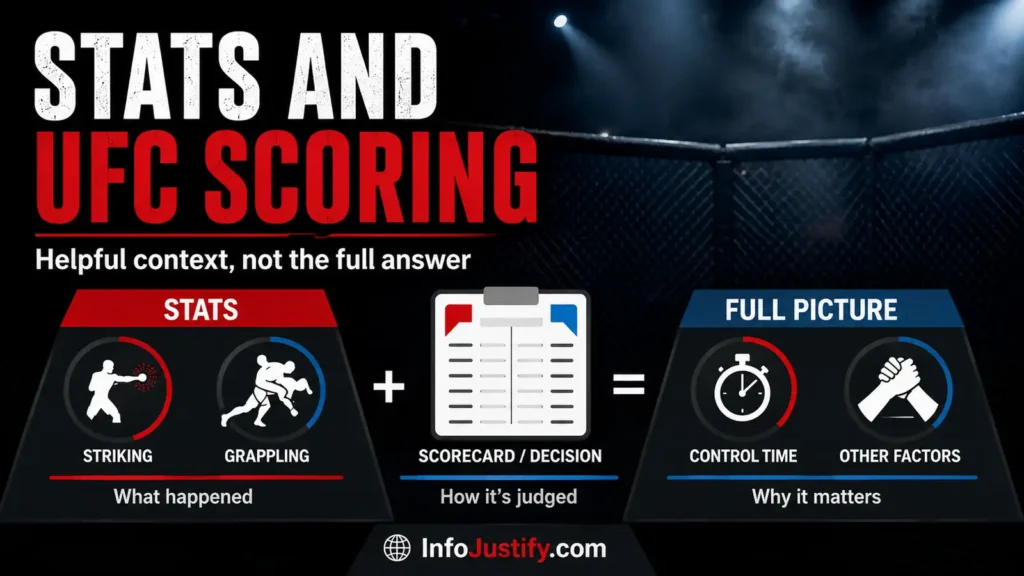
This matters because UFC fight stats are descriptive, while scorecards are decisive. Stats describe the action. Scorecards decide the official result when the fight goes the distance.
That is why UFC stats explained for beginners must separate descriptive fight data from official scoring decisions.
A clean knockdown can outweigh several light strikes. A deep submission attempt can outweigh neutral control. A fighter can land fewer total strikes but land the shots that visibly change the round. A takedown can be important, but it is stronger when followed by offense.
If you are still learning rules and judging, it helps to read this article with InfoJustify’s UFC Fight Rules Explained guide. That gives you the basic framework for rounds, fouls, finishes, and decisions before you try to judge stats like a serious fan.
Quick Rule for Beginners
Use this order after a fight:
- Check the official result.
- If it was a decision, check the scorecards.
- Then study stats to understand why the fight looked the way it did.
- Use round-by-round context before making a strong opinion.
That order protects you from the biggest mistake: using stats to argue against a result before understanding how the rounds were scored.
How to Read a UFC Stats Page After a Fight
When you open a UFC Stats page, do not try to understand every number at once. Start with the basics and move deeper only when needed.
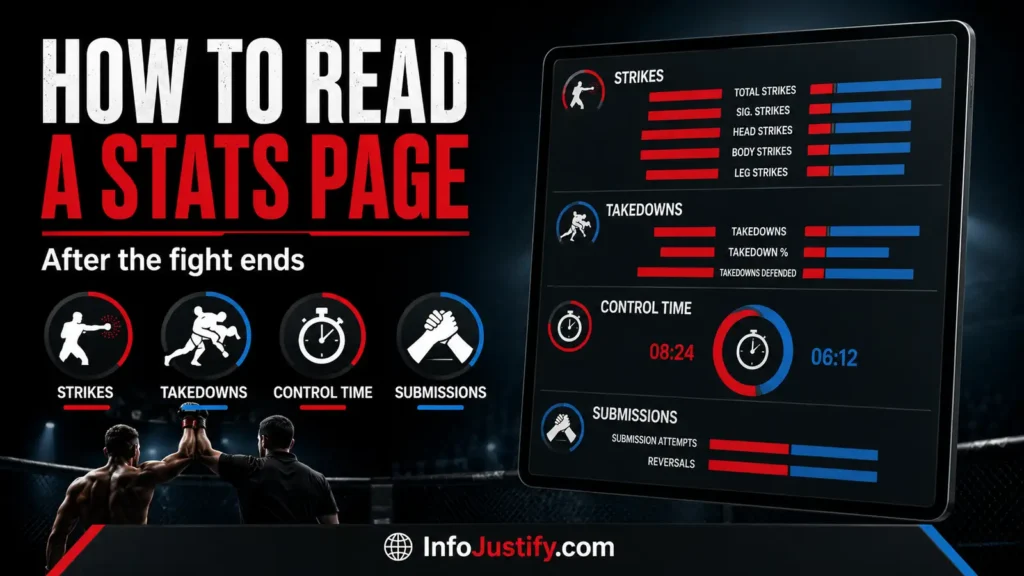
First, confirm the event and bout. Make sure you are looking at the correct fight, especially if fighters have similar names or the card had many bouts. If you are not sure which event you need, the UFC events page can help you find the correct card.
Second, check the method of victory from the official result. A knockout, submission, or decision changes how you read the numbers. In a quick finish, stats may be small but still meaningful. In a full-distance decision, round-by-round numbers become much more important.
Third, compare significant strikes, takedowns, control time, and submission attempts. Do not treat any single number as final proof. Look for patterns: pressure, damage, defense, grappling control, and late momentum.
This keeps UFC fight stats connected to what actually happened, instead of turning one number into a misleading headline.
Fourth, check the round breakdown. This is where many fan debates become clearer. A fighter may have a strong final round but lose the earlier rounds. Another fighter may win through steady round-by-round work without a dramatic highlight.
Quick Recap Box
Best beginner reading order: result -> scorecards -> significant strikes -> takedowns -> control time -> submission attempts -> round-by-round context.
Common Mistakes Fans Make With UFC Fight Stats
The first mistake is treating total strikes as the whole story. Total strikes can include lower-impact offense, and they may not show which strikes actually affected the fight.
The second mistake is assuming every takedown wins a round. A takedown with no control or offense can be less valuable than a round where the other fighter lands the cleaner, more damaging work.
The third mistake is overvaluing control time. Control matters, but it is not magic. Control that creates damage, submission danger, or positional dominance is more meaningful than passive holding.
With UFC takedowns and UFC control time, context matters more than the raw count because grappling numbers are strongest when they create damage, threat, or dominance.
The fourth mistake is ignoring round-by-round scoring. Final totals are not always enough because judges score the fight in rounds. The timing of the work matters.
The fifth mistake is using stats without watching the fight. Numbers can support analysis, but they cannot show every detail: balance, damage reaction, defensive urgency, fatigue, body language, or how dangerous a submission really was.
The safest habit is to use stats as a learning tool. They should make your understanding sharper, not replace your eyes or the official scorecards.
Quick UFC Stats Checklist
Before you trust a UFC stats argument, run through this checklist:
- Did I confirm the official result first?
- Did the fight end early or go to decision?
- Did I check the scorecards for a decision?
- Are the stats being read round by round?
- Are significant strikes separated from total strikes?
- Did takedowns lead to offense, control, or submissions?
- Is control time connected to damage or threat?
- Are submission attempts serious or just loose setups?
- Is one big round hiding two smaller lost rounds?
- Am I using stats as context instead of treating them as the result?
This checklist works for casual fans, bloggers, and creators. It keeps the article reader-friendly and prevents shallow takes like “more strikes always wins” or “more control always wins.”
Used carefully, UFC fight stats can turn a confusing decision into a clearer learning moment without claiming that every number tells the whole truth.
Conclusion
UFC stats explained is really about learning how to read fight numbers with context. Significant strikes, takedowns, control time, submission attempts, accuracy, and round-by-round stats can all help you understand a bout more clearly. But no single number tells the full story.
For beginners, the best process is simple. Confirm the official result, check scorecards for decisions, then use stats to understand the action behind the result. Significant strikes can show cleaner offense. Takedowns can show wrestling success. Control time can show positional pressure. Submission attempts can show grappling danger. But every stat becomes more useful when you connect it to the round, the damage, and the actual fight flow.
When you use stats this way, you become a smarter UFC fan. You stop reacting only to highlights or comment sections and start reading the fight like a complete story.
Sources of Links –
| Linked Topic / Purpose | Clean URL |
| Official completed event stats, fight metrics, significant strikes, takedowns, control time, and submission attempts. | https://ufcstats.com/statistics/events/completed?page=all |
| Official judges’ scorecards for decision fights and round-by-round scoring review. | https://www.ufc.com/scorecards |
| Official winners, methods, rounds, and event outcome confirmation. | https://www.ufc.com/results |
| Scoring criteria, rule context, and why effective striking/grappling matter. | https://www.ufc.com/unified-rules-mixed-martial-arts |
| Long-term UFC stat leader categories such as control time, takedowns, and submissions. | https://statleaders.ufc.com/ |
| Finding the correct fight card before opening stats or result details. | https://www.ufc.com/events |
| Internal reader journey from result-checking to deeper stat interpretation. | https://infojustify.com/how-to-check-ufc-results-simple-steps-for-fans/ |
| Internal support for judge scorecards and round-by-round scoring context. | https://infojustify.com/ufc-scoring-explained/ |
| Internal support for rounds, fouls, finishes, and decision basics. | https://infojustify.com/ufc-fight-rules-explained/ |
| Internal beginner context for MMA basics and sport format. | https://infojustify.com/what-is-ufc-a-simple-explainer-for-new-fans/ |
| Internal support for event and bout navigation. | https://infojustify.com/ufc-fight-card-explained-how-fight-night-works/ |
| Internal support for division context while reading fight stats. | https://infojustify.com/ufc-weight-classes-explained-a-beginner-breakdown/ |
FAQs –
1. What do UFC stats mean?
UFC stats show the counted fight numbers after a bout, such as significant strikes, total strikes, takedowns, submission attempts, control time, and round-by-round activity. They help fans understand how the fight played out, but they do not replace the official result or judges’ scorecards.
2. What are significant strikes in UFC?
Significant strikes in UFC are counted strikes that represent more meaningful offense than basic total strikes. They can include strikes at distance, in the clinch, or on the ground, depending on the official stat tracking. Fans should still judge them with context because not every significant strike has the same impact.
3. Do UFC takedowns automatically win rounds?
No. UFC takedowns do not automatically win rounds. A takedown becomes more valuable when it leads to control, damage, dominant position, or submission danger. A takedown with no follow-up may matter less than cleaner offense from the opponent.
4. What does UFC control time mean?
UFC control time shows how long a fighter controls the opponent in grappling, clinch, or positional situations. It can support a fighter’s case in a round, but it is strongest when connected to damage, submission threats, or meaningful positional advancement.
5. Where can I check official UFC fight stats?
You can check official UFC fight stats through UFC Stats completed event pages. For the full picture, also confirm the official UFC result and use UFC scorecards when the fight goes to a decision.
6. Why can a fighter land more strikes and still lose?
A fighter can land more strikes and still lose because MMA is usually scored round by round, and strike quality matters. Cleaner damage, better grappling, a stronger submission threat, or winning more individual rounds can matter more than the final total number.
7. Are UFC stats useful for beginners?
Yes. UFC stats are useful for beginners when they are read as context. They help explain striking volume, grappling success, control patterns, and submission danger. The key is to combine stats with the official result, scorecards, and round-by-round fight flow.
- UFC Stats Explained: 7 Powerful Fight Numbers Every Fan Should Know
- UFC Champions Explained: Easy Guide to Belts & Title Defenses
- UFC Rankings Explained: Easy Guide to Title Shots
- UFC Scoring Explained: Easy Guide to How Judges Score MMA Fights
- UFC Fight Rules Explained: Rounds, Fouls & Ways to Win
- Protect Outlook OneDrive from Phishing: 9 Smart Safety Steps
- Clicked Phishing Link What to Do: 10 Recovery Steps
- How to Spot Phishing Emails: Red Flags & Examples
- FBI Alert Outlook OneDrive: Phishing Scam Explained
- What Is Phishing? Meaning, Examples & Safety Tips
- How to Improve Your Credit Score in the USA: Complete Guide
- Why Is Roland Garros So Hard to Win? Full Guide
- Roland Garros Winners List: Champions, Records & Legends
- Why Is Roland Garros Played on Clay? Court Guide
- French Open vs Roland Garros: Are They the Same Tournament?
- Roland Garros Meaning, History & Clay Court Explained
- Guzman y Gomez vs Chipotle: Menu, Taste, and Value Compared
- Chipotle Bowl vs Burrito: Which One Is Healthier?
- Chipotle Nutrition Guide: Calories, Protein & Smart Orders
- Healthiest Thing to Eat at Chipotle: Best Orders Explained