
UFC fight rules explained in simple words means understanding how a UFC bout is timed, how fighters can win, what actions are not allowed, and what happens when no one gets a finish. Most UFC fights are three five-minute rounds, while championship fights and many main events are five rounds. Fighters can win by KO/TKO, submission, judges’ decision, disqualification, or other official results. Referees control safety inside the cage, judges score rounds when needed, and fouls can lead to warnings, point deductions, disqualification, or a no contest.
UFC rules can feel confusing when you are a new fan. A fight may end in seconds, last all three rounds, go to five rounds, stop because of an illegal foul, or finish after a doctor checks an injury. That is why this guide keeps the explanation simple, direct, and useful. This makes a clear UFC fight rules explained guide useful before watching any full event.
Think of this as your beginner map. You will learn the basic timing, the major ways to win, common illegal actions, the referee’s job, and how official results are written after a fight. You can also use this article alongside InfoJustify’s guides on what UFC means, UFC weight classes, and how to check UFC results.
- UFC Fight Rules Explained in Simple Words
- How Long UFC Fights Last: 3 Rounds vs 5 Rounds
- Main Ways to Win a UFC Fight
- UFC Fight Rules for Beginners: What Is Legal?
- Common UFC Fouls New Fans Should Know
- What the Referee Controls During a UFC Fight
- How Point Deductions and Penalties Affect the Result
- How Decisions Work When There Is No Finish
- How to Read a UFC Result Line After the Fight
- Beginner Mistakes to Avoid When Watching UFC Rules
- Quick UFC Rules Checklist for New Fans
- Sources of Links –
- Conclusion
- FAQ –
UFC Fight Rules Explained in Simple Words
The easiest way to understand UFC fight rules explained is to separate the sport into four parts: time, legal action, result, and safety. Time tells you how long the fight can last. Legal action tells you what fighters can do. Result tells you how someone wins. Safety tells you why referees, doctors, judges, and commissions are part of the event. In short, UFC fight rules explained should make the bout easier to follow, not harder.
UFC fights are mixed martial arts bouts. That means fighters can use striking, wrestling, grappling, clinch work, and submissions under the Unified Rules of MMA. The goal is not just to be aggressive. The goal is to win legally, safely, and clearly under the rules used for sanctioned professional MMA events.
For new fans, this matters because a fight is not always won by the person who looks busier. A fighter can win by landing cleaner damage, locking in a submission, defending well and winning rounds, or forcing a referee stoppage. A rule-smart fan sees more than punches and kicks; they understand why the fight is being controlled the way it is.
Quick beginner rule: If a fighter wins before the final bell, that is usually a finish. If the fight reaches the final bell, judges decide the winner based on scoring criteria.
How Long UFC Fights Last: 3 Rounds vs 5 Rounds
Most standard UFC bouts are scheduled for three rounds, and each round is five minutes long. There is usually a one-minute rest period between rounds. This means a normal fight can last up to 15 minutes of fighting time if there is no finish. These UFC rounds are the basic time structure most new fans should understand first.
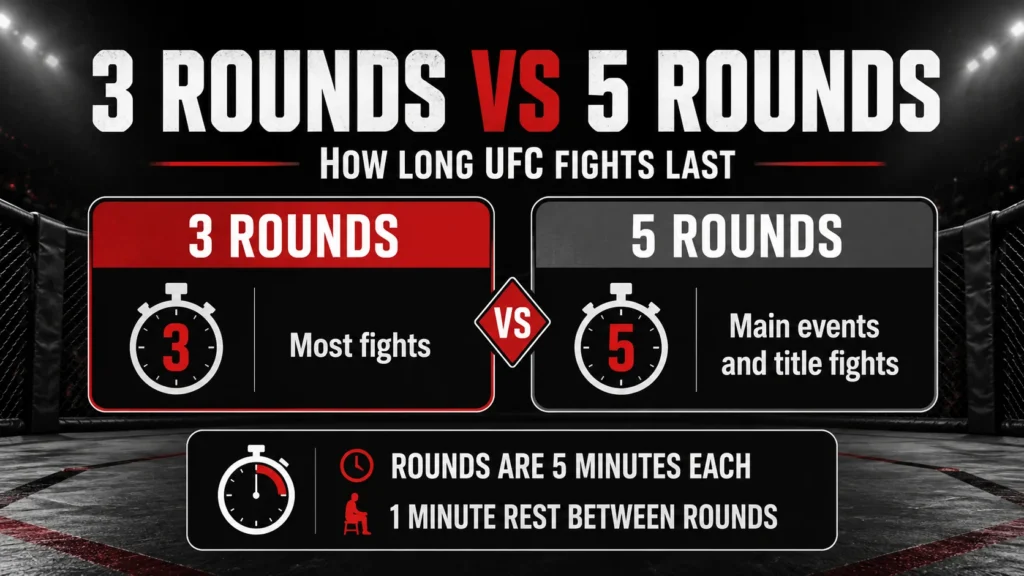
Championship fights are normally scheduled for five rounds, which means up to 25 minutes of fighting time. Many UFC main events are also five-round fights even when no belt is involved. When you look at a UFC fight card, the card position helps you understand why one bout may be three rounds while another is five rounds.
| Fight Type | Typical Length | What New Fans Should Know |
| Standard non-title bout | 3 rounds x 5 minutes | Most prelim and main-card fights use this format. |
| Championship fight | 5 rounds x 5 minutes | Title fights require more endurance and often change strategy late. |
| Main event | Often 5 rounds | Many UFC main events are five rounds even without a title. |
| Rest period | Usually 1 minute | Corners give advice, clean cuts, and help fighters reset. |
The difference between three and five rounds changes strategy. In three-round fights, a slow start can be costly because there is less time to recover on the scorecards. In five-round fights, pace, cardio, body shots, leg kicks, and long-term control can become more important as the fight goes deeper.
A simple way to watch UFC rounds is this: Round 1 often shows the game plan, Round 2 reveals adjustments, and Round 3 or later tests who can keep executing under pressure. This is why UFC rounds are more than a clock; they shape the story of the fight. Once you recognize UFC rounds this way, judging and momentum become easier to read.
- How to Check UFC Results: Simple Steps for Fans
- UFC Weight Classes Explained: A Beginner Breakdown
- UFC Fight Card Explained: How Fight Night Works
- What is UFC? A Simple Explainer for New Fans
Main Ways to Win a UFC Fight
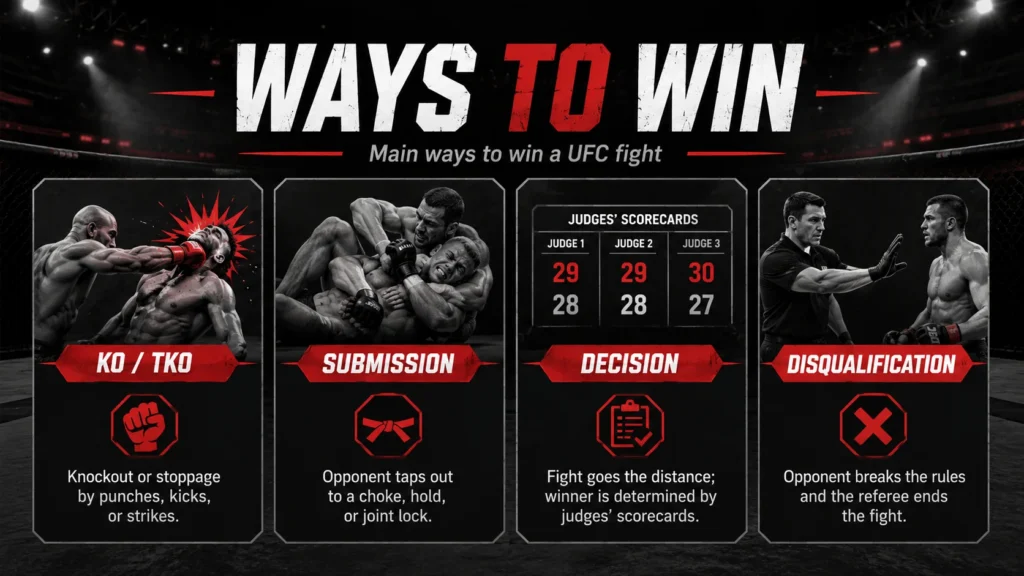
There are several official ways to win a UFC fight. New fans usually hear the terms KO, TKO, submission, decision, disqualification, and no contest. Each one means something different, and understanding them helps you read the result line correctly after the bout. This section also makes the main ways to win a UFC fight situations easier to separate.
KO: Knockout
A knockout happens when a legal strike leaves a fighter unable to continue. The most obvious version is when a fighter is knocked unconscious or cannot intelligently defend after a clean blow. Not every knockdown is a knockout, though. A fighter can be dropped, recover, and continue if the referee believes they are still able to defend.
TKO: Technical Knockout
A TKO usually means the fight was stopped because a fighter could no longer defend safely or continue properly. A referee stoppage, doctor stoppage, or corner stoppage can lead to a TKO. For example, if a fighter absorbs unanswered strikes on the ground, the referee may step in before the fighter is fully unconscious.
Submission
A submission happens when a fighter taps, verbally submits, or cannot safely continue because of a submission hold. Chokes, armlocks, leg locks, and other grappling attacks can end a fight this way. Sometimes the referee stops the fight even without a tap if the fighter goes unconscious or appears unable to protect themselves.
Decision
A decision happens when the fight reaches the final bell and judges decide the winner. UFC fans can check official scorecards after events to see how judges scored each round. Decisions can be unanimous, split, majority, or sometimes a draw depending on the judges’ scores.
Disqualification and No Contest
A disqualification can happen when a fighter commits a serious illegal foul, especially if the foul is intentional or prevents the opponent from continuing. A no contest usually means the fight ends without a winner because of circumstances such as certain accidental fouls or issues outside normal competition. These results are less common than KO/TKO, submission, or decision, but they are important parts of ways to win a UFC fight discussions because they affect official records.
| Result Type | Simple Meaning | Common Fan Clue |
| KO | A legal strike ends the fight clearly. | The opponent cannot continue after impact. |
| TKO | The referee, doctor, or corner stops it. | The fighter is not safely defending or medically fit. |
| Submission | A grappling hold forces a tap or stoppage. | Tap, verbal tap, choke, or joint lock. |
| Decision | Judges decide after time expires. | Scorecards determine the winner. |
| Disqualification | A serious illegal action decides the fight. | A foul makes legal continuation impossible. |
| No Contest | No official winner is declared. | Often tied to accidental fouls or special circumstances. |
UFC Fight Rules for Beginners: What Is Legal?
A UFC fight allows both striking and grappling, but not everything is legal. Fighters can punch, kick, knee, elbow, wrestle, clinch, attempt takedowns, control positions, and use submissions. These actions must happen within the rules, under referee supervision, and inside the permitted target areas. That is the core idea behind UFC rules for beginners: know what is allowed before judging a moment.
The legal action is what makes MMA different from a single-discipline sport. A fighter may strike on the feet, defend a takedown against the fence, reverse position on the ground, or attack with a choke. That variety is why UFC rules for beginners should not be reduced to “two people just fighting.” The rules create a controlled competitive system.
Weight classes also matter because fair rules begin before the fight starts. Fighters are matched inside divisions so size differences are managed. If you need a beginner refresher, use InfoJustify’s guide to UFC weight classes before reading deeper rules.
- Striking includes legal punches, kicks, knees, and elbows depending on position and rule context.
- Grappling includes takedowns, clinch control, guard work, reversals, scrambles, and submissions.
- Defense matters because judges and referees watch whether a fighter is intelligently defending.
- Position matters because some actions are legal in one position but illegal in another.
- Referee instructions matter because ignoring them can lead to warnings or penalties.
Rules can also vary slightly depending on the athletic commission and jurisdiction. That is one reason serious fans check official event information, commission notes, and the current rule context instead of relying only on social media clips. For UFC rules for beginners, checking the official rule context is always better than trusting a short clip.
Common UFC Fouls New Fans Should Know
UFC fouls are illegal actions that can stop the flow of a fight and sometimes change the result. Some fouls are accidental; others may be considered intentional. The referee decides how to handle the situation based on what happened, whether damage occurred, and whether the fouled fighter can continue. Understanding UFC fouls helps fans know why a referee may pause action or issue a warning.
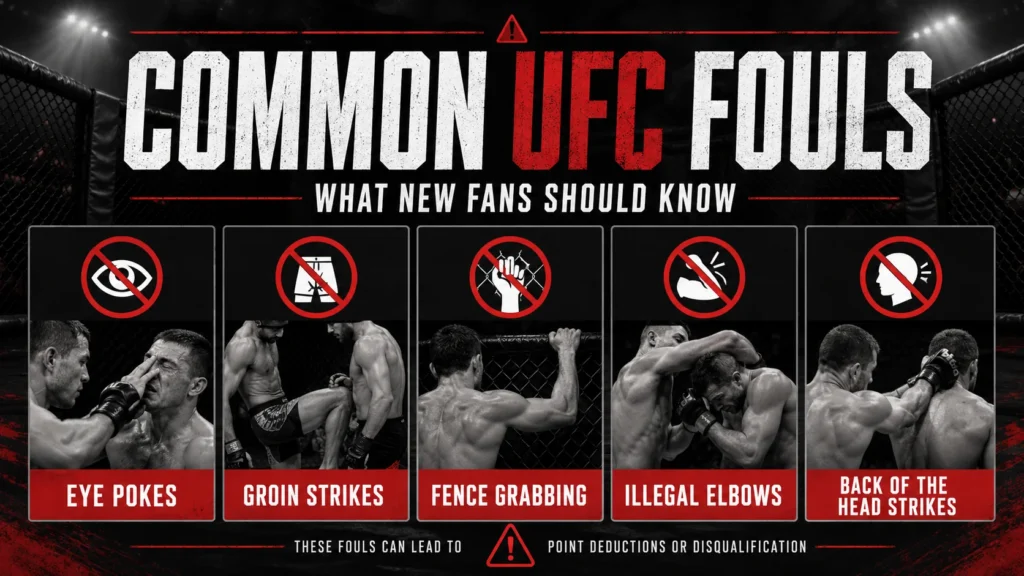
New fans do not need to memorize every foul on day one, but they should recognize the common ones. Many controversial moments happen because viewers do not understand why the referee paused the fight or why a point was taken. Common UFC fouls are especially important in close fights because one illegal action can shift momentum.
- Eye pokes: dangerous contact to the eye area, often during hand-fighting or range control.
- Groin strikes: illegal strikes to the groin, usually followed by recovery time.
- Strikes to the back of the head or spine: dangerous target areas that can cause serious injury.
- Fence grabs: holding the cage to stop a takedown or improve position unfairly.
- Small-joint manipulation: attacking individual fingers or toes instead of larger joints.
- Biting, hair pulling, or fish-hooking: clearly illegal actions that do not belong in legal MMA competition.
- Attacking after the bell or during a break: illegal because the active round or exchange has stopped.
Recent MMA rule updates have also reminded fans that rule details can change, especially around grounded-fighter definitions and elbow rules. For a beginner article, the safest takeaway is simple: always check the latest sanctioned rules and remember that local commission adoption can matter. Rule updates matter because some UFC fouls depend on the exact definition used by the commission.
Beginner note: A foul does not automatically mean a fighter loses. The result depends on intent, severity, damage, recovery, referee judgment, and whether the fight can continue. That is why UFC fouls should be judged by context, not only by crowd reaction.
What the Referee Controls During a UFC Fight
The referee is the most important official inside the cage. Their job is not to help one fighter or keep the fight exciting at all costs. Their job is to enforce the rules, protect fighter safety, and decide when action must stop or continue.
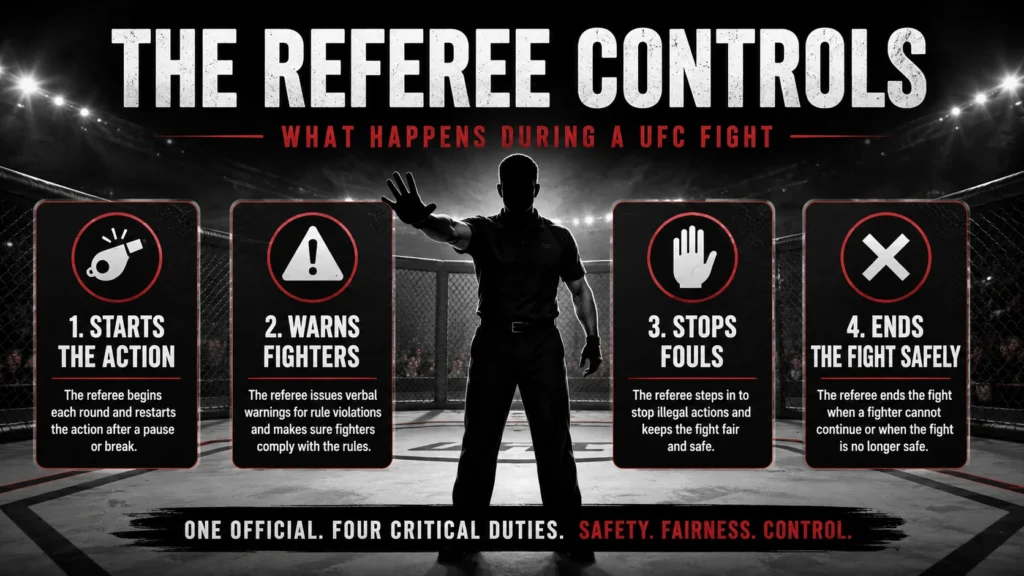
A referee can start rounds, pause the bout, warn fighters, separate inactive positions, stand fighters up, call fouls, ask for a doctor, stop a fight, or disqualify a fighter. When a finish happens, the referee’s body language usually tells you a lot: stepping between fighters, waving off the bout, or physically protecting a hurt athlete.
- Starts and stops action when the round begins, ends, or needs a pause.
- Judges fighter safety when a fighter is hurt, trapped, or not defending.
- Handles fouls by warning, pausing, allowing recovery, or deducting points.
- Requests doctor checks when cuts, injuries, or medical concerns appear serious.
- Confirms submissions when a fighter taps or cannot continue in a hold.
- Calls the official stoppage that becomes part of the final result line.
Fans sometimes disagree with stoppages, especially in TKO situations. But the referee does not have to wait for a fighter to be unconscious. If the athlete is not intelligently defending, the referee can stop the fight to prevent unnecessary damage.
How Point Deductions and Penalties Affect the Result
Point deductions are one of the most misunderstood parts of UFC fight rules explained for new fans. A warning is not the same as a point deduction. A referee may warn a fighter first, especially for a minor or accidental foul, but a serious or repeated foul can lead to one or more points being taken away. In this part of UFC fight rules explained, the key point is that a foul can affect scoring even without ending the bout.
In a close three-round fight, one point can completely change the result. A fighter who wins two close rounds but loses a point may turn a likely win into a draw or even a loss depending on the scorecards. That is why fouls are not just “small interruptions.” They can directly affect the official outcome.
| Penalty Situation | Possible Result | Why It Matters |
| Minor accidental foul | Warning or pause | The fight may continue with no scoring change. |
| Repeated foul | Point deduction | The fighter loses a point on judges’ scorecards. |
| Serious intentional foul | Disqualification possible | The illegal action may decide the result. |
| Accidental foul causes fight stoppage | No contest or technical decision possible | The timing and score situation can matter. |
The most important beginner rule is this: penalties depend on context. Referees consider whether the foul looked intentional, how much damage it caused, whether the opponent can continue, and whether the offending fighter had already been warned. Serious UFC fouls can become more than a warning when they clearly change the opponent’s ability to continue.
How Decisions Work When There Is No Finish
If a UFC fight reaches the final horn, judges decide the result. Most UFC bouts use a round-by-round scoring system commonly known as the 10-point must system. In simple terms, the round winner usually receives 10 points, while the opponent usually receives 9 or fewer points depending on dominance. This is where UFC fight rules explained connects directly with scoring and official scorecards.
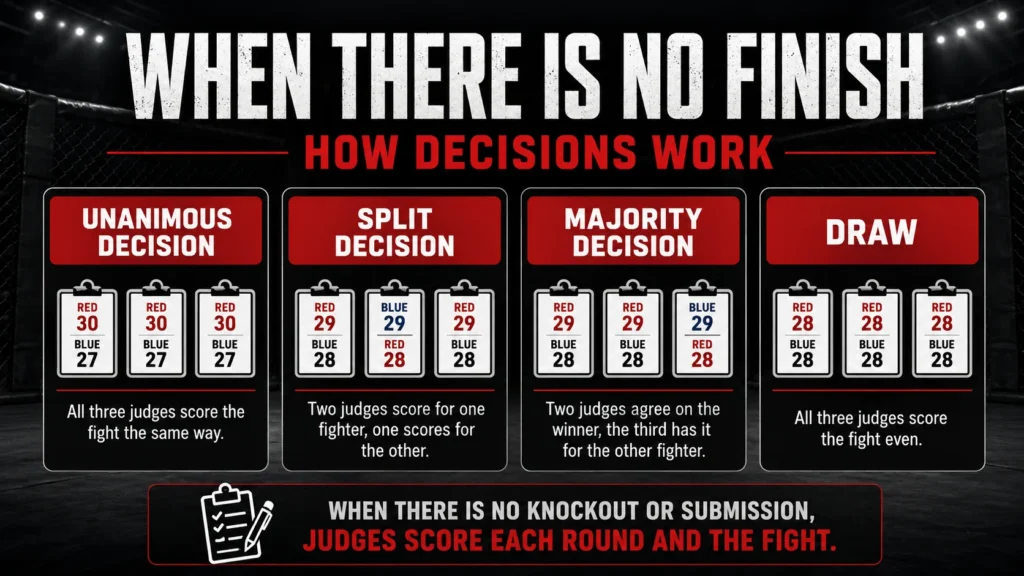
Judges primarily look at effective striking and grappling. That means clean damaging strikes, meaningful grappling, near-finishing sequences, takedowns that lead to control or offense, and submission attempts that force defense. If those are very close, judges may look at aggression and control as secondary factors.
- 10-9 round: one fighter wins a competitive round. For UFC rounds, judges usually score each round separately rather than judging the whole fight as one long exchange.
- 10-8 round: one fighter wins a round with clear dominance, impact, or sustained control.
- Unanimous decision: all three judges pick the same winner.
- Split decision: two judges pick one fighter and one judge picks the other.
- Majority decision: two judges pick one fighter and one judge scores the fight a draw.
- Draw: scoring does not produce a single winner.
This is also why fans should be careful with the phrase “robbery.” Some fights are genuinely controversial, but many close fights turn on one swing round. Looking at official UFC scorecards and UFC Stats can help fans compare what they saw with the judging and statistical record.
How to Read a UFC Result Line After the Fight
Once you understand the basic rules, reading a result line becomes much easier. A result line usually tells you the winner, the method, the round, and the time. For decisions, it may also include the scorecards. Knowing the main ways to win a UFC fight results also helps readers understand why some outcomes look similar but mean different things.
For example, if a result says “Fighter A def. Fighter B by submission, Round 2, 3:12,” you know the fight ended in the second round by a tap or submission stoppage. If it says “by unanimous decision,” you know the bout reached the final horn and all three judges picked the same winner.
| Result Line Part | Example | Meaning |
| Winner | Fighter A def. Fighter B | Fighter A is the official winner. |
| Method | KO/TKO, submission, decision | How the fight ended. |
| Round | Round 2 | Which round the ending happened in. |
| Time | 3:12 | Time elapsed in that round. |
| Scores | 30-27, 29-28, 29-28 | Judge totals when the fight goes to decision. |
To verify official outcomes, fans can check UFC’s official results page after the event. If you want a deeper step-by-step process, use InfoJustify’s guide on how to check UFC results.
Beginner Mistakes to Avoid When Watching UFC Rules
New fans often misunderstand UFC rules because the action is fast and commentary moves quickly. Here are the biggest mistakes to avoid when you are learning the sport.
- Mistake 1: Thinking every knockdown is a knockout. A knockdown only becomes a finish if the referee stops it or the fighter cannot continue.
- Mistake 2: Ignoring grappling value. A takedown alone is not always enough; what happens after the takedown matters.
- Mistake 3: Assuming more volume always wins. Clean damage and meaningful offense can matter more than empty activity.
- Mistake 4: Treating all fouls the same. Intent, damage, and repeat behavior can change the penalty.
- Mistake 5: Forgetting round count. A five-round fight can shift dramatically after Round 3.
- Mistake 6: Trusting social clips without context. Always check the full sequence, official result, and scorecards when possible. This is also why UFC fouls should be reviewed with the full fight context when possible.
A good beginner habit is to watch each round with one question: who created the most effective offense while staying within the rules? That simple lens makes UFC fights easier to follow without overcomplicating every exchange.
Quick UFC Rules Checklist for New Fans
Use this quick checklist when you watch your next UFC event. It keeps the rules simple and helps you follow the bout in real time.
- Check whether the fight is scheduled for three rounds or five rounds.
- Watch for the main win method: KO/TKO, submission, or decision.
- Notice whether a fighter is intelligently defending when hurt.
- Pay attention when the referee pauses action for a foul.
- Remember that a warning is different from a point deduction.
- If the bout reaches the final horn, wait for the official scorecards.
- Check official results before sharing or publishing the outcome.
You can also follow upcoming fight timing through the official UFC events page and use UFC rankings to understand why some bouts matter more for title contention.
- Why Is Roland Garros So Hard to Win? Full Guide
- Roland Garros Winners List: Champions, Records & Legends
- Why Is Roland Garros Played on Clay? Court Guide
- French Open vs Roland Garros: Are They the Same Tournament?
- Roland Garros Meaning, History & Clay Court Explained
Sources of Links –
| Source Name | Clean URL |
| UFC Unified Rules / Rules Reference | https://www.ufc.com/unified-rules-mixed-martial-arts |
| Association of Boxing Commissions | https://www.abcboxing.com |
| UFC Scorecards | https://www.ufc.com/scorecards |
| UFC Results | https://www.ufc.com/results |
| UFC Events | https://www.ufc.com/events |
| UFC Rankings | https://www.ufc.com/rankings |
| UFC Stats | http://ufcstats.com/statistics/events/completed?page=all |
| InfoJustify: What is UFC? | https://infojustify.com/what-is-ufc-a-simple-explainer-for-new-fans/ |
| InfoJustify: UFC Weight Classes | https://infojustify.com/ufc-weight-classes-explained-a-beginner-breakdown/ |
| InfoJustify: How to Check UFC Results | https://infojustify.com/how-to-check-ufc-results-simple-steps-for-fans/ |
| InfoJustify: UFC Fight Card Explained | https://infojustify.com/ufc-fight-card-explained-how-fight-night-works/ |
Conclusion
UFC fight rules explained simply means understanding the timing, win methods, fouls, referee control, penalties, and judging that shape every bout. Once you know these basics, UFC becomes much easier to follow. You can tell why a fight was stopped, why a scorecard looked close, why a foul changed the outcome, and why certain fights are scheduled for five rounds instead of three. A complete UFC fight rules explained article should leave new fans confident enough to follow the next card with less confusion.
For new fans, the smartest path is to learn one layer at a time. Start with rounds and win methods. Then learn fouls and referee decisions. After that, study judging and scorecards. With that foundation, you will not just watch UFC action—you will understand what the result really means. That final layer turns UFC fight rules explained from a list of terms into a practical viewing guide.
FAQ –
What are the basic UFC fight rules?
The basic UFC fight rules cover fight length, legal strikes and grappling, ways to win, fouls, referee control, and judging when a fight reaches the final horn. Most standard bouts are three five-minute rounds, while title fights are usually five five-minute rounds.
How many rounds are in a UFC fight?
Most UFC fights are three rounds of five minutes each. Championship fights and many main events are usually five rounds of five minutes each, with a one-minute rest period between rounds.
What are the main ways to win a UFC fight?
The main ways to win a UFC fight are knockout, technical knockout, submission, judges’ decision, disqualification, and sometimes other official outcomes such as no contest depending on the situation.
What is the difference between KO and TKO in UFC?
A KO usually means a legal strike leaves a fighter unable to continue clearly. A TKO means the referee, doctor, or corner stops the fight because the fighter cannot safely continue or intelligently defend.
What are common UFC fouls?
Common UFC fouls include eye pokes, groin strikes, strikes to the back of the head or spine, fence grabs, biting, hair pulling, small-joint manipulation, and attacking after the bell or during a break.
Can a UFC fighter lose points for a foul?
Yes. A referee can warn a fighter or deduct points for fouls. Repeated, serious, or damaging fouls can affect the scorecards and may even lead to disqualification.
How do judges score UFC fights?
Judges score UFC fights round by round, usually using the 10-point must system. They mainly evaluate effective striking and grappling, then consider aggression and control when the main criteria are close.
Why do some UFC fights go to decision?
A UFC fight goes to decision when no fighter gets a knockout, technical knockout, submission, disqualification result, or other stoppage before the final horn. Judges then decide the winner from the scorecards.
- UFC Scoring Explained: Easy Guide to How Judges Score MMA Fights
- UFC Fight Rules Explained: Rounds, Fouls & Ways to Win
- Protect Outlook OneDrive from Phishing: 9 Smart Safety Steps
- Clicked Phishing Link What to Do: 10 Recovery Steps
- How to Spot Phishing Emails: Red Flags & Examples
- FBI Alert Outlook OneDrive: Phishing Scam Explained
- What Is Phishing? Meaning, Examples & Safety Tips
- How to Improve Your Credit Score in the USA: Complete Guide
- Why Is Roland Garros So Hard to Win? Full Guide
- Roland Garros Winners List: Champions, Records & Legends
- Why Is Roland Garros Played on Clay? Court Guide
- French Open vs Roland Garros: Are They the Same Tournament?
- Roland Garros Meaning, History & Clay Court Explained
- Guzman y Gomez vs Chipotle: Menu, Taste, and Value Compared
- Chipotle Bowl vs Burrito: Which One Is Healthier?
- Chipotle Nutrition Guide: Calories, Protein & Smart Orders
- Healthiest Thing to Eat at Chipotle: Best Orders Explained
- Chipotle Mexican Grill Menu Explained: Best Items to Try
- Social Security Payment Schedule 2026: Dates by Birth Date
- Social Security COLA 2026 Explained: What Changed This Year
- Kyle Busch Pneumonia Sepsis: Cause of Death Explained
- Why Are Social Security Checks Late in May 2026? (The Real Truth)
- Antarctica From Space: 5 Climate Signals to Watch
- Ebola Outbreak 2026: Bundibugyo Virus Explained & Related Topic
- Robert Redfield: Biography, CDC Role, COVID-19 Legacy