

UFC champions explained means understanding how a fighter becomes the recognized titleholder in a UFC division. A champion wins or keeps the UFC championship belt by winning title fights, making weight, and defending the title against top contenders. An interim UFC champion may be created when the undisputed champion cannot compete for a period. A UFC title defense happens when the champion fights a challenger and keeps the belt. For new fans, this guide explains belts, interim titles, undisputed champions, and title defenses in simple terms.
Introduction
New fans often hear words like champion, interim champion, title defense, and undisputed champion during a UFC broadcast. The words sound simple, but the meaning can get confusing when fighters move divisions, belts become vacant, injuries delay fights, or an interim title is created.
This guide keeps UFC champions explained in plain English. It does not try to predict future champions, push betting angles, or claim that one fighter is guaranteed to keep a belt. Instead, it explains the system so readers can follow title fights with more confidence.
For that reason, UFC champions explained should focus on status, context, and verification instead of hype.
For basic context, readers can also review what UFC is, how the official UFC rankings are organized, and how title bouts fit into a normal fight card. Rankings and title results can change quickly, so always confirm current names on official pages before publishing event-specific claims.
- Introduction
- UFC Champion Meaning in Simple Words
- What the UFC Championship Belt Represents
- How Fighters Become UFC Champions
- Undisputed Champion vs. Interim UFC Champion
- What a UFC Title Defense Means
- Vacant Titles, Stripped Titles, and Moving Divisions
- Title Fights vs. Regular UFC Fights
- Why Champions Can Change Quickly
- How New Fans Should Read UFC Champion Lists
- Common Beginner Mistakes About UFC Champions
- Sources of Links
- Conclusion
- FAQ –
UFC Champion Meaning in Simple Words
The simplest UFC champion meaning is this: the champion is the fighter recognized as the titleholder of a specific UFC division. That division may be lightweight, welterweight, women’s flyweight, heavyweight, or another UFC weight class.

Another simple UFC champion meaning is official titleholder status in one division.
A champion is not just a popular fighter. A champion is the person holding the division title after winning a title fight or being promoted into undisputed champion status under UFC matchmaking circumstances. The title tells fans, “This is the fighter at the top of this division right now.”
The key phrase is right now. UFC champions can change after one fight. A dominant champion can lose the belt by knockout, submission, decision, injury-related stoppage, or other official result. A fighter can also vacate a title to move to another division or leave the championship picture for other reasons.
For beginners, think of a UFC champion as the current leader of one competitive ladder. The rankings show the challengers trying to climb that ladder. The champion sits at the top until another eligible fighter wins the belt or the title becomes vacant.
That UFC champion meaning is why division context matters before comparing one champion with another.
- Quick takeaway: a champion is the recognized titleholder, not simply the most famous fighter.
- Simple example: if a fighter wins a championship bout in the welterweight division, that fighter becomes the welterweight champion unless a special title situation applies.
- Fan tip: always check the date of a champion list because titleholders can change after events.
What the UFC Championship Belt Represents
The UFC championship belt represents official recognition. It shows that a fighter is the titleholder in a division, but the belt is more than a trophy. It also affects matchmaking, fight promotion, championship legacy, and how fans understand the top of the sport.
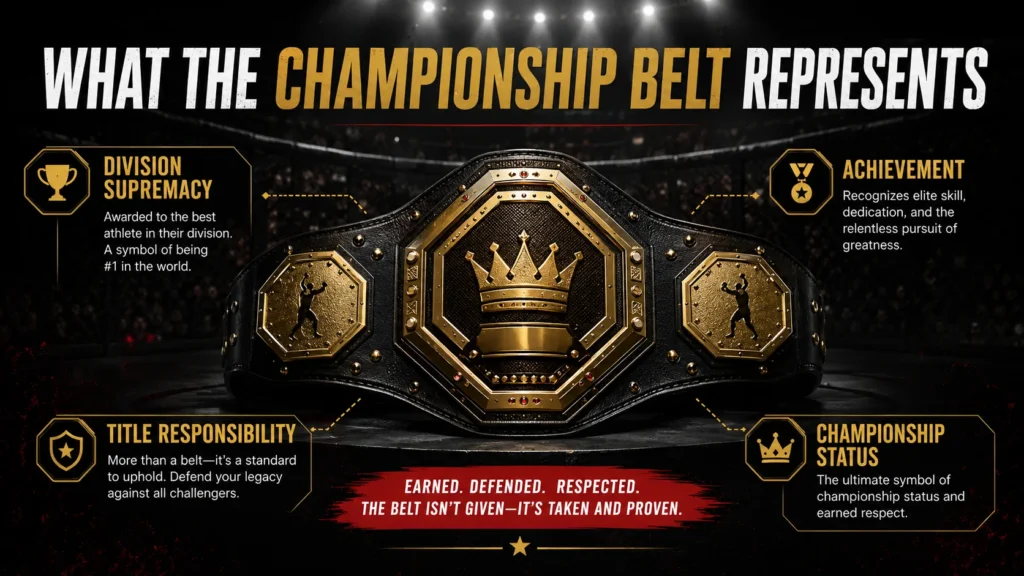
In simple terms, the UFC championship belt is the visible proof of that division’s current titleholder status.
When a fighter becomes champion, future opponents are usually discussed as challengers. The division starts to revolve around title opportunities: who deserves the next shot, who is injured, who is active, who has the strongest recent wins, and who matches up well with the champion.
Because the UFC championship belt changes how a division is discussed, fans should treat it as a status marker, not just a shiny award.
That is why the belt matters in articles about rankings, contenders, and title fights. A fighter can be highly ranked and still not be champion. Another fighter can hold the belt while fans debate whether a different contender deserves the next opportunity. The belt gives official status; the debate around the belt creates the story.
A UFC championship belt also becomes part of a fighter’s legacy. Fans remember how a champion won it, how often the champion defended it, and whether the fighter moved up or down to chase another title. For historical lists, readers should verify official event outcomes through the official UFC results page and confirmed fight records.
For history-minded readers, the UFC championship belt also becomes part of how a reign is remembered.
| Belt Term | Simple Meaning | What It Tells Fans |
| Champion | Current titleholder in a division | This fighter sits at the top of that division. |
| Challenger | Opponent fighting for the title | This fighter is trying to take the belt. |
| Title defense | Champion keeps the belt after a title fight | The champion successfully defended championship status. |
| Interim title | Temporary championship situation | The division needs movement while the undisputed champion is unavailable. |
How Fighters Become UFC Champions
Most fighters become champions by winning a title fight. The path usually starts with wins, activity, rankings movement, and strong performances against credible opponents. But there is no automatic formula that says one exact ranking position must always get the next title fight.

This is where title opportunities are different from a normal sports bracket. UFC matchmaking can consider ranking position, recent wins, injuries, availability, division depth, fan interest, and timing. The best-ranked contender often has a strong case, but a title fight still depends on the real division situation.
A fighter can become champion through several common paths:
- Beating the current champion: the direct and clearest route.
- Winning a vacant title fight: used when a belt has no active titleholder.
- Defeating an interim champion or being promoted: possible when title situations are resolved.
- Moving divisions and earning a title opportunity: possible for elite fighters, though never guaranteed.
The path depends on context. A fighter with a long winning streak may be hard to ignore. A former champion may receive a fast rematch if the first fight was close or controversial. A rising contender may need one more win if the champion is booked, injured, or waiting for a different matchup.
For a full beginner path before the title stage, readers can review how a UFC fight card is organized and how contenders appear in main events, co-main events, and title slots.
Undisputed Champion vs. Interim UFC Champion
The difference between an undisputed champion and an interim UFC champion is one of the most important things for new fans to understand.
An interim UFC champion usually enters the story when the normal title picture needs a temporary solution.
The undisputed champion is the main recognized champion of the division. This is the titleholder fans usually mean when they say “the champion.” An interim champion is used in a temporary or unusual title situation, often when the undisputed champion cannot defend the belt for a period and the division still needs an active championship fight.
An interim UFC champion is still a real champion in that interim context, but the situation is not the same as being undisputed champion. The interim title often sets up a future unification bout. In a unification fight, the interim champion and undisputed champion may fight to decide one clear champion.
A new fan should read an interim UFC champion as a serious titleholder within a specific temporary context.
This is why fans sometimes see two fighters connected to one division title story. One may be the undisputed champion, while the other holds an interim belt. The details matter, so a publish-ready article should never call both fighters the same thing without explaining the situation.
When an interim UFC champion is mentioned, the safest question is whether a unification fight or updated official status has changed the division.
| Term | Plain-English Meaning | Important Note |
| Undisputed Champion | Main recognized champion of the division | Usually the titleholder fans mean when they say champion. |
| Interim UFC Champion | Temporary titleholder during a special situation | Often created when the undisputed champion cannot defend for a time. |
| Unification Fight | Fight to combine the title situation back into one champion | Usually resolves interim vs. undisputed confusion. |
| Vacant Title | No active champion currently holds the belt | A title fight may crown a new champion. |
Important: an interim title is not a fake belt. But it is also not always the same status as the undisputed belt. That distinction is what makes UFC champions explained content useful for new fans.
The phrase interim UFC champion should always be explained with context so readers do not mistake temporary status for a fake achievement.
- UFC Rankings Explained: Easy Guide to Title Shots
- UFC Scoring Explained: Easy Guide to How Judges Score MMA Fights
- UFC Fight Rules Explained: Rounds, Fouls & Ways to Win
What a UFC Title Defense Means
A UFC title defense happens when a current champion fights a challenger and keeps the championship. If the champion wins the title fight, the champion has defended the belt. If the challenger wins, the challenger becomes the new champion and the previous champion loses the title.

Another way to say it: a UFC title defense is a champion proving the belt is still theirs after a title fight.
Title defenses are one of the main ways fans measure a champion’s reign. Winning the belt is difficult, but defending it can be even harder because every top contender is studying the champion. Each defense usually brings a new style problem, new pressure, and a new chance for the division to change.
That is why each UFC title defense adds a different layer to a champion’s resume.
A long championship reign often includes multiple title defenses against different types of opponents. A champion might defend against a wrestler, a striker, a submission specialist, or a former champion. That variety matters when fans discuss greatness.
A UFC title defense is not the same as a regular win. A champion could win non-title fights in another context, but title defenses specifically refer to keeping the championship in a title fight. For fight length and championship-round context, readers can compare title fights with the Unified Rules of Mixed Martial Arts and current commission-approved event details.
When writers count a UFC title defense, they should only count title bouts where the champion entered with the belt and left with it.
- If the champion wins: the title defense is successful.
- If the challenger wins: the belt changes hands.
- If the title is vacant: the winner may become champion, but that is not called a defense because no champion entered the fight defending the belt.
For new fans, the easiest way to read a champion’s resume is to separate three things: how the fighter won the belt, how many times the fighter defended it, and how the reign ended or continued.
A UFC title defense also helps readers compare short reigns with long reigns more fairly.
Vacant Titles, Stripped Titles, and Moving Divisions
Championships can become complicated when a belt is vacant, when a fighter leaves a division, or when a title is removed because the champion cannot defend under the needed circumstances. These situations should be explained carefully because they can confuse readers who are checking champion lists after the fact.
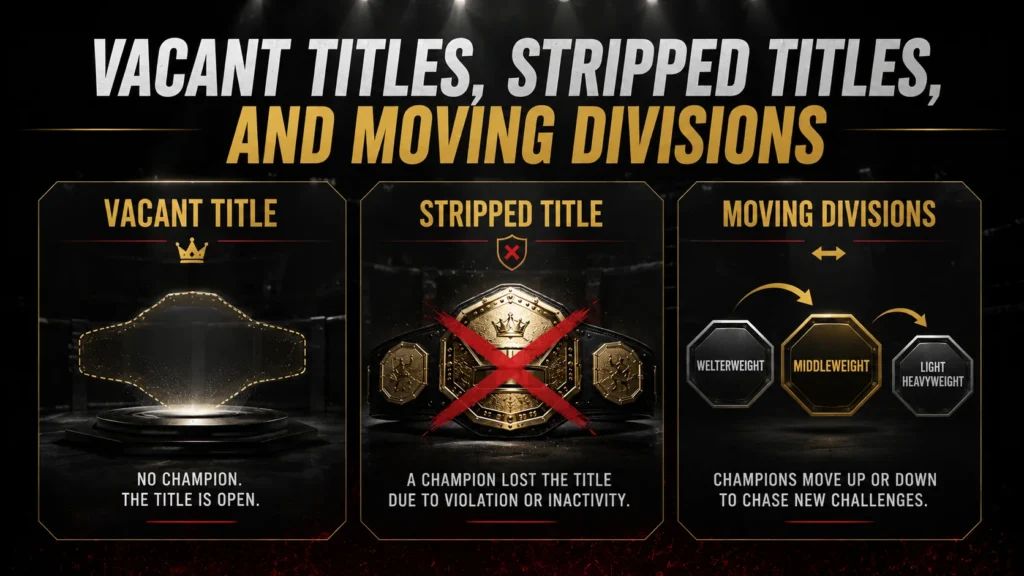
A vacant title means the division currently has no undisputed champion. This can happen when a champion retires, leaves the promotion, moves to another weight class, gives up the belt, or is otherwise no longer holding the title. In that case, the UFC can book a vacant title fight to crown a new champion.
A stripped title means the fighter is no longer recognized as champion because of a serious issue such as inability to defend, official discipline, or another circumstance determined by the promotion and athletic commission environment. Articles should avoid guessing the reason unless it is confirmed by reliable sources.
Moving divisions can also change championship status. A fighter may leave one division to chase another belt. That creates exciting storylines, but it can also reset the title picture. The previous division may need a new title fight, while the new division must decide whether the incoming fighter deserves an immediate title shot.
For body-weight context, readers can review UFC weight classes because a champion’s title is always connected to a division and its weight limit.
| Situation | What It Means | Why Readers Should Care |
| Vacant Title | No current undisputed champion | A new title fight may crown a champion. |
| Stripped Title | Champion no longer recognized as champion | Reason must be verified before publishing. |
| Moving Divisions | Fighter leaves one weight class for another | Old division and new division can both change. |
| Interim Title | Temporary championship solution | Usually points toward a future unification fight. |
Title Fights vs. Regular UFC Fights
A title fight is different from a regular UFC fight because a championship is at stake. A regular fight can affect rankings, momentum, and fan interest, but it does not directly decide who holds the belt.
A regular bout can build a resume, but the UFC championship belt is only at stake in the specific title scenario.
Title fights are normally promoted with extra attention because the result changes or protects the top of a division. They can include a champion defending against a challenger, two contenders fighting for a vacant belt, or an interim champion situation when the division needs activity.
Under the modern MMA ruleset, championship bouts are commonly scheduled for five five-minute rounds, while most non-title bouts are three rounds. UFC main events can also be five rounds even when no title is involved, so readers should check the event listing instead of assuming round count only from the title status.
For event-specific details, use the official UFC events page before publishing. Fight cards can change because of injuries, weigh-in issues, travel, commission decisions, or other real-world factors.
| Fight Type | What Is at Stake? | Beginner Note |
| Regular Fight | Rankings, momentum, future matchmaking | Important, but no belt changes hands. |
| Title Fight | Championship belt | Champion defends or a new champion is crowned. |
| Interim Title Fight | Temporary championship status | Often used when the undisputed champion is unavailable. |
| Vacant Title Fight | Open belt with no current champion | Winner usually becomes the new champion. |
Why Champions Can Change Quickly
UFC champions can change quickly because MMA is unpredictable. One clean strike, one takedown, one submission sequence, one injury, or one judges’ decision can change the top of a division. That unpredictability is part of why title fights attract attention.

A champion may look unbeatable until a challenger creates the right matchup problem. A wrestler may control a striker. A striker may punish a slow entry. A submission specialist may force a mistake. A pressure fighter may turn a close fight by winning championship rounds. This is why titles are decided in the cage, not only on paper.
This also means writers should avoid fake certainty. Do not write that a champion “will definitely” defend the belt or that one contender “cannot lose.” It is safer and more professional to say that a fighter has advantages, momentum, or a strong case, while still recognizing that MMA outcomes are uncertain.
Readers who want to check what happened after a title fight can use verified result pages and detailed fight stats. For deeper event data, the UFC Stats completed events database can help readers review official-style fight details, while the UFC results page provides clean event outcomes.
For an evergreen post, UFC champions explained should always separate current facts from long-term concepts.
- Helpful rule: explain champion status as a current fact, not a permanent guarantee.
- Helpful wording: “The champion enters as the titleholder” is safer than “The champion will keep the belt.”
- Helpful source habit: always verify champion names and event outcomes before updating live posts.
How New Fans Should Read UFC Champion Lists
Champion lists can be useful, but new fans should read them with context. A list may show current champions, former champions, interim champions, title reign length, title defenses, and championship history. Without context, those columns can look confusing.
When checking a list, the UFC championship belt should always be tied to one division and one title status.
The best way to read a champion list is to ask five questions:
If a list shows an interim UFC champion, readers should confirm whether that title has later been unified, vacated, or replaced.
- Which division is this? A champion is tied to a specific weight class.
- Is the title undisputed or interim? That changes the meaning of the belt.
- When did the fighter win it? Dates matter because title reigns change.
- How many defenses are listed? Defenses show how often a champion kept the belt.
- Is the source current? Rankings and champions can change after one event.
For readers who also want to understand post-fight information, link naturally to a guide on how to check UFC results so they can confirm what changed after fight night.
This is the practical side of UFC champions explained: the goal is not only to define terms but to help fans read real title information without confusion.
Common Beginner Mistakes About UFC Champions
Most beginner confusion comes from mixing similar championship terms. Here are the most common mistakes and the simple correction for each one.
| Beginner Mistake | Better Understanding |
| Thinking every top-ranked fighter is champion | A contender can be ranked high without holding the belt. |
| Thinking an interim champion is fake | An interim title is real in context, but it is not always the same as undisputed champion status. |
| Thinking a champion must defend every event | Title defenses depend on matchmaking, injuries, timing, and division activity. |
| Thinking a title defense equals any champion win | A title defense only happens when a champion keeps the belt in a title fight. |
| Thinking old champion lists are always current | Champion status can change after events, vacancies, or division moves. |
Another mistake is focusing only on popularity. Popularity can affect fight interest, but the UFC championship belt is held by the recognized titleholder, not simply the fighter with the loudest fanbase. A famous challenger still has to win the title fight to become champion.
A final mistake is ignoring division context. A champion at 155 pounds is not automatically champion at 170 pounds. Weight classes matter. Rankings matter. Contracted title fights matter. That is why accurate champion articles should always connect title status to division status.
- How to Check UFC Results: Simple Steps for Fans
- UFC Weight Classes Explained: A Beginner Breakdown
- UFC Fight Card Explained: How Fight Night Works
Sources of Links
| Source Name | Linked Topic / Purpose | Clean URL |
| UFC Rankings | Official rankings and division context | https://www.ufc.com/rankings |
| UFC Results | Official event outcome verification | https://www.ufc.com/results |
| UFC Events | Upcoming fight card and title-fight confirmation | https://www.ufc.com/events |
| UFC Athletes | Athlete profile verification | https://www.ufc.com/athletes/all |
| UFC Stats | Completed event and fight data support | http://www.ufcstats.com/statistics/events/completed?page=all |
| ABC Unified Rules of MMA | Rules reference for fight structure and title-fight context | https://www.abcboxing.com/wp-content/uploads/2020/02/unified-rules-mma-2019.pdf |
| InfoJustify Internal – What is UFC | Cluster support for beginner context | https://infojustify.com/what-is-ufc-a-simple-explainer-for-new-fans/ |
| InfoJustify Internal – UFC Weight Classes | Cluster support for divisions and title limits | https://infojustify.com/ufc-weight-classes-explained-a-beginner-breakdown/ |
| InfoJustify Internal – UFC Results | Cluster support for post-fight verification | https://infojustify.com/how-to-check-ufc-results-simple-steps-for-fans/ |
| InfoJustify Internal – UFC Fight Card | Cluster support for title-fight placement | https://infojustify.com/ufc-fight-card-explained-how-fight-night-works/ |
Conclusion
UFC champions explained simply: a champion is the recognized titleholder of a division, the UFC championship belt represents that status, an interim UFC champion exists during a special temporary title situation, and a UFC title defense happens when the champion keeps the belt against a challenger.
The UFC championship belt matters most when readers understand the division and the exact title situation behind it.
The most important lesson for new fans is that championship status is always connected to context. Which division is it? Is the belt undisputed, interim, vacant, or being defended? Did the champion win the title, defend it, vacate it, or lose it? Once readers understand those questions, UFC title stories become much easier to follow.
After a fight, verify whether the result was actually a UFC title defense before describing it as one.
For InfoJustify readers, this article should work as a beginner-friendly reference that supports related guides on rankings, scoring, fight cards, weight classes, and results. It avoids fake promises and keeps the focus on clean explanation, verified links, and practical fan knowledge.
That is why UFC champions explained works best when it teaches readers how to verify title status, not just memorize names.
FAQ –
1. What does UFC champion mean?
A UFC champion is the recognized titleholder of a specific UFC division. The champion holds the belt until another fighter wins it, the title becomes vacant, or another official title situation changes the championship status.
2. What is the UFC championship belt?
The UFC championship belt represents official titleholder status in a division. It shows that the fighter is the champion at that weight class, but the belt can change hands after a title fight or become vacant in special situations.
3. What is an interim UFC champion?
An interim UFC champion is a temporary titleholder created during a special situation, usually when the undisputed champion cannot defend the belt for a period. Interim champions often lead to a future title unification fight.
4. What is a UFC title defense?
A UFC title defense happens when the current champion fights a challenger and keeps the belt. If the challenger wins, the challenger becomes the new champion and the previous champion loses the title.
5. Is an interim champion the same as an undisputed champion?
No. An interim champion holds a real title in a temporary context, but the undisputed champion is the main recognized champion of the division. A unification fight may later decide one clear champion.
6. Can a UFC champion lose the belt without losing a fight?
Yes. A champion can lose or give up the belt through a vacancy, division move, inability to defend, or another official situation. The reason should always be verified with reliable sources before publishing.
7. Do rankings guarantee a UFC title shot?
No. Rankings are important, but they do not guarantee a title shot. Matchmaking can also depend on timing, injuries, availability, opponent quality, fan interest, and the champion’s situation.
- UFC Stats Explained: 7 Powerful Fight Numbers Every Fan Should Know
- UFC Champions Explained: Easy Guide to Belts & Title Defenses
- UFC Rankings Explained: Easy Guide to Title Shots
- UFC Scoring Explained: Easy Guide to How Judges Score MMA Fights
- UFC Fight Rules Explained: Rounds, Fouls & Ways to Win
- Protect Outlook OneDrive from Phishing: 9 Smart Safety Steps
- Clicked Phishing Link What to Do: 10 Recovery Steps
- How to Spot Phishing Emails: Red Flags & Examples
- FBI Alert Outlook OneDrive: Phishing Scam Explained
- What Is Phishing? Meaning, Examples & Safety Tips
- How to Improve Your Credit Score in the USA: Complete Guide
- Why Is Roland Garros So Hard to Win? Full Guide
- Roland Garros Winners List: Champions, Records & Legends
- Why Is Roland Garros Played on Clay? Court Guide
- French Open vs Roland Garros: Are They the Same Tournament?
- Roland Garros Meaning, History & Clay Court Explained
- Guzman y Gomez vs Chipotle: Menu, Taste, and Value Compared
- Chipotle Bowl vs Burrito: Which One Is Healthier?
- Chipotle Nutrition Guide: Calories, Protein & Smart Orders
- Healthiest Thing to Eat at Chipotle: Best Orders Explained