
The French Open and Roland Garros are the same tennis tournament. French Open is the English-friendly name many casual fans use, while Roland-Garros is the official tournament and stadium identity used by the event in Paris. The name comes from Stade Roland-Garros, the venue where the clay-court Grand Slam is played, and that stadium is named after Roland Garros, a French aviation pioneer and World War I hero.
- French Open vs Roland Garros: Quick Difference
- Are the French Open and Roland Garros the Same Tournament?
- Why Does the Tournament Have Two Names?
- What Does “French Open” Mean?
- What Does “Roland Garros” Mean?
- Why Is the Stadium Called Roland-Garros?
- How US Fans and Broadcasters Use Both Names
- French Open vs Roland Garros Comparison Table
- Why the Name Confusion Matters for New Tennis Fans
- Why Roland-Garros Uses a Hyphen
- Is One Name More Correct Than the Other?
- Why the French Open Is So Closely Linked With Clay
- Common Search Questions Around the Name
- Simple Explanation for Beginners
- Why This Topic Is Evergreen
- Clean Source List –
- Conclusion
- FAQ –
French Open vs Roland Garros: Quick Difference
The simplest difference between French Open vs Roland Garros is naming. French Open is the name that explains the tournament quickly for English-speaking sports fans. Roland-Garros is the official event identity connected to the Paris stadium, the tournament brand, and the historical person behind the stadium name.
For readers in the United States, French Open usually feels easier because it follows the same naming pattern as the US Open and Australian Open. You can hear it once and immediately understand that it is France’s major tennis championship. Roland Garros feels less obvious because it sounds like a person’s name, and that is exactly why many new fans get confused.
The important point is that both names point to the same Grand Slam. If you see a broadcaster say French Open and then see an official schedule say Roland-Garros, you are not looking at two different competitions. You are seeing two ways of naming the same event.
This naming confusion becomes common every spring when tennis coverage increases. Casual fans may search for French Open explained, while regular tennis fans may search Roland Garros tournament, draw, results, or schedule. A helpful explanation should connect both names clearly instead of treating them as separate topics.
Are the French Open and Roland Garros the Same Tournament?
Yes, the French Open and Roland Garros are the same tournament. The event is one of tennis’s four Grand Slam tournaments, along with the Australian Open, Wimbledon, and the US Open. WTA’s Roland Garros overview describes the French Open as also known as Roland Garros and notes its clay-court Grand Slam identity.
The official tournament identity uses Roland-Garros, while English-speaking media and casual fans often use French Open. Both are correct. The best term depends on the context. A general sports fan may recognize French Open faster, while a tennis fan may be more used to seeing Roland-Garros in official tournament coverage.
This is why the search question “is Roland Garros the French Open” has such strong evergreen value. Every season, new fans see both names and want a direct answer. The answer should be given quickly: yes, Roland Garros is the French Open.
After that quick answer, the deeper explanation is about why the names developed differently. One name points to the national championship identity. The other points to the venue and the historical figure honored by that venue. Together, they tell the full story of the tournament.
- Ebola Outbreak 2026: Bundibugyo Virus Explained & Related Topic
- Types of Yoga: 30 Powerful Styles Explained
- What is Cloud Storage ? 7 Best Basics
Why Does the Tournament Have Two Names?
The tournament has two names because one name works as a broad English label, while the other reflects the official French tournament identity. French Open is simple, descriptive, and easy to understand. Roland-Garros carries venue history, French identity, and official branding.
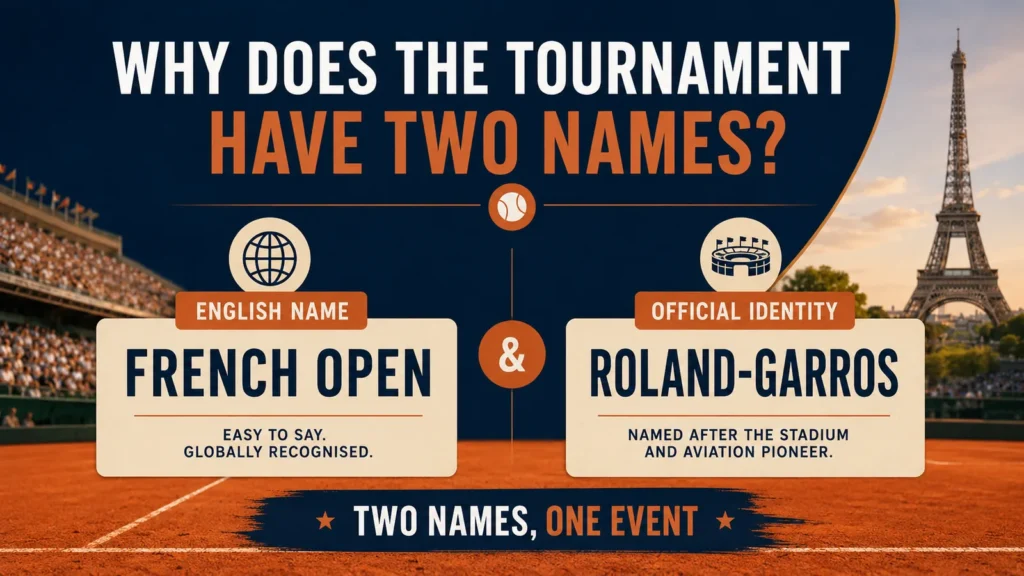
The phrase French Open tells readers that this is France’s major open tennis championship. It follows a familiar sports naming pattern. A reader who knows the US Open can understand the French Open without needing extra background knowledge.
Roland-Garros works differently. It is tied to Stade Roland-Garros, the Paris stadium complex where the tournament is played. The stadium was named in honor of Roland Garros, not because he was a tennis champion, but because he was a notable French aviator and First World War hero.
Over time, the stadium name became so closely connected with the event that Roland-Garros became the tournament’s official global identity. Today, the tournament’s website, social channels, graphics, and official coverage lean strongly into the Roland-Garros name.
This dual naming is not unusual in sports, but it can feel unusual for beginners. In the United States, a person may say US Open when talking about the tournament and Flushing Meadows when talking about the venue area. In Paris tennis, Roland-Garros became both venue identity and tournament identity.
What Does “French Open” Mean?
The French Open name means France’s open tennis championship. In modern tennis, an open tournament is one that allows professional players to compete under official entry rules. For everyday fans, the phrase simply means the major international tennis tournament held in France.
The name is helpful because it gives the reader instant context. It tells you the country, the sport type, and the event style. That is why many US outlets and casual sports discussions still use French Open when speaking to broad audiences.
It also fits neatly into the Grand Slam calendar. Fans often learn the four major tournaments in order: Australian Open, French Open, Wimbledon, and US Open. That naming pattern makes French Open easier for beginners than Roland-Garros, which requires a little historical explanation.
The phrase French Open explained usually carries beginner search intent. Readers do not only want the name. They want to know what the tournament is, where it is played, why it is important, and why the name Roland Garros appears everywhere during the event.
So, French Open is not a wrong or unofficial fan nickname. It is a widely understood English name for the same tournament. Roland-Garros is the official identity, but French Open remains extremely useful for reader clarity, headlines, and beginner education.
What Does “Roland Garros” Mean?
Roland Garros refers to the tournament identity, the Paris tennis stadium, and the historical figure behind the stadium name. In everyday tennis coverage, when people say Roland Garros, they usually mean the French Open tournament.
The official Roland-Garros page about the man explains that the French Open stadium was not named after a tennis champion. That point is important because many beginners assume Roland Garros must have been a famous tennis player. He was not. He was a French aviation pioneer and war hero.
That story makes the name more memorable. The tournament does not only carry a sports identity. It also carries a piece of French history. This is one reason Roland-Garros feels different from tournament names that are based only on a country, city, or sponsor.
The Roland Garros tournament name became globally famous because the French Open is played at Stade Roland-Garros. The venue and the event became inseparable in the minds of tennis fans. When fans see red clay, Paris, and Roland-Garros together, they immediately think of the French Open.
For SEO and reader clarity, it is useful to use both forms naturally: Roland Garros without the hyphen because many people type it that way, and Roland-Garros with the hyphen when referring to the official tournament brand or stadium identity.
Why Is the Stadium Called Roland-Garros?
Stade Roland-Garros is named after Roland Garros, a French fighter pilot remembered for aviation achievements and service during the First World War. The official stadium page says the complex was inaugurated in 1928, the year it hosted the Internationaux de France for the first time.

The same stadium source describes Roland-Garros stadium as an emblematic tennis venue in Paris’s 16th arrondissement. It also explains that the tournament became one of the world’s prestigious Grand Slam events and stands out because it is played on clay.
This matters because the stadium name explains the tournament name. The French Open is played at Stade Roland-Garros, so the event became widely known as Roland-Garros. The name is not random, and it is not a separate tournament. It is the venue identity becoming part of the tournament identity.
For new fans, this is the cleanest explanation: Roland Garros was a person; Stade Roland-Garros is the stadium named after him; Roland-Garros is the official tournament identity; French Open is the English name many fans use for the same event.
How US Fans and Broadcasters Use Both Names
In the United States, casual fans often use French Open because the name is easier to understand quickly. A sports fan who mostly follows football, basketball, baseball, or college sports may immediately understand “French Open” as a major international tennis event in France.
Tennis-focused audiences are more likely to use Roland Garros because that is the language of official tournament branding and global tennis coverage. Draws, match highlights, on-site signage, tournament social posts, and many tennis reports use Roland-Garros or Roland Garros regularly.
This split creates a real search pattern. A beginner might ask, “Why is the French Open called Roland Garros?” A tennis fan might ask, “Is Roland Garros the French Open?” Both questions are really asking the same thing from different angles.
A strong article for a US audience should respect both search behaviors. It should open with the direct answer, then use simple examples to show why both names are correct. That makes the content helpful for beginners and still accurate for tennis fans.
This is also why the headline French Open vs Roland Garros works well. The word “vs” signals a comparison, but the article quickly clarifies that the difference is not a rivalry. It is a naming difference.
French Open vs Roland Garros Comparison Table
This table gives readers a quick beginner-friendly comparison. The main takeaway is simple: French Open vs Roland Garros is not a rivalry between two events. It is a naming difference for the same tournament.
| Comparison Point | French Open | Roland Garros |
| Meaning | English name for France’s Grand Slam | Official tournament and venue identity |
| Best for | Casual and beginner audiences | Official and tennis-specific context |
| Name origin | France as host country | Roland Garros, French aviator and war hero |
| Event level | Grand Slam | Grand Slam |
| Venue | Stade Roland-Garros | Stade Roland-Garros |
| Surface | Clay | Clay |
| Reader memory trick | Country + event | Venue + official identity |
Why the Name Confusion Matters for New Tennis Fans
The name confusion matters because it can make a major sports event feel harder to follow than it really is. If a new fan hears “French Open” on one platform and “Roland-Garros” on another, they may think they are seeing two different tournaments.
That confusion can reduce interest. A casual viewer may skip an article or video if the basic name is not clear. This is why a short, direct explanation near the top is important. It helps the reader feel oriented before the article goes deeper into history, venue, and tradition.
The name also matters because Roland-Garros is not only a tournament label. It connects to the venue, the clay-court surface, French sports culture, and the event’s unique identity among the four Grand Slams.
Once a beginner understands the name, the rest of the tournament becomes easier to enjoy. They can follow schedules, draws, highlights, winners, and clay-court discussions without wondering whether French Open and Roland Garros are separate events.
For InfoJustify, this is exactly the kind of evergreen explainer that can help readers every year. The tournament season changes, but the question behind the name remains useful and searchable.
Why Roland-Garros Uses a Hyphen
You may notice that the official tournament branding often uses Roland-Garros with a hyphen. In casual English writing, many people type Roland Garros without the hyphen. Both forms are commonly understood by readers and search engines.
For a blog article, the best approach is practical. Use Roland Garros naturally in regular sentences because that matches common search behavior. Use Roland-Garros when talking about the official event identity, the stadium name, or the tournament’s own branding style.
This keeps the article readable and accurate at the same time. It avoids making every sentence look too formal while still respecting the way the tournament presents itself.
For Rank Math and SEO, the non-hyphenated version is usually easier because most readers search without typing the hyphen. However, sprinkling the official hyphenated version where natural can support trust and precision.
Is One Name More Correct Than the Other?
Both names are correct, but they are useful in different situations. French Open is best when you are speaking to broad English-speaking audiences or writing a beginner-friendly sports explanation. Roland-Garros is best when referring to the official tournament brand, official website, stadium identity, and tennis-specific coverage.
If you are talking casually with a friend in the United States, saying French Open is perfectly normal. If you are looking at the official tournament site or a tennis broadcast graphic, Roland-Garros may be the version you see more often.
A clean sentence that solves the issue is: The French Open, officially known as Roland-Garros, is the clay-court Grand Slam held every year in Paris.
That one sentence includes both names, answers the main confusion, and gives the reader location and surface context. It is also a strong opening explanation for beginner content.
Why the French Open Is So Closely Linked With Clay
The name question often leads to another question: why is the French Open so closely connected with clay? The answer is that Roland-Garros is the only Grand Slam currently played on clay, which gives the tournament a very different playing style from the Australian Open, Wimbledon, and the US Open.
Clay courts slow the ball down, create a higher bounce, and make rallies longer. Players need patience, footwork, sliding movement, endurance, and tactical control. This is why the French Open often feels more physical and strategic than faster-court tournaments.
Even though this article focuses on names, the clay connection helps explain why Roland-Garros has such a strong identity. The red clay, Paris venue, and official Roland-Garros branding all work together to create an event that tennis fans recognize instantly.
For beginners, this is useful context. French Open tells you the country. Roland-Garros tells you the venue and identity. Clay tells you why the tournament feels so different on the court.
Common Search Questions Around the Name
People search for this topic in several ways because the confusion appears in different forms. Some type French Open vs Roland Garros. Others type is Roland Garros the French Open, French Open name meaning, Roland Garros tournament explained, or why is the French Open called Roland Garros.
All of those searches share the same intent. The reader wants a quick answer first and a simple explanation second. They do not want a complicated tennis history lesson before the basic question is solved.
That is why this article starts with the answer immediately, then expands step by step. This structure is helpful for readers and also supports featured-snippet style search results.
A good beginner explainer should also avoid overusing the focus keyword. The phrase French Open vs Roland Garros is important, but the article should still sound natural. Related phrases like French Open explained, Roland Garros tournament, and French Open name meaning can support the topic without making the writing feel forced.
Simple Explanation for Beginners
Here is the easiest way to remember the difference. The French Open is the tournament name that many English-speaking fans use. Roland Garros is the official identity connected to the stadium and tournament brand. They refer to the same Grand Slam event in Paris.
A casual fan may say, “I am watching the French Open.” A tennis fan may say, “I am watching Roland Garros.” Both are talking about the same event.
The tournament is especially famous because it is played on clay. That surface makes the matches slower, longer, and more physically demanding. So when you hear Roland Garros, you should think of Paris, red clay, long rallies, and Grand Slam tennis.
The name may seem confusing at first, but once you know the story, it becomes simple. French Open explains the event in English. Roland-Garros honors the stadium and the historical figure behind it.
- Roland Garros Meaning, History & Clay Court Explained
- Guzman y Gomez vs Chipotle: Menu, Taste, and Value Compared
- Chipotle Nutrition Guide: Calories, Protein & Smart Orders
- Kyle Busch Pneumonia Sepsis: Cause of Death Explained
Why This Topic Is Evergreen
The French Open vs Roland Garros question is evergreen because new tennis fans ask it every year. Every spring, the tournament returns to the sports conversation. Viewers see both names across TV, social media, official schedules, search results, and highlight videos.
Unlike live scores or daily schedules, the name explanation does not expire quickly. The champions change, the draw changes, and the match results change, but the relationship between French Open and Roland-Garros stays the same.
That makes this article valuable as a cluster post under a broader Roland Garros content plan. It can support a main pillar article about what Roland Garros is, a clay-court explainer, a winners-list article, and a difficulty-based article about why Roland Garros is so hard to win.
This kind of content is strong for long-term SEO because it solves a repeat beginner question. It also creates a natural internal linking path for readers who want to learn more about the tournament.
Clean Source List –
– Roland-Garros official history page
– Official Roland-Garros page about Roland Garros the aviator
– Stade Roland-Garros official stadium page
– WTA Roland Garros tournament overview
– Encyclopaedia Britannica French Open overview
Conclusion
The French Open vs Roland Garros difference is simple once the naming is explained. They are not two different tournaments. They are two names connected to the same Grand Slam tennis event in Paris.
French Open is the English-friendly name that many casual fans in the United States understand quickly. Roland-Garros is the official tournament and stadium identity, named after Roland Garros, a French aviation pioneer and First World War hero.
So if you see French Open in a headline and Roland-Garros on an official schedule, do not get confused. Both point to the same clay-court Grand Slam, one of the most historic and unique tournaments in tennis.
For new fans, the easiest memory trick is this: French Open explains the country and event, while Roland-Garros explains the official venue identity. Together, they describe the same tournament.
FAQ –
1. Is Roland Garros the French Open?
Yes. Roland Garros and the French Open refer to the same Grand Slam tennis tournament held in Paris, France.
2. Why is the French Open called Roland Garros?
The French Open is called Roland Garros because it is played at Stade Roland-Garros, a Paris stadium named after French aviator and First World War hero Roland Garros.
3. Was Roland Garros a tennis player?
No. Roland Garros was not a tennis player. He was a French aviation pioneer and First World War hero.
4. Which name should I use: French Open or Roland Garros?
Both names are correct. French Open is easier for casual English-speaking fans, while Roland-Garros is the official tournament and stadium identity.
5. Where is Roland Garros played?
Roland Garros is played at Stade Roland-Garros in Paris, France.
6. Why do US fans often say French Open?
US fans often say French Open because it is easier to understand as France’s Grand Slam tournament, similar to the US Open or Australian Open.
7. Is Roland-Garros written with a hyphen?
The official tournament branding often uses Roland-Garros with a hyphen, but many readers search and write Roland Garros without the hyphen. Both forms are commonly understood.
- Why Is Roland Garros So Hard to Win? Full Guide
- Roland Garros Winners List: Champions, Records & Legends
- Why Is Roland Garros Played on Clay? Court Guide
- French Open vs Roland Garros: Are They the Same Tournament?
- Roland Garros Meaning, History & Clay Court Explained
- Are AI voices safe for YouTube monetization
- Realistic Indian Accent AI Voices for Free: 3 Best Tools
- ElevenLabs Free Alternatives for Emotional Voices: 3 Picks
- Best Free AI Voice Generators for Faceless YouTube Shorts
- Top 5 Free AI Voice Generator Realistic Tools
- Free AI Video Generators Without Watermark: 2026 Truth
- AI vs Machine Learning: Powerful 2026 Career Truth
- Generative AI Uses and Risks: 11 Real-Life Lessons for Beginners
- What is Generative AI? 12 Powerful Basics for Beginners
- What is AI? 11 Powerful Basics Every Beginner Should Know
3 thoughts on “French Open vs Roland Garros: Are They the Same Tournament?”