
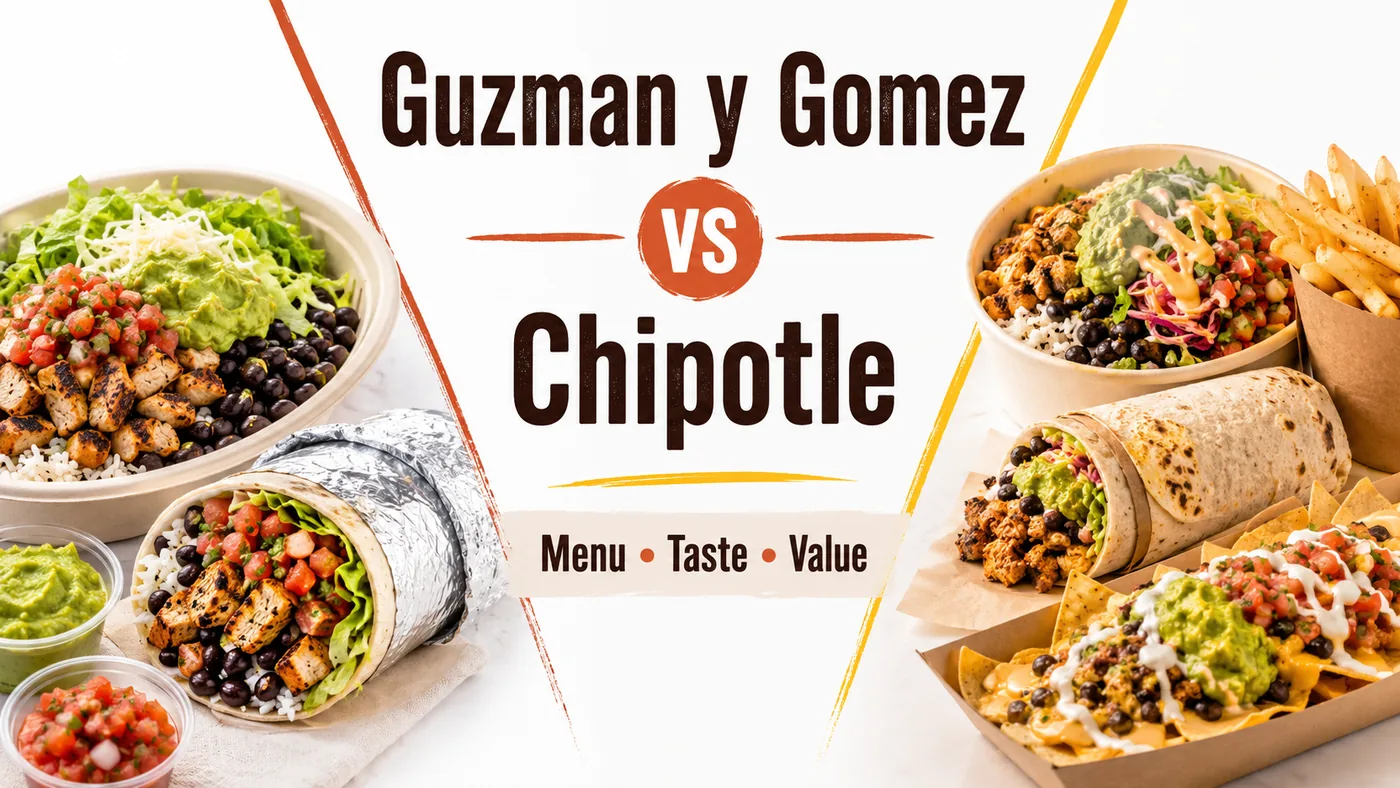
Chipotle is the more practical choice for most U.S. readers because it has stronger U.S. access, a simpler customization model, a useful nutrition calculator, and a very familiar bowl/burrito ordering flow. Guzman y Gomez is more interesting as an international comparison brand with a broader Mexican-style menu personality and a strong “fresh food” brand message. If you searched GYG vs Chipotle, this quick verdict gives the practical answer first.
If you are comparing the brands for taste, GYG may appeal to people who want more restaurant-style Mexican fast food with items such as burritos, bowls, nachos, quesadillas, fries, and sides depending on market availability. Chipotle may appeal to readers who want a cleaner build-your-own line where the decision is mostly format, protein, rice, beans, salsa, and toppings.
For most U.S. searchers, the winner is Chipotle for availability and ordering practicality. For global readers in Australia, Singapore, or Japan, GYG may be a stronger everyday option because the brand is active in those markets and has a clearer local presence there.
| Category | Better Fit | Why It Matters |
| U.S. availability | Chipotle | Chipotle is easier for most U.S. readers to find and order. |
| Global comparison interest | GYG | GYG is useful for readers comparing international Mexican fast-casual brands. |
| Nutrition tools | Chipotle | Chipotle provides a clear nutrition calculator and U.S. nutrition facts PDF. |
| Menu variety feel | GYG | GYG often feels broader, with items such as nachos, fries, and more market-specific choices. |
| Simple build-your-own flow | Chipotle | Chipotle keeps the decision easy: bowl, burrito, tacos, salad, protein, and toppings. |
- Introduction
- U.S. Availability Update
- What Is Guzman y Gomez?
- What Is Chipotle?
- Menu Comparison
- Taste and Freshness Comparison
- Nutrition and Customization
- Price, Value, and Portion Logic
- Ordering Experience, App, Rewards, and Catering
- Which Brand Is Better for Different Customers?
- How to Compare a Meal Fairly
- Best Orders to Compare Side by Side
- Business and Brand Positioning
- Common Mistakes When Comparing These Brands
- Final Comparison Table
- Conclusion
- FAQs –
Introduction
The Guzman y Gomez vs Chipotle comparison is not just a simple burrito battle. Both brands sit inside the Mexican fast-casual space, but they feel different in menu personality, availability, ordering style, nutrition tools, and brand strategy. Chipotle is a familiar U.S. name with a strong bowl-and-burrito system, while Guzman y Gomez, often called GYG, has built a major identity outside the United States around fresh, made-to-order Mexican-inspired food.
For U.S. readers, the most important starting point is availability. Chipotle remains widely accessible in the United States through restaurants, app ordering, group orders, and catering options. GYG has a global presence, but recent U.S. availability changed sharply, so readers should not assume the two brands are equally easy to order from in America.
This guide compares menu style, taste, nutrition, value, convenience, and who each brand fits best. It is written as a practical food decision guide, not as a fan argument. The goal is simple: help readers understand which brand makes more sense for their actual location, appetite, budget, and ordering goal. This Mexican fast casual comparison is built around real ordering decisions, not just brand popularity.
U.S. Availability Update
A fair Guzman y Gomez vs Chipotle comparison has to mention current availability. NBC Chicago reported that Guzman y Gomez announced it was exiting the U.S. market and closing its Chicago-area operations in May 2026. That means U.S. readers should treat GYG as a comparison brand, not as an equally available local option.
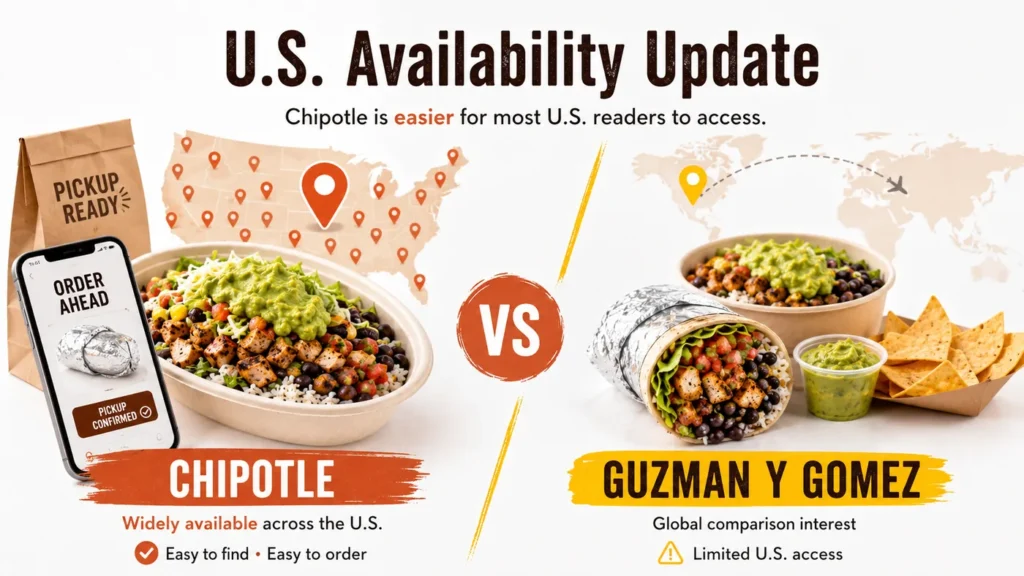
For current availability, check GYG’s official website and local market pages before making any ordering decision. For the U.S. closure context, the NBC Chicago report is included in the source list for transparency.
This availability detail also changes the article’s practical verdict. If you live in the U.S., Chipotle is usually the easier choice. If you live in a market where GYG operates, the comparison becomes more about taste, menu style, value, and how much variety you want beyond the standard bowl or burrito experience.
What Is Guzman y Gomez?
Guzman y Gomez is an Australian-born quick-service restaurant brand focused on Mexican-inspired food. Its investor information describes GYG as a fast-growing QSR business delivering clean, fresh, made-to-order Mexican-inspired food, and says the brand opened its first restaurant in Sydney in 2006 and expanded to more than 200 restaurants globally.
The brand’s official investor page gives useful background on its growth story and positioning; readers can review the GYG Investor Centre for company-level context. For menu context, the GYG Our Food page shows how the brand presents burritos, sides, and ingredient-led menu items.
What makes GYG different from Chipotle is the feeling of the menu. GYG often looks more like a broader Mexican-style quick-service restaurant, while Chipotle feels more like a focused build-your-own bowl and burrito system. That difference matters because one brand may feel more flexible, while the other may feel simpler and faster to understand.
What Is Chipotle?
Chipotle is a U.S.-based Mexican fast-casual brand built around a straightforward customization model. A typical Chipotle order starts with a burrito, bowl, tacos, salad, or quesadilla, then the customer adds protein, rice, beans, salsa, vegetables, cheese, sour cream, guacamole, queso, and other extras.
The official Chipotle menu and ordering site also highlights catering, group ordering, rewards, and nutrition access, which makes it convenient for repeat customers. Chipotle’s structure is easy to understand because it does not require customers to study a large fixed-meal menu before ordering.
The big advantage for U.S. readers is familiarity. Most people understand the Chipotle line quickly: pick a format, choose protein, add rice or beans, choose salsas, and decide whether the richer toppings are worth it. That simplicity is one reason Chipotle remains a strong reference point for Mexican fast-casual comparisons.
- Chipotle Bowl vs Burrito: Which One Is Healthier?
- Chipotle Nutrition Guide: Calories, Protein & Smart Orders
- Healthiest Thing to Eat at Chipotle: Best Orders Explained
Menu Comparison
The menu comparison is where the two brands feel most different. Chipotle is more focused. It gives customers a small number of meal formats and lets them build around ingredients. GYG, depending on market, can feel broader because it often includes burritos, bowls, tacos, nachos, quesadillas, fries, dips, sides, breakfast items, and market-specific limited options.
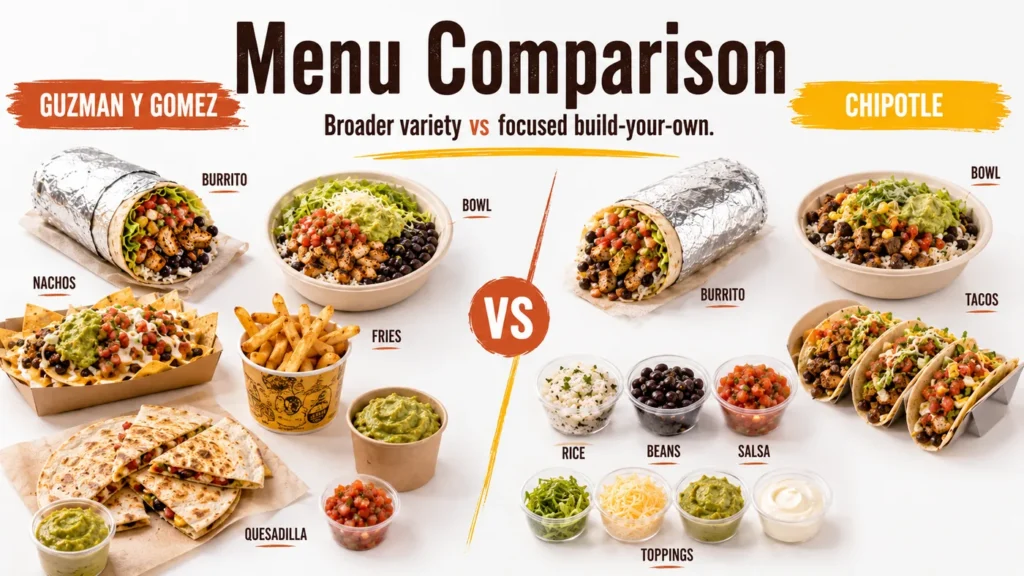
That does not automatically make one better. A bigger menu can be exciting, but it can also make the first order harder. A tighter menu can feel repetitive, but it can also be easier for people who want to order fast and repeat a favorite meal without overthinking.
If you want one predictable order every week, Chipotle may be easier. If you like exploring more menu categories and market-specific items, GYG may feel more interesting where it is available.
| Menu Area | Chipotle | Guzman y Gomez |
| Core format | Burrito, bowl, tacos, salad, quesadilla | Burritos, bowls, tacos, nachos, quesadillas, sides, and market-specific items |
| Customization style | Ingredient-by-ingredient build-your-own flow | More varied menu feel with customization depending on item and market |
| Best for | Fast repeat orders and clear nutrition tracking | Variety seekers and international fast-casual comparison readers |
| U.S. practicality | Strong | Limited by current U.S. availability changes |
Taste and Freshness Comparison
Taste is subjective, but the brand experiences are not identical. Chipotle usually tastes like a fresh assembly-line meal where the main flavor comes from the protein, rice, beans, salsa, guacamole, cheese, sour cream, and queso choices. It is simple, repeatable, and easy to adjust one topping at a time.
GYG’s brand message leans heavily into fresh, made-to-order Mexican-inspired food. Its 2026 nutrition and allergen guide says GYG kitchens are full of fresh ingredients prepared and cooked in-store daily, while also warning that nutrition can vary because of supplier, seasonal, and product variations.
For readers who care about ingredient and allergen details, the GYG nutrition and allergen guide is the source to check. For Chipotle, the Chipotle nutrition facts PDF gives ingredient-level nutrition context and notes that nutrition may vary by portion size, recipes, seasons, and ingredient sources.
In plain language, Chipotle wins on easy predictability, while GYG may win for people who want a broader “fast Mexican” menu feeling. The best taste choice depends on whether you prefer a controlled bowl-building process or a more varied menu style.
Nutrition and Customization
Nutrition is one of the most important parts of the comparison because both restaurants can be light or heavy depending on the order. A bowl with lean protein, beans, vegetables, and salsa can be balanced. A burrito or nacho-style meal with rice, cheese, sour cream, queso, guacamole, chips, and a sugary drink can become much larger.
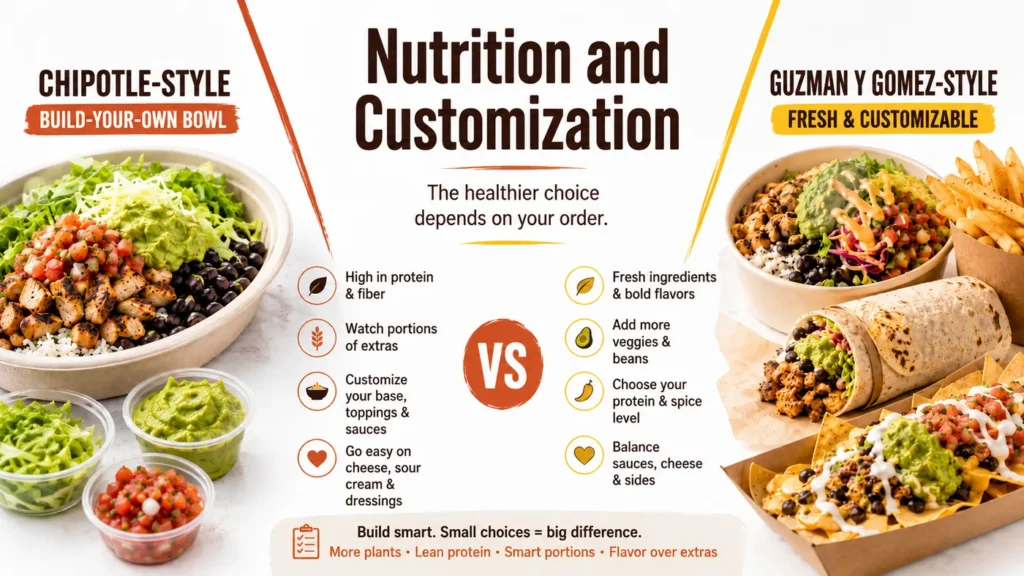
Chipotle has a strong advantage for U.S. nutrition planning because customers can build orders with the Chipotle nutrition calculator. GYG provides detailed nutrition and allergen information in PDF format, but users may need to manually compare items depending on their market.
The healthiest choice is not always about the brand. It is about the format, protein, sides, sauces, and portion choices. A Chipotle bowl can be balanced or heavy. A GYG bowl can also be balanced or heavy. The brand matters less than the build.
For sodium-conscious readers, be careful with tortillas, seasoned proteins, salsas, queso, chips, and sides. Restaurant meals can stack sodium quickly, and readers who need a medically lower-sodium diet should follow professional guidance rather than relying on a general food comparison article.
Price, Value, and Portion Logic
Price and value are hard to compare nationally because menu pricing changes by location, delivery method, tax, market, promotions, and limited-time offers. Chipotle’s own nutrition PDF tells customers to check local menu boards for pricing, which is a useful reminder for any restaurant comparison.
Value is not only the cheapest price. A bowl that becomes two meals can be a better value than a cheaper order that leaves you hungry. A burrito can be a better value for people who need a portable, filling meal. Nachos, fries, chips, queso, or premium extras can make the meal more fun but also raise the total cost.
The best value order is the one that matches your actual use case. For a quick work lunch, a predictable Chipotle bowl may win. For a more indulgent meal in a GYG market, a broader menu item may feel more worth it.
Ordering Experience, App, Rewards, and Catering
Chipotle has a strong U.S. convenience advantage because the brand supports online ordering, app ordering, rewards, group orders, and catering. Its official homepage describes catering for groups and group ordering for up to 15 meals, which is helpful for offices, families, and small teams.
Chipotle also promotes a Rewards program where members earn points toward rewards. GYG also has its own app and rewards ecosystem in markets where it operates, but U.S. readers should confirm local availability before comparing rewards value.
Ordering experience matters because most fast-casual decisions are practical. People want a meal that is easy to understand, easy to repeat, and easy to customize without slowing down the line. Chipotle’s system is especially strong for that kind of repeat behavior.
Which Brand Is Better for Different Customers?
Chipotle is better for U.S. readers who want accessibility, predictable ordering, nutrition tools, and an easy bowl or burrito workflow. It is also better for people who already know their favorite protein, rice, beans, salsa, and topping combination.
GYG is better for readers in active GYG markets who want a broader menu personality and a different fast-Mexican experience. It may also be more interesting for people comparing restaurant business models, international expansion, and brand positioning.
For health-conscious customers, the winner is whichever order is built more carefully. Choose a bowl or lighter format, prioritize protein and vegetables, use salsa for flavor, and treat cheese, sour cream, queso, guacamole, fries, chips, and sweet drinks as intentional extras.
| Customer Goal | Better Fit | Reason |
| U.S. quick lunch | Chipotle | Easier to find and repeat. |
| International fast-casual curiosity | GYG | More useful as a global brand comparison. |
| Nutrition tracking | Chipotle | Calculator and U.S. nutrition PDF make planning easier. |
| Menu variety | GYG | Broader menu personality in active markets. |
| Simple custom bowl | Chipotle | Fewer decisions and a cleaner ordering flow. |
How to Compare a Meal Fairly
A fair comparison is not “one brand’s lightest bowl” against “the other brand’s biggest burrito.” That kind of comparison is entertaining, but it does not help real readers. To compare honestly, match the same goal on both sides: a light lunch, a high-protein meal, a comfort-food meal, or a portable meal.
For example, a Chipotle chicken bowl with beans, salsa, vegetables, and controlled toppings should be compared with a similar GYG bowl or lighter menu build, not with loaded nachos or a large burrito with fries. The same rule works in reverse. A fully loaded Chipotle burrito should not be compared against the cleanest possible GYG bowl.
For sodium, use official numbers and the FDA sodium guide as context. FDA guidance explains that 5% Daily Value or less is low and 20% Daily Value or more is high, which helps readers understand why restaurant meals can add up quickly even when ingredients look fresh.
The fair method is goal first, format second, toppings third. Once the goal is clear, the better brand becomes easier to choose because you are comparing like-for-like meals instead of random menu items.
Best Orders to Compare Side by Side
If a reader has access to both brands, the best way to compare them is to order similar formats. Start with a chicken bowl against a chicken bowl, a steak burrito against a steak burrito, or a vegetarian build against a vegetarian build. Then compare freshness, portion control, flavor, price, and how you feel after the meal.
A balanced Chipotle test order could be a bowl with chicken, brown rice or light rice, black beans, fajita vegetables, fresh tomato salsa, and lettuce. A comparable GYG test order would be a bowl-style meal with a similar protein, rice, beans, salsa-style ingredients, and controlled rich extras where available.
For a comfort-food test, compare a fuller burrito from each brand. In that case, the question is not which is lighter. The question is which one tastes better, feels more satisfying, travels better, and gives better value for the appetite you had that day.
| Comparison Goal | Chipotle Test Order | GYG Test Order | What to Judge |
| Balanced lunch | Chicken bowl with beans, vegetables, salsa, and lettuce | Similar bowl-style build with protein, rice, beans, and fresh toppings | Freshness, fullness, and ease of repeat ordering |
| Portable meal | Burrito with protein, rice, beans, and salsa | Burrito with similar fillings | Taste, portability, and value |
| Vegetarian meal | Sofritas or beans with rice, vegetables, salsa, and guacamole | Vegetarian build where available | Flavor, protein, fiber, and satisfaction |
| Indulgent meal | Burrito, queso, chips, or richer toppings | Nachos, fries, queso, or fuller burrito-style item | Taste, comfort, and price expectations |
Business and Brand Positioning
This article also has a business angle because Chipotle and Guzman y Gomez are not at the same stage in the United States. Chipotle is an established U.S. fast-casual brand with a deeply familiar ordering model. GYG is a major international name, but its U.S. story has been more difficult and availability changed in 2026.
That context matters for readers who follow restaurant trends. A brand can have good food and still struggle in a crowded market if customer awareness, real estate, labor, supply costs, marketing costs, and local competition make growth difficult. The U.S. Mexican fast-casual category is competitive, so expanding there is not only about having a strong burrito.
For InfoJustify readers, the business lesson is simple: Chipotle wins the U.S. practicality test because it is already built into many American routines. GYG remains important as a global comparison brand because it shows how different markets can respond differently to a similar fast-casual idea.
Food comparison and business comparison are not the same thing. A reader may prefer GYG’s flavor where available, while still recognizing that Chipotle is currently the more practical U.S. option. Some readers search Chipotle vs Guzman y Gomez from a business angle, while others only want the better lunch choice.
Common Mistakes When Comparing These Brands
The first mistake is treating the comparison as if both brands are equally available to every U.S. reader. They are not. Availability changes the practical answer before taste or value even enters the discussion.
The second mistake is comparing one heavy order from one brand against one light order from the other. A fully loaded burrito, nachos, fries, queso, or chips can change the nutrition profile quickly. The comparison must use similar goals, not random meals.
The third mistake is assuming “fresh” always means lower calorie. Fresh ingredients can still create a large meal when portions, sauces, cheese, dips, and sides stack together. Freshness is valuable, but it does not replace portion awareness.
The fourth mistake is ignoring allergens. Chipotle warns that individual foods may come into contact during preparation and cannot guarantee complete absence of allergens. GYG also warns that removing an ingredient may not eliminate its presence and that kitchen ingredients may be present in menu items.
Readers with food allergies should review Chipotle allergen information and the GYG allergen guide before ordering. This article is not medical advice, and severe allergy decisions should be handled with official restaurant guidance and personal medical advice.
- Chipotle Mexican Grill Menu Explained: Best Items to Try
- Social Security Payment Schedule 2026: Dates by Birth Date
- Kyle Busch Pneumonia Sepsis: Cause of Death Explained
Final Comparison Table
| Area | Chipotle | Guzman y Gomez | Practical Winner |
| U.S. access | Strong U.S. presence | U.S. operations reportedly closed in 2026 | Chipotle |
| Menu style | Focused build-your-own bowls and burritos | Broader Mexican fast-food feel in active markets | Depends on taste |
| Nutrition tools | Calculator plus U.S. PDF | Detailed nutrition/allergen guide | Chipotle for U.S. users |
| Taste personality | Predictable, customizable, familiar | More varied and market-specific | Depends on preference |
| Value logic | Best when you build a repeatable order | Best when menu variety fits your appetite | Depends on order |
| Best audience | U.S. lunch, quick dinner, predictable meal | Global readers and active-market customers | Mixed |
Conclusion
The Guzman y Gomez vs Chipotle comparison has two answers. For most U.S. readers, Chipotle is the more practical choice because it is easier to access, easier to customize, and easier to track through official nutrition tools. For readers in active GYG markets, Guzman y Gomez can be a more varied fast-Mexican option with a different menu personality.
If the question is “which brand is healthier,” the answer depends on the order. A simple bowl with protein, beans, vegetables, salsa, and controlled extras can work at either brand. A burrito, nachos, chips, queso, fries, or extra-rich toppings can make either brand heavier.
Final verdict: Chipotle wins for U.S. convenience and nutrition planning; GYG wins for international comparison interest and broader menu personality where available. The smartest choice is not the trendiest brand. It is the meal that fits your location, budget, taste, and nutrition goal. In simple terms, the best Mexican fast casual choice is the one that fits your location, appetite, budget, and ordering habits.
FAQs –
Is Guzman y Gomez better than Chipotle?
Guzman y Gomez may be better for readers in active GYG markets who want a broader Mexican fast-food menu personality. Chipotle is usually better for U.S. readers who want easier access, simpler customization, and official nutrition tools.
Is Chipotle healthier than Guzman y Gomez?
Chipotle is not automatically healthier than Guzman y Gomez. The healthier choice depends on the format, protein, rice, beans, sauces, sides, and toppings you choose. A balanced bowl can work better than a heavily loaded meal at either brand.
Is Guzman y Gomez available in the United States?
Recent reporting says Guzman y Gomez exited the U.S. market and closed its Chicago-area restaurants in May 2026. U.S. readers should check the official GYG website for current availability before comparing local ordering options.
Which has better nutrition information, Chipotle or GYG?
Chipotle is more convenient for U.S. nutrition planning because it offers a nutrition calculator and a U.S. nutrition facts PDF. GYG also provides nutrition and allergen information, but readers may need to compare items manually depending on their market.
Which brand is better for a quick lunch?
For most U.S. readers, Chipotle is better for a quick lunch because the ordering flow is familiar and easy to repeat. In active GYG markets, GYG can also work well if the local menu fits your taste and routine.
Which brand is better for value?
Value depends on the exact order, location, portion size, sides, delivery fees, and promotions. A meal that matches your appetite and can be repeated confidently is usually a better value than a cheaper order that does not fit your goal.
- Guzman y Gomez vs Chipotle: Menu, Taste, and Value Compared
- Chipotle Bowl vs Burrito: Which One Is Healthier?
- Chipotle Nutrition Guide: Calories, Protein & Smart Orders
- Healthiest Thing to Eat at Chipotle: Best Orders Explained
- Chipotle Mexican Grill Menu Explained: Best Items to Try
- Are AI voices safe for YouTube monetization
- Realistic Indian Accent AI Voices for Free: 3 Best Tools
- ElevenLabs Free Alternatives for Emotional Voices: 3 Picks
- Best Free AI Voice Generators for Faceless YouTube Shorts
- Top 5 Free AI Voice Generator Realistic Tools
- Free AI Video Generators Without Watermark: 2026 Truth
- AI vs Machine Learning: Powerful 2026 Career Truth
- Generative AI Uses and Risks: 11 Real-Life Lessons for Beginners
- What is Generative AI? 12 Powerful Basics for Beginners
- What is AI? 11 Powerful Basics Every Beginner Should Know