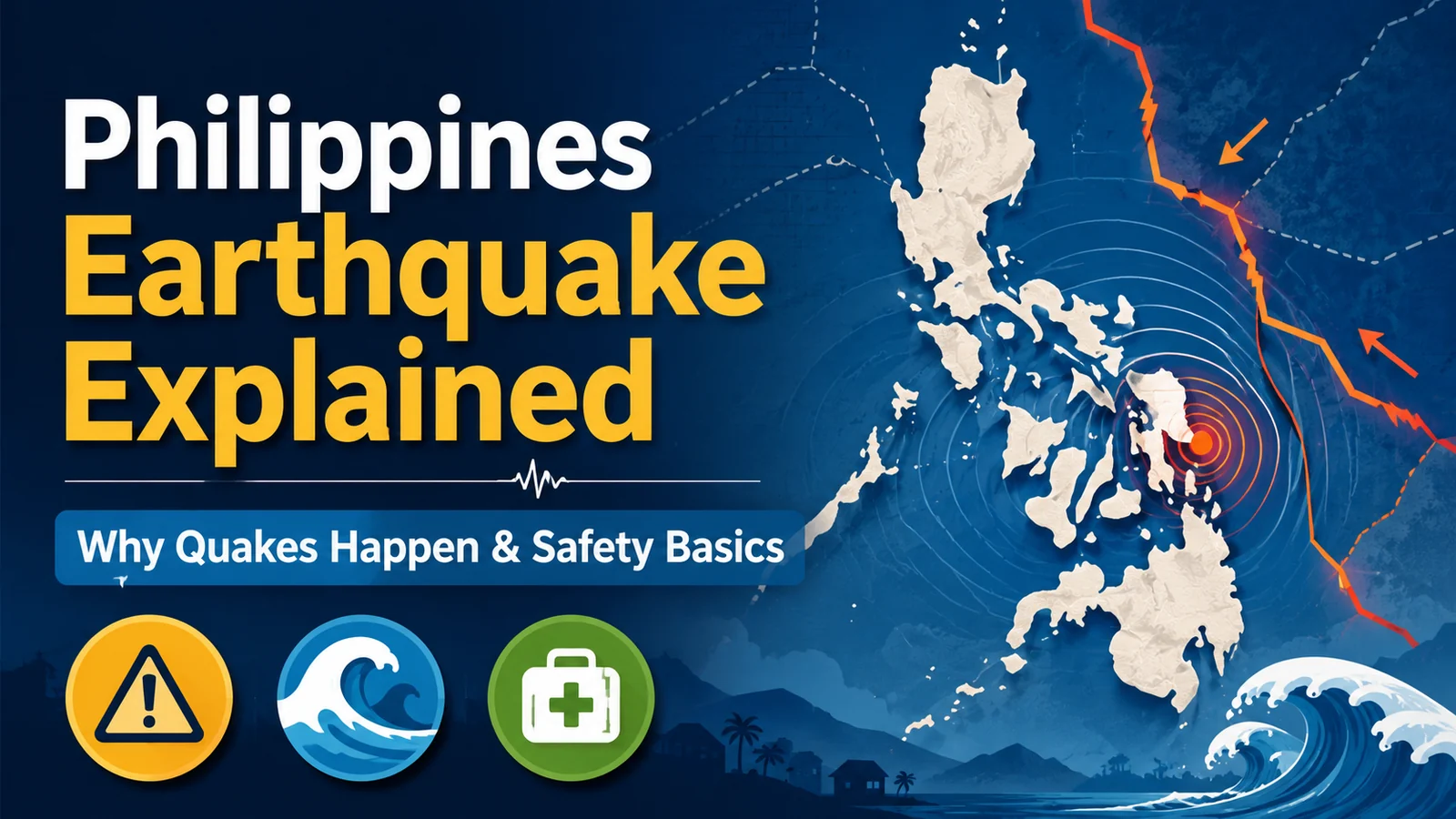
Philippines earthquake explained simply means understanding why the country experiences frequent shaking, how earthquakes happen, what makes some areas more vulnerable, and what people should do before, during, and after strong ground movement. The Philippines sits in a highly active tectonic region around the Pacific, where moving plates, trenches, faults, and subduction zones can produce earthquakes and sometimes tsunami threats. A strong earthquake does not always mean a tsunami will happen, so people should check official updates from PHIVOLCS, USGS, and tsunami warning authorities before reacting.
Introduction
Earthquakes in the Philippines are not rare surprises. They are part of the country’s natural geologic setting. For readers in the United States and around the world, the key point is not panic. The key point is understanding what earthquake terms mean, where reliable alerts come from, and which safety steps matter most.
The Philippines is located in a seismically active region affected by plate movement, faults, trenches, and subduction zones. For live event details, readers can use the USGS Latest Earthquakes map, while Philippines-specific advisories should be checked through PHIVOLCS and local authorities.
This guide does not predict earthquakes. It does not claim that one city will be hit next. Instead, it explains how earthquakes work, why the Philippines is exposed to frequent seismic activity, what tsunami alerts mean, how aftershocks should be understood, and how families can prepare without fear.
Why the Philippines Gets So Many Earthquakes
The easiest way to understand earthquakes in the Philippines is to remember this: the country is located in a very active part of the Earth’s crust. The Earth’s outer shell is not one solid piece. It is divided into large moving plates that can push, pull, slide, or sink beneath one another.
When stress builds up along faults or plate boundaries, the rocks may suddenly slip. That sudden slip releases energy as seismic waves. Those waves travel through the ground and create shaking.
The Philippines is affected by complex plate interactions. Some earthquakes happen inland along faults. Others happen offshore near trenches or subduction zones. This is why earthquake activity can be felt in different regions, including Luzon, Visayas, and Mindanao.
A good Philippines earthquake explained article should never create fear just to get clicks. It should help readers understand risk in a practical way. Earthquakes are natural events. What reduces danger is preparedness, safe construction, clear local alerts, and calm decision-making.
Quick Recap
| Question | Simple Answer |
| Why does the Philippines get earthquakes? | Because it is in a tectonically active region. |
| Are all earthquakes dangerous? | No. Many are small, deep, or far from populated areas. |
| Can earthquakes be predicted exactly? | No. Agencies monitor seismic activity and issue alerts, but exact prediction is not possible. |
| Should people panic after every earthquake? | No. They should check official updates and follow local instructions. |
What an Earthquake Really Is
An earthquake happens when stored energy in the Earth’s crust is suddenly released. That release creates seismic waves. People feel those waves as shaking, rolling, or vibration, depending on the location and the type of wave.
Here is a simple example: imagine bending a dry stick. At first, it resists pressure. Then it snaps suddenly. Faults are not the same as sticks, but the example helps beginners understand how pressure can build and release suddenly.
Earthquakes can happen along plate boundaries, on land faults, under the sea, near volcanic regions, and at different depths below the surface. Not every earthquake feels the same. A moderate earthquake close to a city and near the surface can sometimes cause stronger local shaking than a larger but deeper offshore event.
Why Depth Matters
Earthquake depth matters because shaking can feel different depending on where the earthquake begins. A shallow earthquake can produce stronger shaking near the epicenter, while a deeper earthquake may be felt across a wider area. Depth alone does not decide the danger, but it is an important part of the full picture.
Why Distance Matters
The closer a community is to the earthquake source, the more intense the shaking may feel. Still, distance is not the only factor. Local soil, building quality, ground conditions, terrain, and construction materials can all affect how people experience the same event.
Why Location Matters in the Philippines
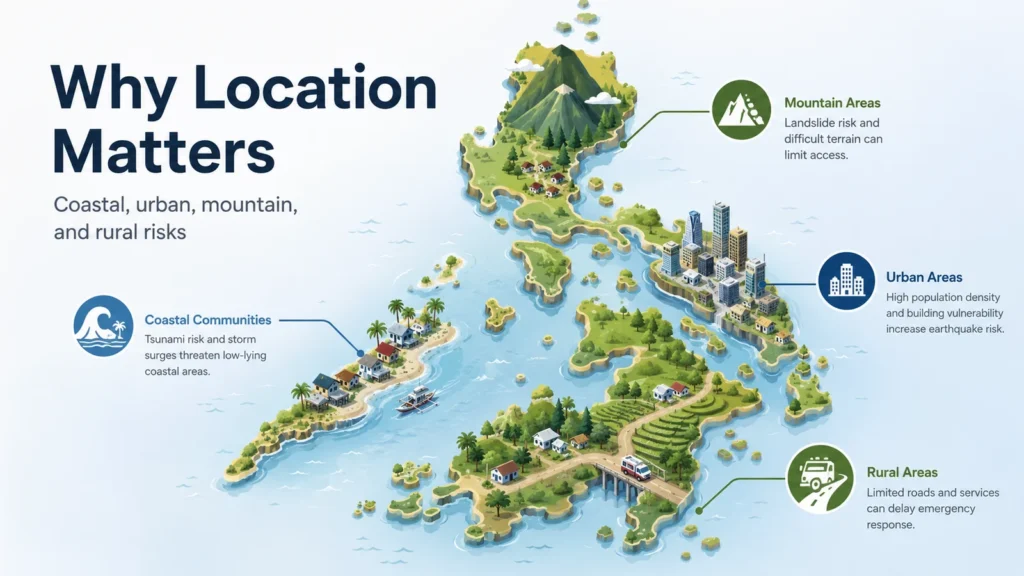
Location matters because the Philippines is made of islands, coastal communities, mountains, cities, and rural areas with different risks. Some places may be closer to active faults. Some coastal areas may need to pay attention to tsunami messages after a strong offshore earthquake. Mountain communities may need to watch for landslides after heavy shaking.
Mindanao Earthquake Explained
Mindanao earthquake explained simply means understanding that southern Philippines can experience significant seismic activity because it is part of a larger active tectonic setting. Mindanao can be affected by offshore earthquakes, local faults, regional plate movement, and nearby trenches.
It is not accurate to say that every Mindanao earthquake will be destructive. Impact depends on magnitude, depth, distance from communities, building strength, local ground conditions, landslide risk, and whether the earthquake happens offshore or inland.
Coastal vs Inland Risk
| Area Type | Main Concern |
| Coastal communities | Tsunami alerts, strong currents, evacuation routes, shoreline safety |
| Mountain communities | Landslides, falling rocks, blocked roads, unstable slopes |
| Urban areas | Building safety, glass, power lines, elevators, falling objects |
| Rural areas | Road access, communication gaps, emergency supplies, damaged bridges |
What this means for readers is simple: know your local hazard. A family near the coast needs tsunami evacuation knowledge. A family in a mountain area needs landslide awareness. A city resident needs to know how to stay safe around buildings, shelves, glass, and power lines.
Magnitude vs Intensity: The Simple Difference
One of the biggest earthquake misunderstandings is the difference between magnitude and intensity. Magnitude describes the size of the earthquake at the source. Intensity describes how strong the shaking feels or how much impact happens at a specific location.
The USGS Earthquake Hazards Program provides official earthquake education and monitoring resources that help readers understand these terms without relying on viral social media posts.
A large earthquake deep under the sea may be felt mildly in some places. A smaller earthquake near a city and close to the surface may be felt more strongly. That is why a headline with only a magnitude number is not enough.
| Term | What It Means | Why It Matters |
| Magnitude | Size of the earthquake at the source | Helps compare earthquake energy |
| Intensity | Shaking felt at a specific location | Helps explain local impact |
| Epicenter | Point on the surface above the earthquake source | Helps locate the event |
| Depth | How far below the surface the quake started | Helps explain shaking pattern |
| Aftershock | Smaller quake after a main earthquake | Helps people stay alert after the first event |
For beginners, the best habit is to look beyond one number. Check magnitude, depth, location, intensity reports, local damage updates, and tsunami advisories when relevant.
Why Some Earthquakes Trigger Tsunami Warnings
Not every earthquake creates a tsunami. Tsunami risk is usually connected to sudden movement of the seafloor that displaces a large amount of water. That is why strong offshore earthquakes receive special attention from warning centers.
The U.S. Tsunami Warning Centers message definitions explain that tsunami messages may be based first on preliminary earthquake information and then updated using additional seismic analysis, water-level measurements, forecast models, and historical tsunami information.
Tsunami Warning Philippines Explained
Tsunami warning Philippines explained in simple words means this: if authorities issue a tsunami warning for an affected coastal area, people should take it seriously and follow local instructions. A warning does not mean every coastline will be destroyed. It means dangerous coastal flooding or powerful currents may be possible in the warned area.
| Alert Type | Simple Meaning | Public Action |
| Warning | Dangerous coastal flooding or powerful currents may occur | Move to high ground or inland if instructed |
| Advisory | Strong currents or waves may be dangerous near water | Stay away from beaches, harbors, and waterways |
| Watch | Impact is not yet known | Stay tuned and be prepared to act |
| Information Statement | No destructive threat or still being evaluated | Usually no immediate action suggested |
If you feel very strong or long shaking near the coast, do not wait for social media rumors. Move away from the shoreline and follow official local guidance. Coastal safety depends on speed, trusted alerts, and knowing evacuation routes before an emergency.
Why Aftershocks Happen After a Strong Earthquake
Aftershocks are smaller earthquakes that happen after a main earthquake. They occur because the crust is still adjusting after the main rupture. Aftershocks can continue for hours, days, weeks, or even longer depending on the event.
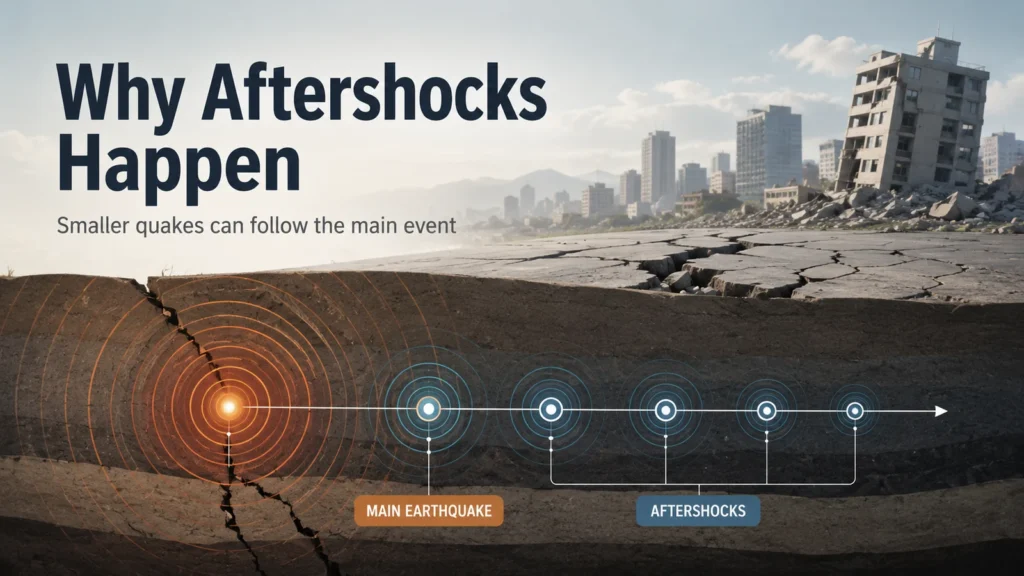
Most aftershocks are smaller than the mainshock, but some can still be strong enough to cause more damage, especially to buildings that were already weakened. This is why people should not rush back into damaged structures just because the first shaking has stopped.
After a strong earthquake, families should keep shoes nearby, watch for falling debris, keep phones charged when possible, avoid cracked walls and damaged bridges, and follow official updates. A calm plan is more useful than panic.
Quick Safety Note
Aftershocks do not mean a bigger earthquake is guaranteed. They mean the area is still adjusting. Do not trust posts claiming an exact next earthquake time unless that information comes from official agencies.
How to Check Official Earthquake Updates Safely
When people search usgs earthquakes philippines, they usually want reliable earthquake data. The safest habit is to check official earthquake information instead of relying on screenshots or reposted videos.
The USGS Latest Earthquakes map can show recent earthquake locations, magnitude, depth, and event information. For Philippines-specific advisories, people should also check PHIVOLCS and local government instructions because local agencies provide country-specific intensity reports, tsunami advisories, and emergency guidance.
| Detail | Why It Matters |
| Magnitude | Shows the size of the earthquake |
| Depth | Helps explain possible shaking pattern |
| Location | Shows where the quake happened |
| Time | Helps compare updates and aftershocks |
| Intensity reports | Shows how strongly places felt it |
| Tsunami advisory | Important for coastal areas |
| Official source | Helps avoid fake viral claims |
Avoid These Sources
- Random social media screenshots without a source link
- Old earthquake videos reposted as new footage
- Fake tsunami maps with no official reference
- AI-generated breaking-news images with dramatic claims
- Posts that claim the exact date, time, and place of the next earthquake
Earthquake Safety Guide for Families
This earthquake Philippines safety guide is not a replacement for local emergency instructions. It is a practical evergreen checklist that families can use before, during, and after shaking.
Before an Earthquake
- Secure tall shelves, cabinets, and heavy furniture.
- Keep emergency water, food, flashlights, batteries, and basic medicine.
- Store a first-aid kit in an easy-to-reach place.
- Save emergency contacts offline, not only in cloud apps.
- Know your evacuation route if you live near the coast.
- Choose a family meeting point in case phone networks fail.
- Keep shoes near your bed to protect your feet from broken glass.
During an Earthquake
If you are indoors, protect yourself from falling objects. Many earthquake injuries happen because people are hit by glass, furniture, shelves, or debris. Ready.gov’s earthquake safety guidance advises people to drop, cover, and hold on during shaking when appropriate.
- Drop to the ground.
- Cover your head and neck.
- Get under a sturdy table if one is nearby.
- Hold on until the shaking stops.
- Stay away from windows and heavy objects.
If You Are Outside
Move away from buildings, power lines, trees, bridges, streetlights, and walls that may collapse. Stay in an open area until the shaking stops.
If You Are Near the Coast
If shaking is strong or long near the coast, stay alert for tsunami risk and follow local evacuation instructions. Do not go to the beach to watch waves. Move to higher ground or inland if officials tell you to do so.
After an Earthquake
- Check yourself and others for injuries.
- Avoid damaged buildings.
- Do not use elevators.
- Watch for gas leaks, fire, broken wires, and unstable walls.
- Expect aftershocks.
- Use text messages if phone networks are overloaded.
- Follow official updates instead of rumors.
Common Mistakes People Make After an Earthquake
Earthquake safety is not only about what people do during shaking. What they do after the shaking can also matter.
Mistake 1: Running Outside During Strong Shaking
Running during shaking can be dangerous because people may fall, glass may break, and objects may drop. In many indoor situations, it is safer to protect yourself where you are until shaking stops.
Mistake 2: Believing Exact Prediction Posts
No reliable agency can tell the exact date, time, and place of the next damaging earthquake. Treat viral prediction posts as unreliable unless official agencies confirm the information.
Mistake 3: Ignoring Tsunami Instructions
If authorities issue a tsunami warning for your area, do not stay near the coast to record videos. Follow local instructions and move away from the shoreline when told.
Mistake 4: Returning Too Soon to Damaged Buildings
A building that looks safe from outside may have internal damage. Aftershocks can make weakened structures more dangerous.
Mistake 5: Sharing Unverified Images
Old disaster videos are often reshared during new emergencies. Before sharing, check the date, location, and original source.
The safest action plan is simple: before an earthquake, prepare supplies and routes; during shaking, protect your head and neck; after shaking, check injuries and official updates; near the coast, move away from the shoreline if instructed or if shaking is strong and long. This basic approach is useful for the Philippines, but it can also help readers understand earthquake safety in other active regions.
If readers remember only a few points from this guide, they should remember these: earthquakes cannot be exactly predicted, strong shaking near the coast deserves quick attention, tsunami warnings should be taken seriously, aftershocks are normal after major events, and official sources are more reliable than viral posts.
Practical Recap for Readers
A strong evergreen article also avoids false certainty. It should never say that one region is “safe forever” or that another region will “definitely be hit soon.” Earthquake risk can be studied, but exact short-term prediction is not possible. The best content teaches preparedness, not panic.
For InfoJustify readers, this matters because millions of people may use a safety article during a stressful moment. The content should be simple, accurate, and calm. It should explain terms like magnitude, intensity, epicenter, aftershock, tsunami warning, and evacuation without making readers feel helpless.
A trustworthy earthquake article does not pretend to know everything immediately. It clearly separates confirmed information from changing information. It links to official sources, avoids exact predictions, and does not use fake maps or old videos as proof. For evergreen articles, the safest approach is to teach readers how to understand earthquakes and how to check updated information themselves.
What Makes an Earthquake Article Trustworthy?
Here is a simple way to read an earthquake headline: look for the place, time, magnitude, depth, and source. Then check whether the article explains what is known, what is still being verified, and what readers should do next. Good earthquake content should reduce confusion, not increase fear.
Readers should be careful with dramatic words such as “massive,” “devastating,” or “monster quake” when those words are not supported by official reports. A strong earthquake can be serious, but responsible reporting should separate confirmed facts from early estimates. It is better to write “officials are checking damage” than to claim major destruction before reliable updates are available.
Earthquake headlines are often written quickly because people want fast updates. That speed can sometimes create confusion. A headline may focus on magnitude, but readers still need context. A magnitude number alone does not explain how close the event was to land, how deep it was, how many people felt it, or whether a tsunami threat exists.
How to Read Earthquake Headlines Without Being Misled
A useful earthquake response mindset is: verify first, act safely, and share carefully. Sharing unverified warnings can confuse people who are already scared. Sharing official links and simple safety reminders is much more helpful.
For example, if a person sees the phrase “Philippines earthquake” trending on social media, they should not assume the worst. They should open official earthquake pages, compare the time and location of the event, and check whether PHIVOLCS or local emergency offices have issued any instructions for the affected area. This approach protects readers from fake panic posts and outdated disaster footage.
This guide is designed to stay useful even when a specific earthquake update becomes old. During a future event, readers should use the article as a calm checklist, not as a live alert page. The first step is to check whether shaking was actually reported by official monitoring agencies. The second step is to read the location, magnitude, depth, and local advisory details together. The third step is to follow instructions from local authorities, especially if tsunami, landslide, or building-safety concerns are mentioned.
How Readers Should Use This Guide During Future Earthquakes
The final habit is information discipline. Readers should avoid spreading screenshots or dramatic claims unless they can trace the information to an official source. Good earthquake awareness is not only about protecting yourself; it is also about helping other people receive accurate, calm, and useful information.
For coastal areas, the checklist should include one more step: know the fastest route to higher ground. If a strong or long earthquake happens near the sea, people should not walk toward the shore to look at the water. They should listen for official tsunami instructions and move inland or upward when advised. This simple habit can save time when every minute matters.
A short checklist can make this guide easier to use. Before an earthquake, readers should know the safest spots in each room, keep heavy objects away from beds, and store emergency supplies where they can be reached quickly. During shaking, they should protect the head and neck first because falling objects are a major danger. After shaking, they should check injuries, avoid damaged buildings, and expect aftershocks.
Sources of Links –
| Linked Topic / Purpose | Clean URL |
| Official earthquake map and recent event checking | https://earthquake.usgs.gov/earthquakes/map/ |
| Tsunami warning, advisory, watch, and information definitions | https://www.tsunami.gov/?page=message_definitions |
| Philippines-specific earthquake and tsunami advisories | https://www.phivolcs.dost.gov.ph/ |
| Earthquake safety steps | https://www.ready.gov/earthquakes |
| Earthquake education and terminology | https://www.usgs.gov/programs/earthquake-hazards |
Conclusion
Philippines earthquake explained is not just a geology topic. It is a safety and awareness topic. The Philippines experiences frequent earthquakes because of its active tectonic setting, but the goal is not fear. The goal is preparedness.
Readers should understand the difference between magnitude and intensity, know why some offshore earthquakes can trigger tsunami warnings, expect aftershocks after strong events, and rely on official sources such as USGS, PHIVOLCS, Ready.gov, and tsunami warning centers.
The safest mindset is simple: learn before shaking happens, act calmly during shaking, and verify information after shaking stops.
FAQs
1. Can scientists predict the exact time of the next Philippines earthquake?
No. Scientists can study earthquake zones, monitor seismic activity, and issue alerts after an earthquake happens, but they cannot predict the exact date, time, and location of the next damaging earthquake. That is why preparedness is more useful than believing viral prediction posts or panic-based claims.
2. When can a Philippines earthquake create a tsunami risk?
A tsunami risk is more likely when a strong earthquake happens under or near the sea and causes sudden movement of the seafloor. Not every offshore earthquake creates a tsunami, and not every tsunami warning means the same level of danger everywhere. Coastal residents should follow official tsunami alerts and local evacuation instructions.
3. What should people check after feeling an earthquake in the Philippines?
After feeling an earthquake, people should check the earthquake’s magnitude, depth, location, time, local intensity reports, aftershock updates, and any tsunami advisory if they are near the coast. The safest approach is to use official sources such as USGS, PHIVOLCS, tsunami warning centers, and local emergency offices.
4. What is the safest action during strong shaking?
During strong shaking, people should protect their head and neck, stay away from windows, avoid running near falling objects, and use the Drop, Cover, and Hold On method where appropriate. After the shaking stops, they should check for injuries, avoid damaged buildings, expect aftershocks, and follow official safety instructions.
5. Why should people avoid sharing unverified earthquake posts?
Unverified earthquake posts can spread fear, old videos, fake tsunami maps, or incorrect damage claims. During a disaster, wrong information can delay safe decisions. Before sharing any earthquake update, people should check the date, location, source, and whether the information comes from an official or reliable organization.
One thought on “Philippines Earthquake Explained: 7 Powerful Reasons Quakes Happen”