
Kyle Busch pneumonia sepsis is being searched because his family said the NASCAR champion died after severe pneumonia progressed into sepsis and caused rapid, overwhelming complications. The confirmed public explanation is not that a minor cold suddenly killed him; it is that a serious lung infection became a body-wide medical emergency. This article explains the reported cause of death, the pneumonia-to-sepsis connection, the warning signs readers should understand, and why the story should be handled with respect instead of rumor.
The most responsible way to read this story is to separate confirmed reporting from general medical education. Public reports can summarize the family statement and known emergency details, but they cannot reveal every private medical record. For readers, the practical lesson is broader and urgent: pneumonia can become dangerous, sepsis can move quickly, and symptoms such as shortness of breath, confusion, collapse, or coughing blood should never be treated as ordinary tiredness.
This article also avoids one common mistake in viral health stories: turning a confirmed cause of death into a broad medical claim. Kyle Busch’s case should be discussed through reliable reporting and trusted health guidance, not speculation. Readers can honor the facts by understanding the medical pathway, checking source dates, and remembering that emergency symptoms require doctors, not social-media diagnosis.
- What Happened to Kyle Busch?
- Cause of Death: Severe Pneumonia Progressing Into Sepsis
- How Pneumonia Can Turn Into Sepsis
- Warning Signs Readers Should Not Ignore
- Why Athletes May Miss Serious Illness Signals
- Kyle Busch's NASCAR Legacy
- What This Case Teaches About Pneumonia and Sepsis
- Common Questions People Are Asking
- What Readers Should Know Before Sharing the Story
- Responsible Reporting for Readers
- Conclusion
- Frequently Asked Questions
What Happened to Kyle Busch?
Kyle Busch died on May 21, 2026, at age 41 after being hospitalized during the week of the Coca-Cola 600. The Associated Press reported that his family later said a medical evaluation found severe pneumonia had progressed into sepsis. NASCAR also updated its official driver page to describe his sudden passing after a severe illness, while highlighting his long Cup Series career, Richard Childress Racing connection, and championship record.
The timeline shocked many fans because Busch had continued to compete while feeling unwell. Reports said he had been dealing with illness earlier in May, later won a Truck Series race, and then became unresponsive during a Chevrolet simulator session. Emergency-call details described shortness of breath, overheating, a feeling that he might pass out, and coughing up blood. Those details matter because they point toward serious respiratory distress rather than routine fatigue.
Busch was not a minor sports figure. NASCAR lists him as a two-time Cup Series champion, the winner of 63 Cup races, and the driver with 234 victories across NASCAR’s three national series. That legacy explains why the search interest is so high: fans want to understand the medical explanation, but they also want to remember a major racing figure without turning a family tragedy into speculation.
Cause of Death: Severe Pneumonia Progressing Into Sepsis
The reported cause of death has two connected parts. Pneumonia describes the serious lung infection, while sepsis describes the body-wide emergency that can happen when an infection triggers an extreme response. The CDC explains that sepsis is the body’s extreme response to infection and that infections leading to sepsis often start in the lungs, gastrointestinal tract, skin, or urinary tract. In this case, the public statement connected the starting point to pneumonia.
Pneumonia is not just a cough when it becomes severe. Common symptoms can include cough, fever or chills, fatigue, chest pain when breathing or coughing, nausea, confusion, and shortness of breath. Mayo Clinic also notes that pneumonia symptoms can vary from mild to life-threatening. That range is important because a person may first think they have a manageable respiratory illness, then worsen faster than expected.
Sepsis is the dangerous second step in this reported progression. Without fast treatment, sepsis can lead to tissue damage, organ failure, and death. The National Institute of General Medical Sciences explains that sepsis can progress rapidly, and in the worst cases blood pressure drops, the heart weakens, and organs such as the lungs, kidneys, or liver may fail. That is why the phrase pneumonia progressed into sepsis is medically serious.
The key phrase in the family explanation was rapid and overwhelming complications. That wording helps readers understand why a person can appear to decline suddenly. Sepsis does not always look dramatic at first because early symptoms can overlap with flu, bronchitis, exhaustion, or a hard work schedule. By the time breathing difficulty, confusion, low blood pressure, or collapse appears, the body may already need emergency-level care.
How Pneumonia Can Turn Into Sepsis
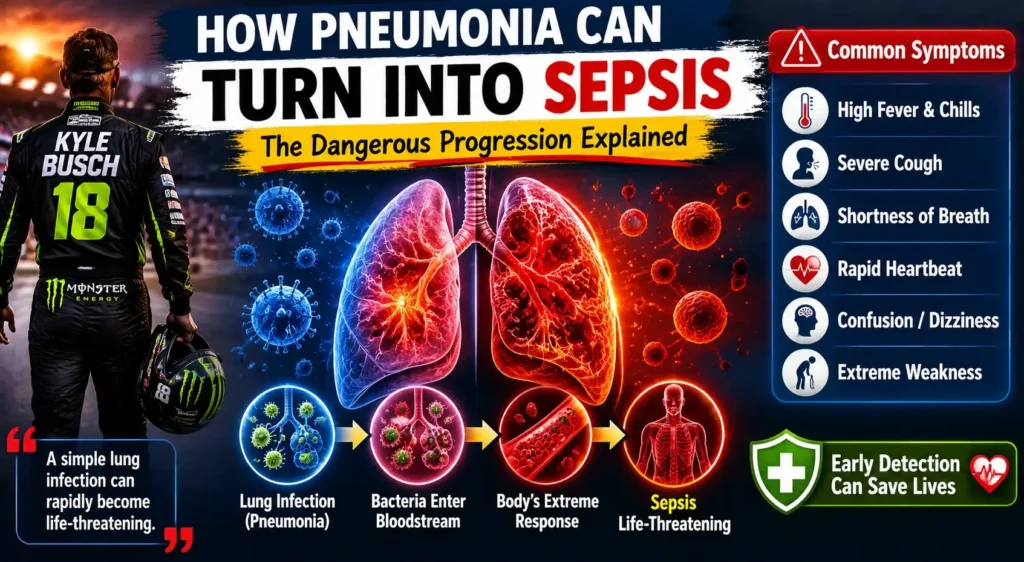
A simple way to understand pneumonia to sepsis is this: pneumonia begins in the lungs, but sepsis is the body’s harmful response to infection across the body. When germs and inflammation overwhelm normal defenses, immune signals can spread, blood vessels can be affected, and organs may receive less oxygen-rich blood. The original infection may be in one place, but the body’s reaction becomes the life-threatening problem.
The lungs are a common starting point because pneumonia can interfere with oxygen exchange. If air sacs fill with fluid or pus, a person may cough, breathe faster, feel exhausted, or struggle to maintain oxygen levels. If the infection becomes severe or the body reacts abnormally, the illness can move beyond a local chest infection. That is when doctors worry about sepsis, septic shock, and organ stress.
The exact biological path can differ by patient. Pneumonia may be bacterial, viral, or fungal, and treatment depends on cause, severity, and test results. WHO notes that sepsis is usually caused by bacterial infections, but it may also result from viruses, parasites, or fungi. Because the exact organism in Busch’s case has not been publicly confirmed, a responsible article should not guess it.
This matters because readers sometimes ask whether a person can be strong, young, or athletic and still become critically ill. The answer is yes. Fitness may support health, but it does not block every severe infection or immune reaction. Sepsis can affect anyone, and the risk rises when an infection is not improving, symptoms change quickly, or breathing and circulation become unstable.
Warning Signs Readers Should Not Ignore
This story should not make people panic over every cough. Most respiratory infections do not become fatal. But it should remind readers to watch for red flags such as worsening shortness of breath, chest pain, confusion, extreme weakness, bluish lips, fainting, coughing blood, very high fever, unusually low temperature, or symptoms that get worse quickly. Those are not signs to simply push through.
CDC sepsis materials list signs such as clammy or sweaty skin, confusion or disorientation, extreme pain or discomfort, fever or feeling very cold, high heart rate or weak pulse, and shortness of breath. WHO also describes sepsis as a life-threatening condition that can lead to shock, multiple organ failure, and death if not recognized early and treated promptly. The practical message is simple: sudden worsening needs urgent evaluation.
Pneumonia symptoms also deserve attention when they are intense or persistent. The CDC lists cough, fever or chills, fatigue, chest pain when breathing or coughing, nausea, vomiting, diarrhea, confusion, and shortness of breath. People at higher risk include older adults and those with certain medical conditions, but severe infections can also happen in people who seemed healthy and active. Strength is not the same as immunity.
A helpful rule for readers is not to self-diagnose sepsis online, but also not to ignore emergency symptoms. Articles can explain patterns, but they cannot measure oxygen levels, blood pressure, chest imaging, blood tests, or organ function. If someone with a known or suspected infection becomes confused, cannot breathe comfortably, collapses, or looks severely ill, medical care should be urgent rather than delayed.
Why Athletes May Miss Serious Illness Signals
Athletes and competitive professionals often learn to keep going through discomfort. In motorsports, the pressure can be intense because drivers train, test, travel, and compete through long weekends. That culture can make ordinary illness feel like another obstacle to manage. The danger is that serious infection symptoms can look like fatigue at first, especially when the person is already pushing hard.
Busch’s case is not proof that racing caused his death, and no article should suggest that without medical evidence. The safer point is broader: people with demanding schedules may delay care because they are used to functioning under stress. When breathing problems, faintness, fever, or coughing blood appear, the situation has moved beyond normal toughness. Those symptoms deserve immediate professional attention.
The AP report also included reactions from drivers who reflected on how athletes sometimes continue while sick. That context is useful because it connects the news to a common human habit: minimizing symptoms until they become impossible to ignore. The lesson is not that every illness is deadly; the lesson is that fast-changing symptoms should interrupt the schedule, even for high-performing people.
- Why Are Social Security Checks Late in May 2026? (The Real Truth)
- Antarctica From Space: 5 Climate Signals to Watch
- Ebola Outbreak 2026: Bundibugyo Virus Explained & Related Topic
Kyle Busch’s NASCAR Legacy
Kyle Busch’s legacy is central to why this story reached so many readers. NASCAR credits him with the 2015 and 2019 Cup Series championships, 63 Cup wins, and 234 national-series victories. He raced for major organizations, built a reputation as one of the most talented and polarizing drivers of his era, and remained a major figure through Richard Childress Racing at the time of his passing.
For fans, the medical explanation does not erase the emotional part of the story. They remember the victories, rivalries, interviews, aggressive style, and long career across NASCAR’s top divisions. A good article should make space for that legacy while still answering the health-related question accurately. It should not use the medical details as a hook without giving readers clear context and useful safety information.
His death also shows how quickly a sports story can become a public-health search topic. People who may never have searched for sepsis before are now asking what it means, how pneumonia can lead to it, and which warning signs matter. That makes accuracy important. The best tribute in an explainer article is not dramatic wording; it is clear reporting and useful medical awareness.
What This Case Teaches About Pneumonia and Sepsis
The first lesson is that pneumonia has a wide range. Some cases can be treated and recover well, while others become severe enough to require hospitalization. The second lesson is that sepsis is not a separate infection; it is the body’s extreme response to an infection. That distinction helps readers understand why a lung illness can become a crisis involving circulation, organs, and mental status.
The third lesson is that warning signs matter more than labels. A person does not need to know whether they have pneumonia, flu, bronchitis, or another infection before seeking urgent help for severe breathing trouble or confusion. Doctors can sort out the diagnosis, but the patient or family must recognize when the situation is no longer safe to watch at home.
The fourth lesson is to avoid false certainty. Public articles do not know every clinical detail in Busch’s case, and they should not pretend to. The confirmed line is severe pneumonia progressing into sepsis. Everything beyond that should be written as general medical explanation unless directly supported by a reliable source. That approach protects both reader trust and the family’s privacy.
Common Questions People Are Asking
Was this really Kyle Busch’s cause of death? Based on the family statement reported by major outlets, yes: the public explanation is severe pneumonia progressing into sepsis. That does not mean every private medical detail is public. It means the reported cause is clear enough for news coverage, and the rest should be treated carefully without guessing about hidden conditions, exact test results, or treatment decisions.
Can pneumonia turn deadly in a younger adult? Yes, although many people recover from pneumonia, severe cases can become life-threatening. Risk depends on many factors, including the germ involved, oxygen levels, complications, timing of care, and a person’s overall condition. Sepsis can happen when the body reacts dangerously to infection, which is why worsening symptoms should be assessed promptly.
Could this have been prevented? No responsible article can answer that about a specific person without access to the full medical record. In general, prevention can include vaccination when recommended, infection control, timely medical care, and fast action when symptoms become severe. But once a case is reported publicly, the ethical focus should be education, not blame.
What Readers Should Know Before Sharing the Story
Because this is a death-related search, readers may see social posts that simplify the story too much. A careful share should say that Kyle Busch’s family reported severe pneumonia progressing into sepsis, not that every cough is dangerous or that one visible symptom explains everything. The best public summary is short, sourced, and respectful: confirmed reporting gives the cause, while medical sources explain how pneumonia and sepsis can be connected.
Readers should also avoid using this case to diagnose someone else. If a friend has a cough or fever, that does not automatically mean sepsis. But if the person has severe shortness of breath, confusion, chest pain, fainting, or sudden worsening, that is different. CDC guidance supports acting quickly when an infection seems to be getting worse, because early evaluation can change the outcome in serious infection cases.
The phrase coughing blood can frighten readers, and it should. Blood in cough can have different causes, but it is not something to ignore, especially when paired with breathing trouble, overheating, weakness, or feeling faint. Public reporting mentioned that symptom in the emergency context. The safe reader takeaway is not to guess the cause at home, but to seek urgent medical evaluation when alarming respiratory symptoms appear.
Another important point is that sepsis is not contagious in the same simple way people think about a cold. The infection that starts the problem may involve bacteria, viruses, fungi, or other causes, but sepsis itself is the body’s extreme response to that infection. This distinction prevents confusion and helps readers focus on infection prevention, early treatment, and warning signs instead of fear-based assumptions.
For a United States audience, this article should also encourage practical health literacy. Many people know pneumonia as a chest infection, but fewer understand how a lung infection can connect to blood pressure, organs, and mental status. That is why a news story about a driver can become a useful public-health explainer when it is written carefully, sourced clearly, and framed around emergency awareness rather than shock.
The final sharing rule is simple: do not add details that have not been confirmed. Do not claim a hidden condition, a specific germ, a medical mistake, or a preventable cause unless a reliable source states it. The published article should stay with the verified report, the official NASCAR context, and trusted medical education. That is the safest approach for accuracy, reader trust, and respect for the family.
Responsible Reporting for Readers
A responsible article on Kyle Busch should not sound like strangers solving a mystery. The strongest public sources give a clear but limited answer: severe pneumonia progressed into sepsis. Good reporting should repeat that verified line, explain the medical meaning, and avoid pretending to know private details such as exact lab findings, medications, hospital decisions, or the organism that caused the infection.
Readers also deserve calm language. Words such as sudden, tragic, severe, and emergency may be accurate, but they should not be used to create panic. The better approach is to explain that pneumonia can range from mild to life-threatening, sepsis is urgent, and severe warning signs need medical evaluation. That gives people useful information without turning a family tragedy into fear-based content.
This is especially important for health SEO. A ranking article can still be humane, accurate, and useful. It can answer what happened, define pneumonia, define sepsis, explain warning signs, and cite trusted sources without sensational claims. For InfoJustify, the goal is to help readers understand the news, respect the NASCAR community, and encourage safer decisions when symptoms are serious.
Before publishing, editors should recheck the date, the family-statement wording, all source links, and any new NASCAR updates. News stories can change as more official details appear, and medical explainers should stay aligned with public-health guidance. If later reporting adds or corrects details, the article should be updated transparently instead of quietly changing the story in a confusing way.
- Robert Redfield: Biography, CDC Role, COVID-19 Legacy
- Types of Yoga: 30 Powerful Styles Explained
- What is Cloud Storage ? 7 Best Basics
Conclusion
Kyle Busch pneumonia sepsis can be explained responsibly in one sentence: his family said a medical evaluation found that severe pneumonia progressed into sepsis, causing rapid and overwhelming complications. The case is heartbreaking because it took a legendary NASCAR driver at only 41, but it is also important because it reminds readers that pneumonia and sepsis are not abstract medical terms. They can become urgent, fast-moving emergencies.
For fans, the respectful response is to remember Busch’s career, family, and impact on racing. For readers thinking about health, the practical response is to take severe respiratory symptoms seriously. If pneumonia-like symptoms are worsening, breathing becomes difficult, confusion appears, or someone collapses, seek emergency help. This article cannot replace a doctor, but it can help people understand why pneumonia-to-sepsis progression is so dangerous.
Frequently Asked Questions
1. What was Kyle Busch’s cause of death?
Kyle Busch’s reported cause of death was severe pneumonia that progressed into sepsis, according to a family statement reported by the Associated Press and Reuters. The public explanation says the illness caused rapid and overwhelming complications. This wording should be used carefully because it comes from the released family statement, not from unofficial rumor.
2. How can pneumonia lead to sepsis?
Pneumonia can lead to sepsis when a lung infection triggers an extreme body-wide immune response. The CDC explains that sepsis happens when an infection already in the body starts a chain reaction, which can lead to tissue damage, organ failure, and death without fast treatment. Lung infections are among the common starting points for sepsis.
3. What symptoms can suggest pneumonia is becoming serious?
Serious pneumonia warning signs can include shortness of breath, chest pain when breathing or coughing, confusion, severe fatigue, fever or chills, and coughing blood. CDC lists several common pneumonia symptoms, while public reporting in Busch’s case mentioned shortness of breath and coughing blood. Anyone with severe or rapidly worsening symptoms should seek medical care urgently.
4. Is sepsis always fatal?
No, sepsis is not always fatal, but it is always a medical emergency because it can progress quickly. Survival depends on early recognition, the source of infection, the person’s overall health, and how quickly effective treatment begins. WHO and CDC guidance stress urgent care because delayed treatment can lead to organ failure, septic shock, and death.
5. What should someone do if they suspect sepsis?
If someone with an infection develops confusion, shortness of breath, clammy skin, extreme pain, high heart rate, weak pulse, sudden collapse, or severe worsening, they should seek emergency medical help immediately. Online information can support awareness, but it cannot diagnose sepsis. Fast professional evaluation is essential because sepsis can become life-threatening quickly.
Associated Press: https://apnews.com/article/d198c16d4cb7e383b7c7e16f6ba471aa
Reuters: https://www.reuters.com/sports/family-kyle-busch-died-severe-pneumonia-sepsis–flm-2026-05-23/
NASCAR official Kyle Busch driver profile: https://www.nascar.com/drivers/kyle-busch/
CDC: About Sepsis: https://www.cdc.gov/sepsis/about/index.html
CDC: About Pneumonia: https://www.cdc.gov/pneumonia/about/index.html
CDC: Preventing Infections That Can Lead to Sepsis: https://www.cdc.gov/sepsis/prevention/index.html
WHO: Sepsis fact sheet: https://www.who.int/news-room/fact-sheets/detail/sepsis
NIH/NIGMS: Sepsis fact sheet: https://nigms.nih.gov/education/fact-sheets/Pages/sepsis
Cleveland Clinic: Sepsis: https://my.clevelandclinic.org/health/diseases/12361-sepsis
Mayo Clinic: Pneumonia symptoms and causes: https://www.mayoclinic.org/diseases-conditions/pneumonia/symptoms-causes/syc-20354204
Mayo Clinic: Sepsis symptoms and causes: https://www.mayoclinic.org/diseases-conditions/sepsis/symptoms-causes/syc-20351214
- Kyle Busch Pneumonia Sepsis: Cause of Death Explained
- Ebola Outbreak 2026: Bundibugyo Virus Explained & Related Topic
- Robert Redfield: Biography, CDC Role, COVID-19 Legacy
- Are AI voices safe for YouTube monetization
- Realistic Indian Accent AI Voices for Free: 3 Best Tools
- ElevenLabs Free Alternatives for Emotional Voices: 3 Picks
- Best Free AI Voice Generators for Faceless YouTube Shorts
- Top 5 Free AI Voice Generator Realistic Tools
- Free AI Video Generators Without Watermark: 2026 Truth
- AI vs Machine Learning: Powerful 2026 Career Truth
- Generative AI Uses and Risks: 11 Real-Life Lessons for Beginners
- What is Generative AI? 12 Powerful Basics for Beginners
- What is AI? 11 Powerful Basics Every Beginner Should Know