
Robert Redfield is an American physician, virologist, public health leader, and former director of the U.S. Centers for Disease Control and Prevention. In the United States, his name is most often connected with three major subjects: HIV/AIDS research, CDC leadership, and the federal public health response during COVID-19.

Many readers first heard the name Robert Redfield during 2020, when he served as CDC director under President Donald Trump. But his career started decades earlier in military medicine, infectious disease research, and clinical HIV work. That longer background is important because it explains why he became a national public health figure before the pandemic made him a familiar name.
This guide gives a clear Robert Redfield biography for readers who want more than a short news summary. It explains his medical background, his CDC leadership, his COVID-19 role, his later public health views, and why former CDC director Robert Redfield still appears in U.S. public health debates today.
Who Is Robert Redfield?
Robert R. Redfield, MD, is a physician and virologist who served as CDC director from 2018 to 2021. The CDC’s official past-directors record lists Robert R. Redfield, MD, for the 2018-2021 period, placing him in charge of the agency during one of the most demanding public health moments in modern U.S. history.
In simple terms, Robert Redfield is important because his career connects medical research, federal disease-control leadership, COVID-19 policy, and today’s biosecurity conversation. He is not only a former government official. He is also a long-time infectious disease doctor whose earlier work focused heavily on HIV/AIDS and chronic viral infections.
For a U.S. audience, the phrase Robert Redfield CDC usually points to his time leading the Centers for Disease Control and Prevention. That job made him responsible for helping guide a large public health agency that works on disease surveillance, outbreak response, health guidance, data communication, and support for state and local health departments.
His public image is mixed. Supporters often point to his infectious disease experience and long clinical background. Critics often focus on controversies around his appointment, earlier HIV-related disputes, and the CDC’s pandemic-era communication problems. A helpful biography should explain both sides without turning the article into a political attack.
Robert Redfield Biography: Medical and Public Health Background
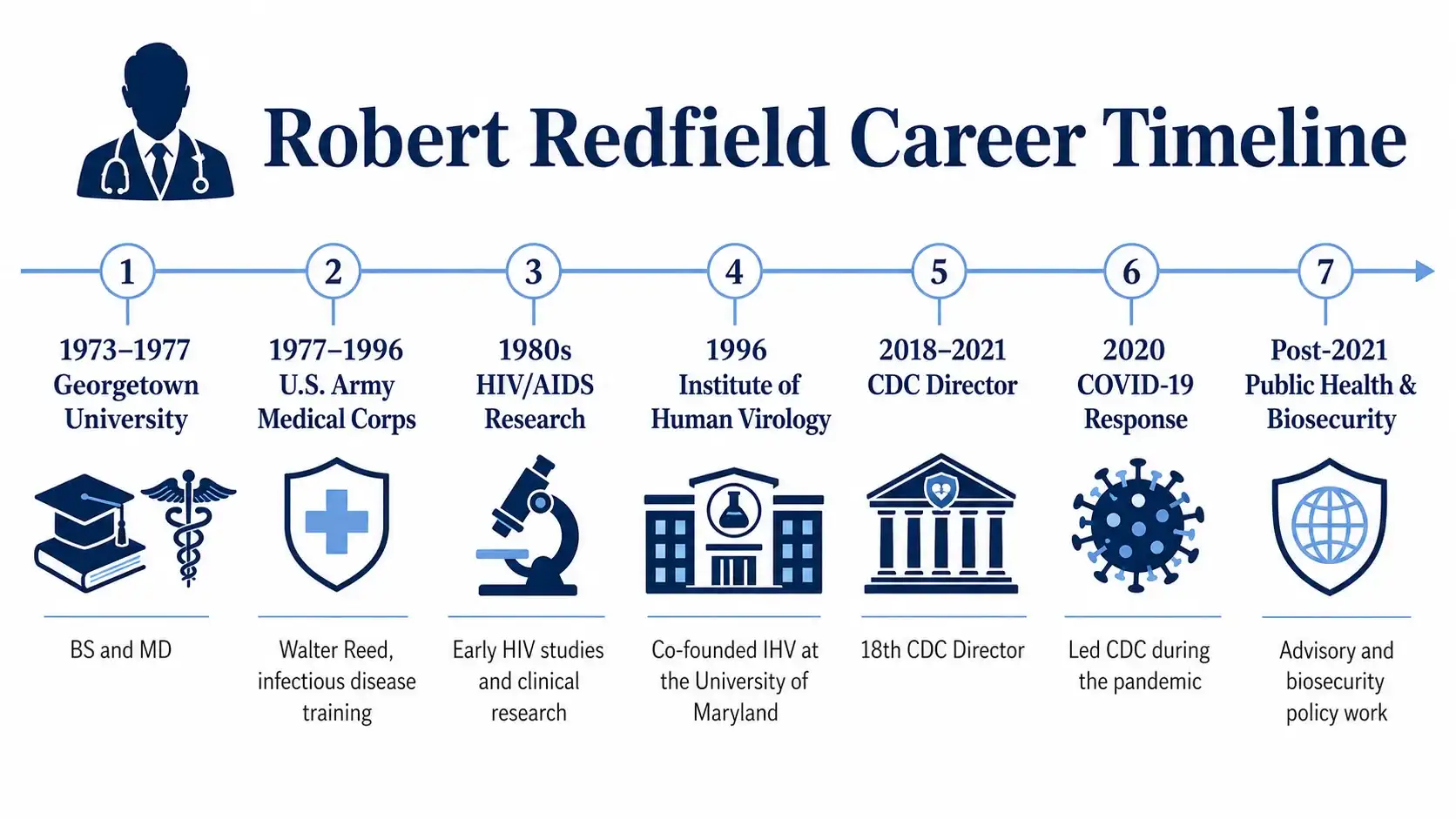
A useful Robert Redfield biography begins with his training as a physician and his long work in infectious disease. Redfield built his career around virology, clinical research, and public health. Georgetown University’s Center for Global Health Practice and Impact describes him as Colonel (Ret.) Robert R. Redfield, MD, and notes his decades of work with chronic human viral infections and infectious diseases.
Redfield served in the U.S. Army from 1977 to 1996 as a physician and medical researcher, retiring as a colonel. That military medicine background is important because it placed him in environments where infectious disease, laboratory research, and population-level health concerns intersect.
After his military service, Redfield became strongly associated with the University of Maryland School of Medicine and the Institute of Human Virology. His academic work included medicine, microbiology, immunology, infectious disease leadership, and clinical research. This mix of patient care and research shaped the public health identity that later followed him to the CDC.
Redfield’s biography also shows how public health careers often move across institutions. One person may work in a military setting, a university, a research institute, a federal agency, an advisory council, and a policy organization. Redfield’s career includes all of these areas, which is why his name appears in many different public health discussions.
HIV/AIDS Research and the Institute of Human Virology
Before the search phrase Robert Redfield COVID-19 became common, Redfield was known mainly for infectious disease and HIV/AIDS research. During the early decades of the HIV/AIDS epidemic, the United States needed physicians and scientists who could study transmission, disease progression, clinical care, and treatment approaches.
The University of Maryland School of Medicine described Redfield as a co-founder and associate director of the Institute of Human Virology, and as a renowned clinical AIDS researcher, public health expert, and chief of infectious diseases. The same source states that he began his infectious disease work in the late 1970s at Walter Reed Army Medical Center and later helped establish the Institute of Human Virology in 1996.
This part of Robert Redfield’s biography matters because it explains why he was seen as a serious infectious disease figure before entering the CDC director role. His background was not only administrative. It included clinical care, research programs, and work with chronic viral infections.
At the same time, his HIV/AIDS record has drawn criticism from some public health writers and advocates. Some disputes involved earlier vaccine research and policy positions. The best way to handle this in an article is to acknowledge that criticism exists while keeping the main biography grounded in verified source material.
Robert Redfield CDC Leadership: 2018 to 2021
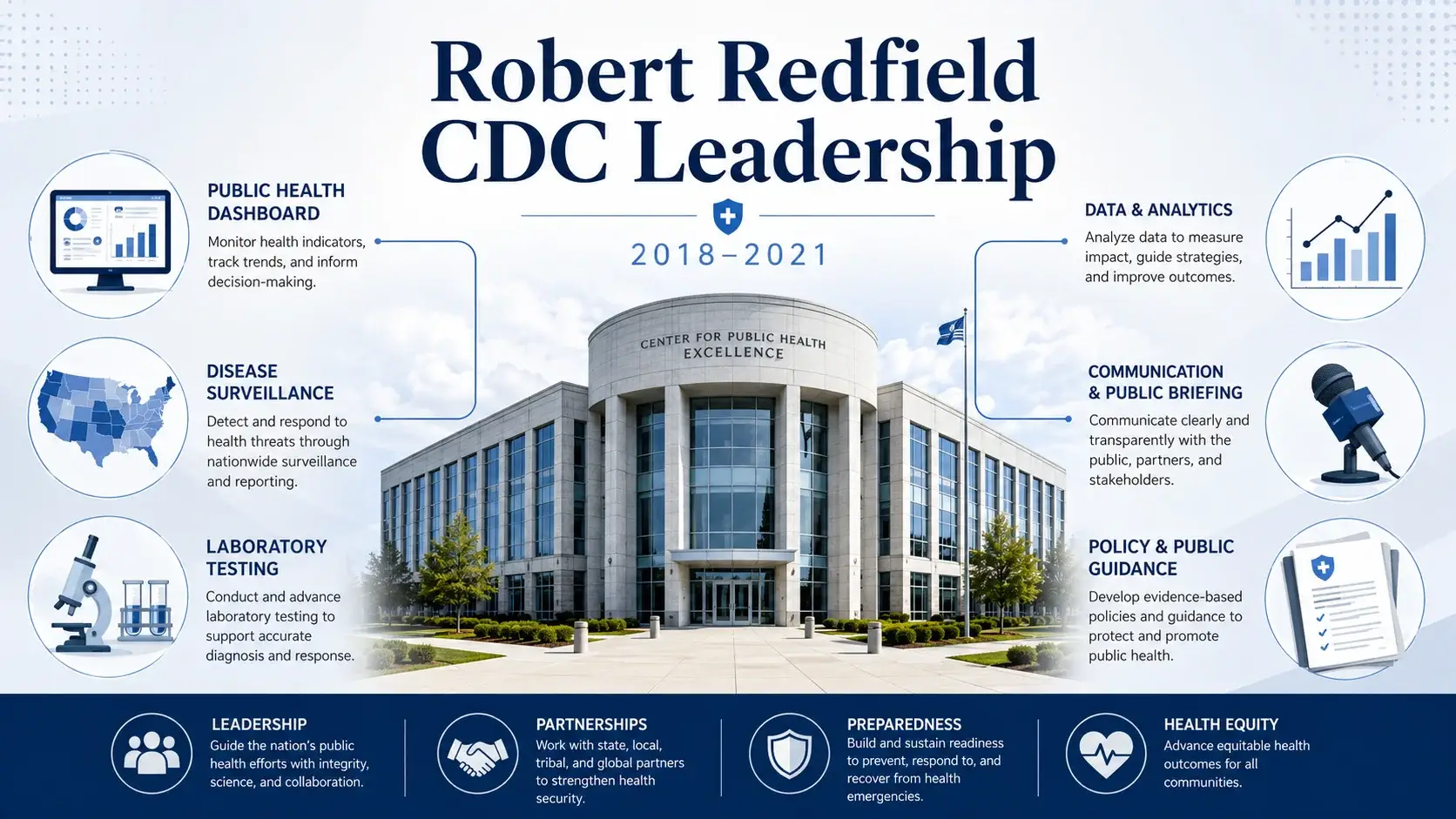
The Robert Redfield CDC chapter began in 2018, when he became director of the Centers for Disease Control and Prevention. The CDC is one of the most visible public health agencies in the world. It tracks diseases, supports local health departments, publishes guidance, manages health data, and helps respond to outbreaks.
When Redfield took the role, the CDC was already dealing with several serious public health concerns, including opioid overdose deaths, vaccine-preventable disease risks, global health security, and infectious disease surveillance. These issues were important, but COVID-19 soon changed the scale of the job.
In 2020, the CDC became a central institution in America’s pandemic response. The agency had to provide guidance on testing, masking, isolation, quarantine, schools, healthcare settings, and public risk. Redfield’s role as director placed him at the center of public attention, even though CDC guidance was shaped by many scientists, federal departments, state agencies, and political decisions.
A CDC congressional testimony page from July 2020 identifies Robert R. Redfield, MD, as CDC director in a Senate hearing connected to Operation Warp Speed, vaccines, diagnostics, and therapeutics. That shows how closely the CDC director was tied to the federal response structure during the first pandemic year.
Former CDC Director Robert Redfield and COVID-19
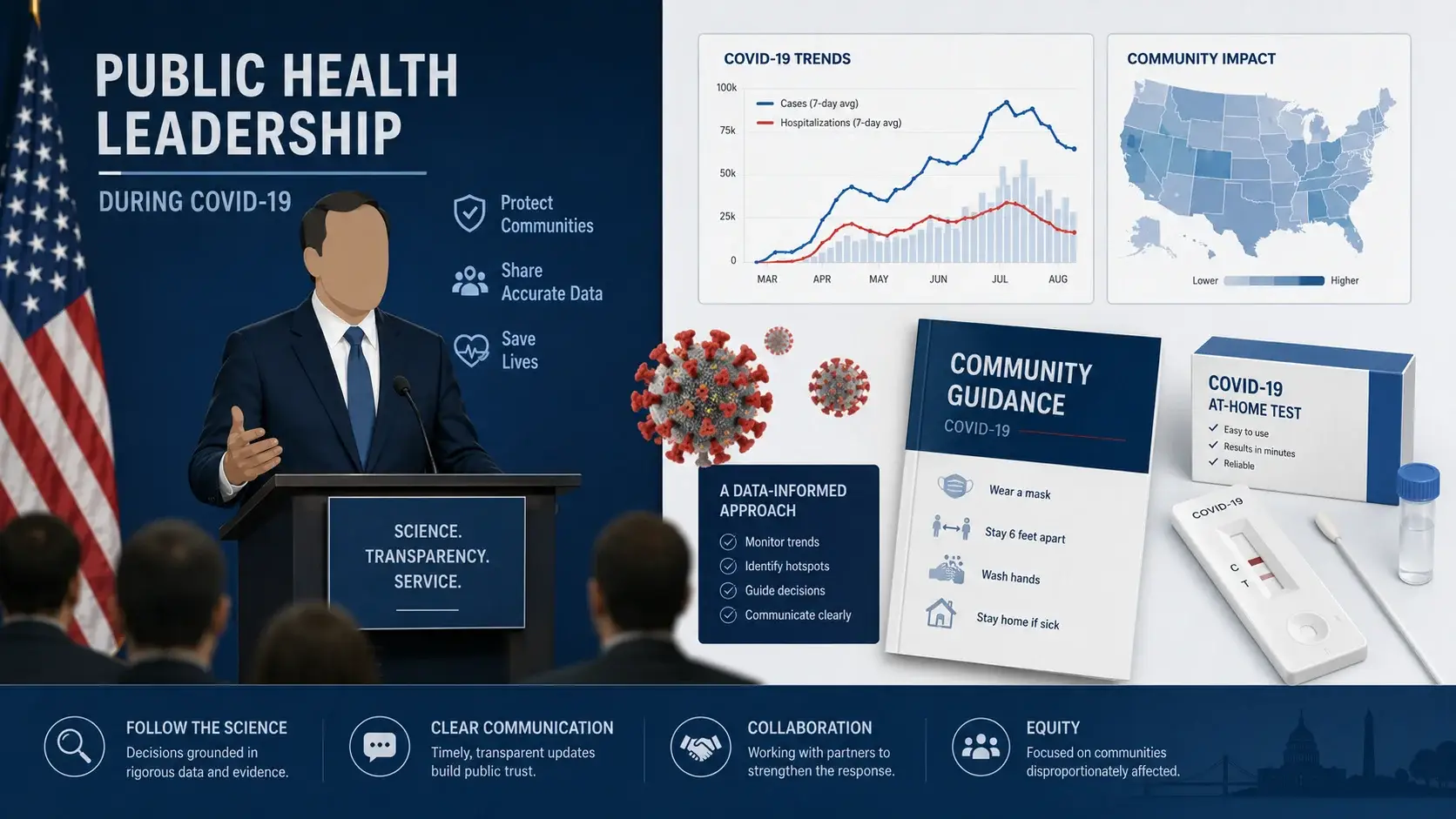
Former CDC director Robert Redfield is most widely remembered for his public role during COVID-19. The pandemic placed extraordinary pressure on public health agencies. The country needed fast answers about a new virus, but science was developing in real time.
During that period, Redfield served as a member of the White House Coronavirus Task Force. Georgetown’s profile also notes his role as a member of the board of Operation Warp Speed. These positions connected him with the national response on testing, public health guidance, vaccines, and pandemic planning.
The COVID-19 response was difficult because public health officials had to communicate uncertainty. Guidance changed as new evidence emerged. Early testing problems, changing mask recommendations, school reopening debates, and public confusion all affected the CDC’s image.
It is important to understand that a CDC director does not act alone. The agency director works inside a larger federal system that includes the White House, the Department of Health and Human Services, the Food and Drug Administration, the National Institutes of Health, state governments, and local public health departments. Still, as the agency leader, Redfield became one of the main public faces of CDC decisions during the first pandemic year.
For readers researching Robert Redfield COVID-19, the main point is that his pandemic role cannot be explained only by one press conference, one policy, or one controversy. It was a long crisis involving science, politics, public behavior, media pressure, and real-time decision-making.
Robert Redfield COVID-19 Views After Leaving CDC
After leaving the CDC in 2021, Redfield continued to speak about COVID-19, pandemic preparedness, and biosecurity. One reason his name remains in the news is his position on the origins of COVID-19.
Redfield has argued that COVID-19 may have resulted from an accidental laboratory leak and that this possibility should be investigated seriously. A House Oversight hearing page from March 2023 lists Dr. Robert Redfield, MD, former director of the U.S. Centers for Disease Control and Prevention, as a witness for a hearing titled Investigating the Origins of COVID-19.
This topic requires careful wording. Redfield’s view should be described as his position, not as a settled fact. The broader origin question remains complex and politically sensitive. Some U.S. agencies and officials have leaned toward a lab-related incident, while other scientists continue to argue that natural spillover remains plausible.
The Associated Press reported that the CIA assessed a laboratory origin as more likely but with low confidence, while also noting that both research-related and natural-origin scenarios remained plausible. That low-confidence wording matters because it means the evidence was not considered definitive.
For InfoJustify readers, the safest summary is this: Robert Redfield is one of the most prominent former U.S. public health officials associated with the lab-leak argument, but the origin of COVID-19 remains a debated subject and should be discussed with balanced, source-based language.
Robert Redfield and U.S. Public Health Trust
One of the biggest lessons from Robert Redfield’s CDC period is the importance of public health trust. During a national emergency, people do not only need scientific data. They need clear explanations, honest uncertainty, and consistent communication.
The COVID-19 pandemic showed how quickly trust can weaken when guidance changes without enough context. In a fast-moving outbreak, guidance may change because evidence changes. That is normal in science. The communication challenge is explaining why advice changed, what evidence supports the change, and what people should do next.
Redfield’s time at the CDC is often discussed in this wider trust debate. Some critics argue that pandemic messaging was too confusing. Others argue that public health officials were trying to work under extreme pressure with incomplete data and political interference. Both perspectives help explain why the CDC became a major topic in American public life.
Public health trust also depends on independence. A public health agency is strongest when people believe its recommendations are evidence-based rather than politically shaped. Whether readers agree or disagree with Redfield’s decisions, his tenure highlights how difficult that independence can be during a crisis.
How CDC Leadership Works in a National Emergency
To understand Robert Redfield CDC leadership, readers should understand what a CDC director can and cannot do. The director leads the agency, but the CDC is part of a larger federal health system. It does not control every hospital, every state health department, or every White House decision.
The CDC can collect and analyze health data, publish guidance, support laboratories, assist state and local health departments, and communicate risk. During a national emergency, that work becomes more urgent and more visible.
However, the CDC’s guidance often depends on data from states, research from scientists, coordination with other agencies, and legal or political decisions made outside the agency. This is one reason pandemic response can look confusing from the outside.
Redfield’s leadership period shows that public health agencies need more than scientific expertise. They also need strong data systems, fast testing capacity, clear communication channels, and public confidence. When any of those parts are weak, the agency’s reputation can suffer.
Current Role: Biosecurity and Public Health Policy
Robert Redfield remains active in public health policy after leaving the CDC. Georgetown’s profile says he is currently a senior visiting fellow for biosecurity and public health policy at the Heritage Foundation. The Heritage Foundation also lists him as a senior visiting fellow for public health policy in its Center for Health and Welfare Policy.
This current role helps explain why he continues to appear in policy discussions, interviews, hearings, and commentary about pandemic preparedness. Biosecurity includes concerns such as laboratory safety, emerging infectious diseases, global surveillance, biological threats, and national readiness for future outbreaks.
Redfield’s post-CDC role keeps him connected to debates over how the United States should prepare for the next major public health emergency. Those debates include stronger outbreak detection, better laboratory oversight, international cooperation, vaccine readiness, public health funding, and improved communication with the public.
For a biography article, this section is useful because it shows that Redfield’s public role did not end in January 2021. He is no longer CDC director, but his views continue to influence conversations about health security and future pandemic response.
Major Criticism and Controversies
A balanced Robert Redfield biography should mention criticism without becoming unfair or sensational. His appointment as CDC director drew both support and concern. Supporters emphasized his infectious disease experience, HIV/AIDS background, and long clinical career. Critics raised questions about earlier controversies and public health policy positions.
Some criticism predates COVID-19 and relates to debates around AIDS research and prevention policies. Other criticism came during the pandemic, when the CDC faced intense scrutiny over testing, guidance changes, and public messaging.
It is also fair to say that some criticism was directed at the broader federal response rather than Redfield alone. COVID-19 involved multiple federal agencies and high-level political leadership. Still, because Redfield led the CDC, the agency’s performance during that period became part of his public legacy.
The best editorial approach is to avoid extreme language. Do not describe him as either a flawless expert or the sole cause of CDC failures. A trustworthy article should show that his career includes major public health service, scientific work, visible leadership, and real controversy.
Career Timeline
| Period | Career Moment | Why It Matters |
|---|---|---|
| 1977-1996 | U.S. Army physician and medical researcher | Built experience in infectious disease, military medicine, and clinical research |
| 1996 | Co-founded the Institute of Human Virology at the University of Maryland | Connected him to major HIV/AIDS and chronic viral infection research programs |
| 2018 | Became CDC director | Entered top federal public health leadership |
| 2020 | Led the CDC during the first U.S. pandemic year | Became nationally visible during the COVID-19 response |
| 2021 onward | Former CDC director and public health policy voice | Continued public discussion on pandemic preparedness and origins |
| Current role | Senior visiting fellow in biosecurity and public health policy | Keeps him active in public health and biosecurity debate |
Why Robert Redfield Still Matters
Robert Redfield still matters because his career connects several areas that continue to shape the United States. First, he represents the long history of HIV/AIDS research and clinical infectious disease work. Second, he led the CDC during the most disruptive public health crisis in recent U.S. memory. Third, he remains active in debates about biosecurity and pandemic preparedness.
His story also helps readers understand how public health leadership works under pressure. A national health crisis is not only about science. It is also about communication, trust, politics, funding, data systems, public behavior, and institutional readiness.
For students, journalists, and general readers, Robert Redfield is a useful case study. His career shows how a medical researcher can become a federal agency leader, how a public health official can become a national figure, and how one crisis can define a person’s public legacy.
Final Takeaway
Robert Redfield is a major figure in modern U.S. public health. He is a physician, virologist, HIV/AIDS researcher, former CDC director, and current voice in biosecurity policy debates.
His public reputation is closely linked to the COVID-19 pandemic, but his full career began much earlier. To understand Robert Redfield fairly, readers need to consider his decades of infectious disease work, his leadership at the CDC, his role in the federal COVID-19 response, and his later views on pandemic origins and public health preparedness.
The most important conclusion is simple: Robert Redfield’s career is not just a biography. It is also a window into how the United States handles public health leadership, scientific uncertainty, agency trust, and future pandemic readiness.
FAQs
Who is Robert Redfield?
Robert Redfield is an American physician, virologist, and former director of the U.S. Centers for Disease Control and Prevention. He served as CDC director from 2018 to 2021 and is widely known for his role during the COVID-19 pandemic.
Why is Robert Redfield famous?
Robert Redfield is famous for his long career in HIV/AIDS research and for serving as CDC director during the early COVID-19 pandemic. His name is also often discussed in debates about COVID-19 origins and biosecurity.
What was Robert Redfield's role at the CDC?
Robert Redfield served as CDC director from 2018 to 2021. During that period, the CDC handled major public health issues, including the first year of the COVID-19 pandemic in the United States.
What is Robert Redfield's connection to COVID-19?
Robert Redfield was CDC director during the early COVID-19 response. He served on the White House Coronavirus Task Force and later became known for supporting serious investigation of the lab-leak theory about COVID-19 origins.
What is Robert Redfield doing now?
Robert Redfield has continued working in public health policy and biosecurity discussions. Georgetown University and the Heritage Foundation list him as a senior visiting fellow focused on biosecurity and public health policy.
Sources and Further Reading
InfoJustify publishing note: This article uses neutral, source-based wording for public health and COVID-19 origins topics. No affiliate links are included in this block.
2 thoughts on “Robert Redfield: Biography, CDC Role, COVID-19 Legacy”