
AI vs Machine Learning: The Clear Difference Beginners Need to Know
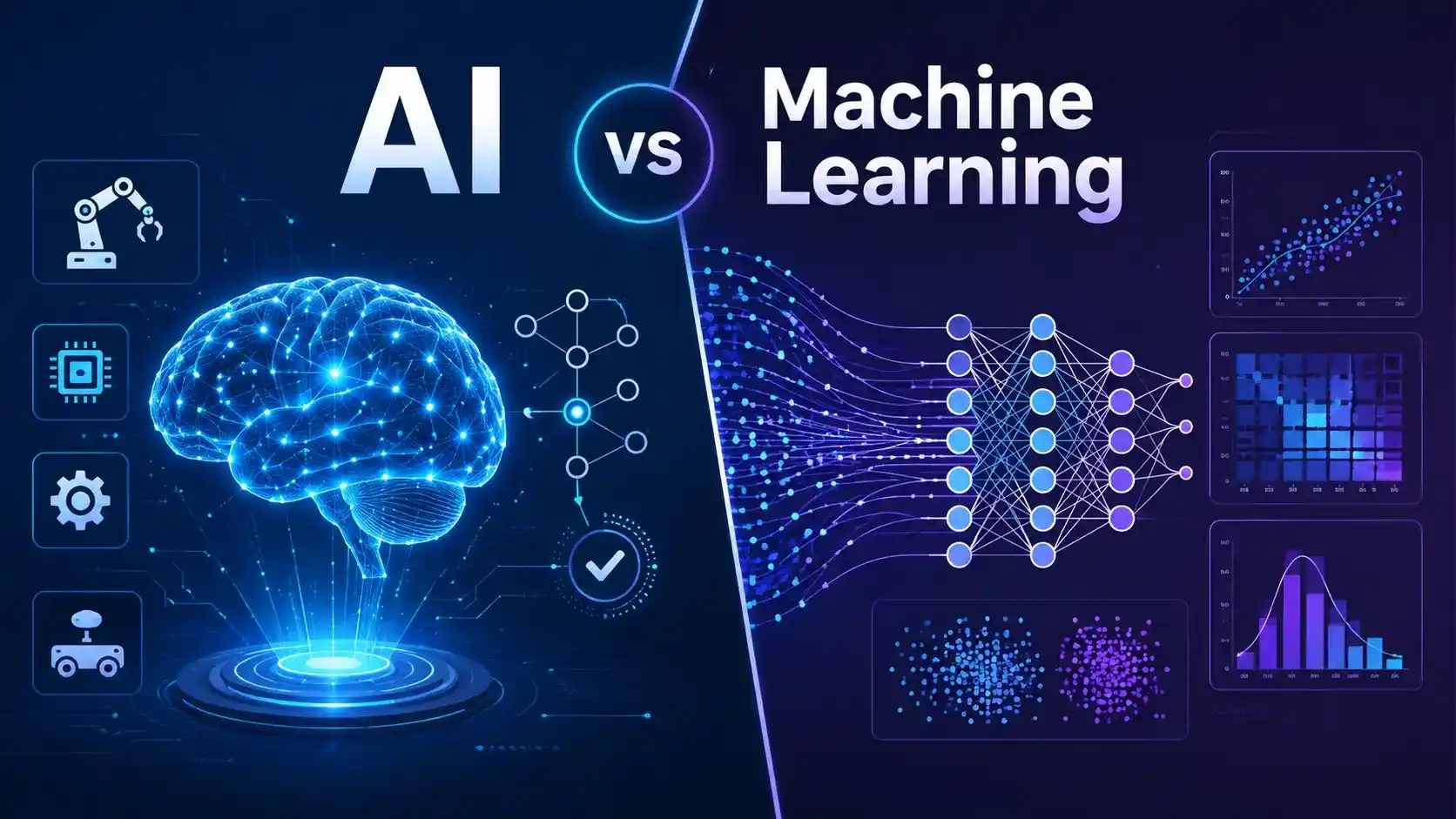
AI vs Machine Learning is one of the most common technology comparisons because both terms are often used together. The truth is simple: they are connected, but they are not the same.
BLUF: Artificial intelligence is the broader field of making machines perform tasks that usually require human intelligence. Machine learning is a major method inside AI that trains systems to learn patterns from data and improve predictions.
AI is the big umbrella. Machine learning is one powerful engine under that umbrella. Deep learning and generative AI sit deeper inside this modern AI stack.
Table of Contents: AI vs Machine Learning
What Exactly Is Artificial Intelligence? Beyond the Sci-Fi
Artificial intelligence is the broad science of building machines that can perform tasks linked with human intelligence. IBM describes AI as technology that enables computers and machines to simulate learning, comprehension, problem-solving, decision-making, creativity, and autonomy.
That definition helps remove the movie confusion. AI is not only robots, space-age machines, or fictional systems. It is also a search engine ranking results, a fraud tool scanning transactions, and a medical system reading images.
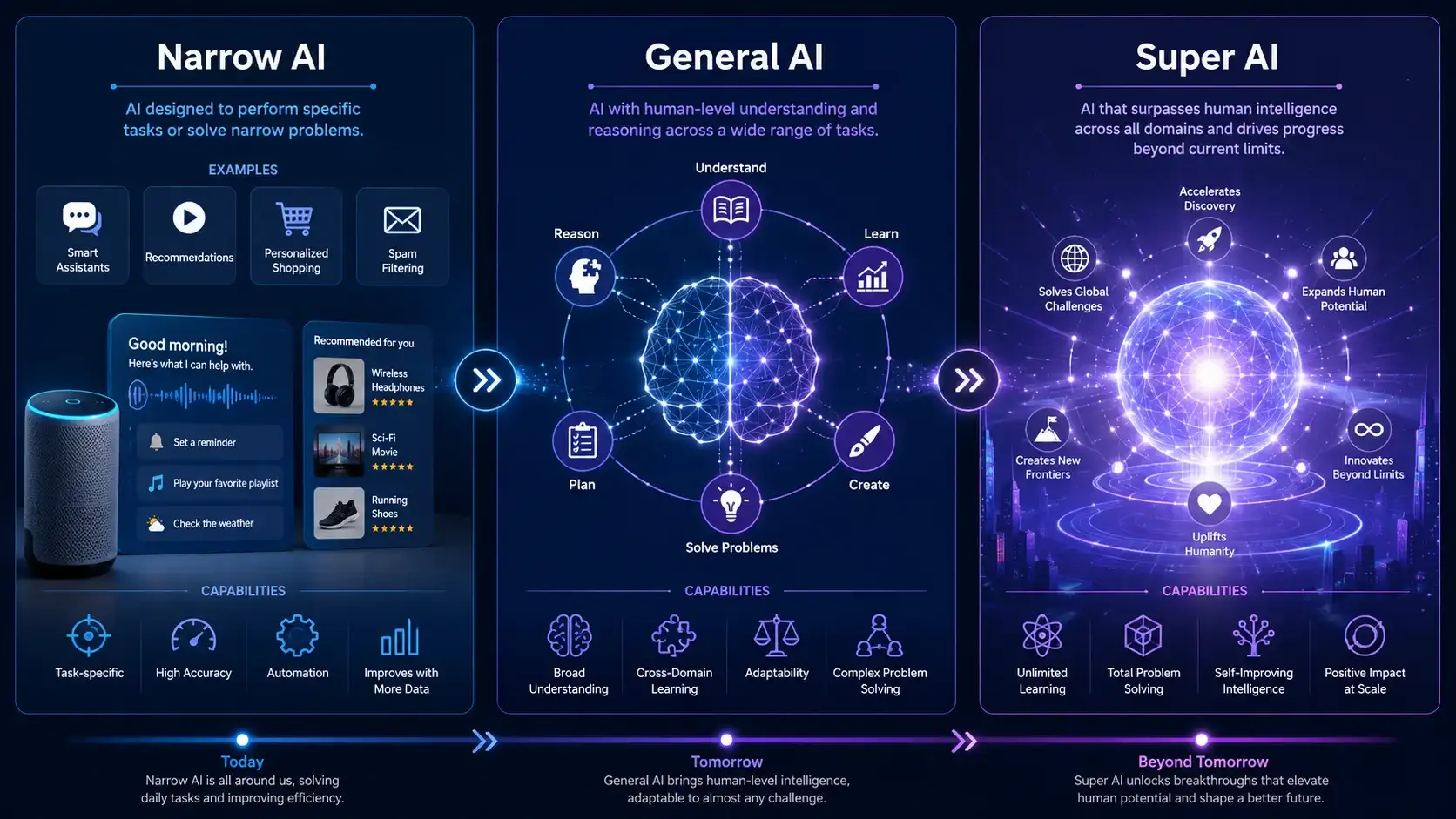
1. Narrow AI: The AI We Use Now
Narrow AI, also called Artificial Narrow Intelligence, performs a specific task. It can be strong in that task, but it does not understand the full world like a person.
Examples include Siri, Google Maps traffic prediction, Netflix recommendations, Gmail spam filtering, fraud detection, and AI writing assistants.
2. General AI: The Human-Level Goal
Artificial General Intelligence means a system that could learn, reason, and adapt across many fields like a human. It would not need a separate custom build for every task.
Current AI tools may look impressive, but they are not reliable human-level general intelligence.
3. Super AI: The Theoretical Stage
Artificial Super Intelligence means a theoretical system that could outperform humans across nearly every intellectual task. It does not exist today.
The clean rule is simple: Narrow AI is real, General AI is a research goal, and Super AI is theoretical.
The Real Goals of AI
Machine Learning: The Brains Behind the Operation
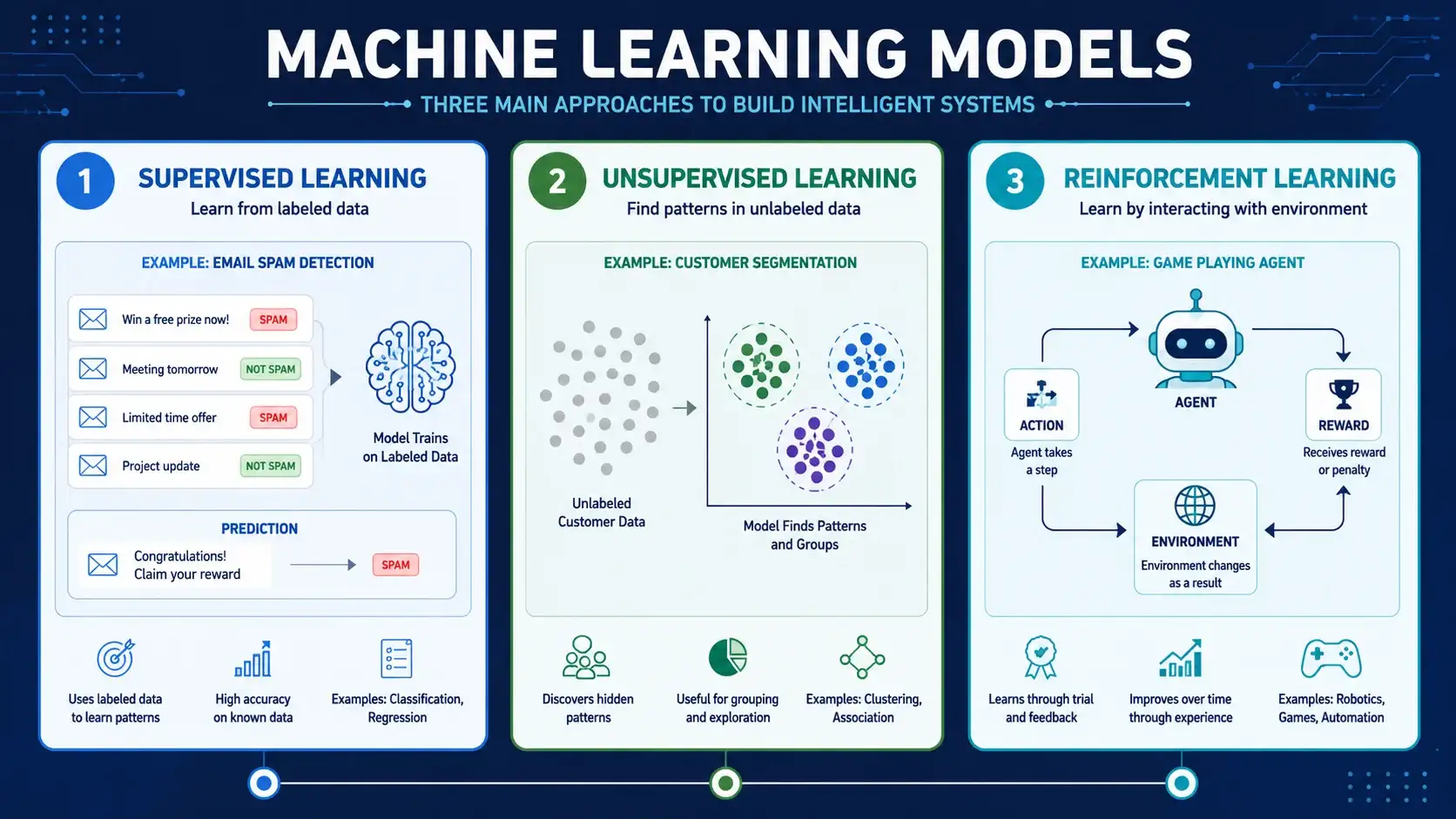
Machine learning is a subset of artificial intelligence that uses data and algorithms to identify patterns, make predictions, and improve performance.
Instead of writing every decision rule by hand, engineers train a model on examples. This is why Machine Learning models sit at the center of search ranking, spam detection, recommendations, fraud scoring, translation, and medical image tools.
1. Supervised Learning
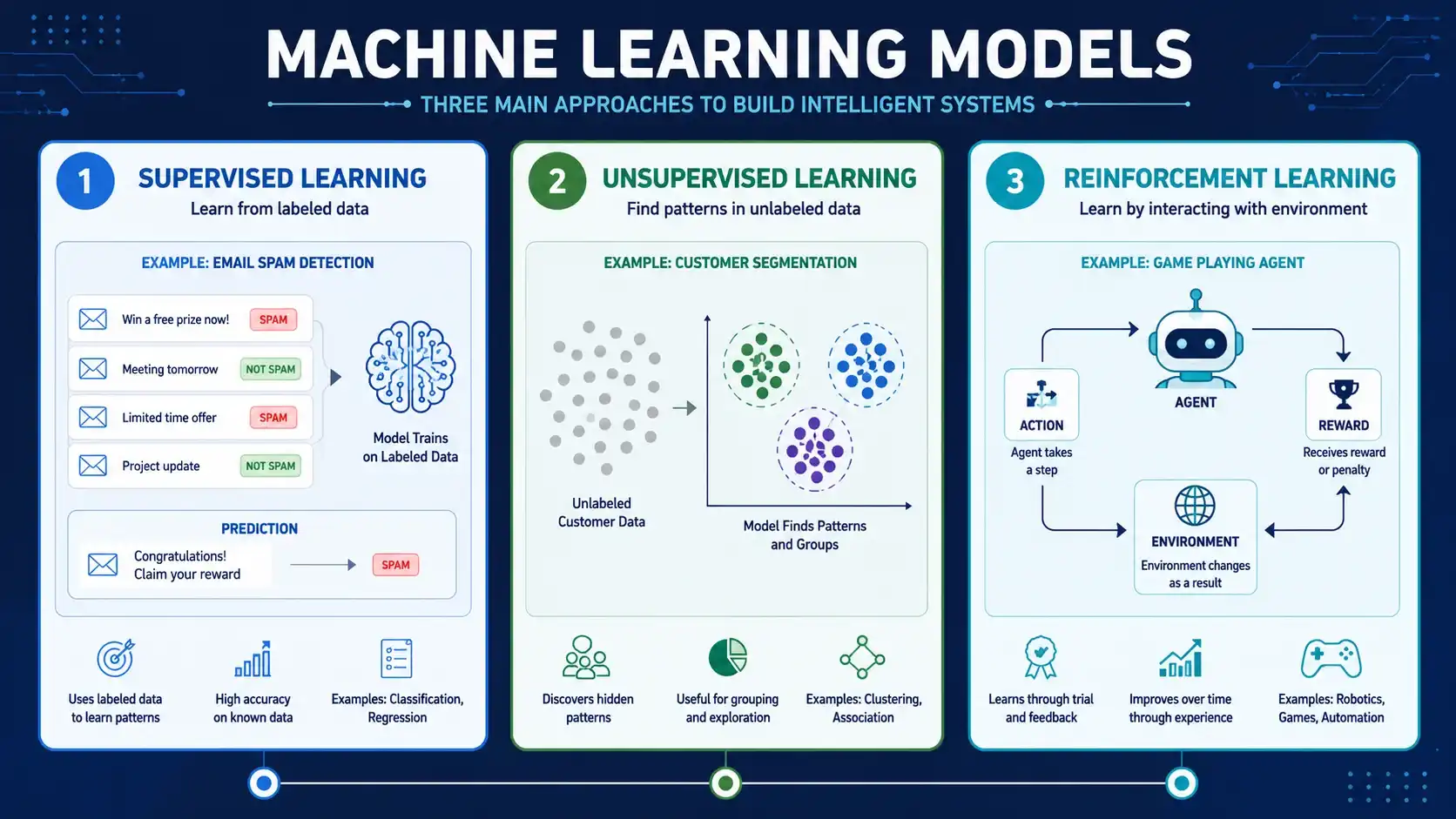
Supervised learning trains a model with labeled data. The system sees examples where the correct answer is already known, then learns how input patterns connect to output labels.
A simple example is spam detection. The model studies emails labeled as spam or not spam and learns patterns in sender behavior, wording, links, formatting, and reports.
Example: Spam detection2. Unsupervised Learning
Unsupervised learning works with data that has no ready-made answer labels. The model looks for hidden structure, clusters, or unusual patterns.
A strong example is customer segmentation, where a company groups users by purchase behavior, order value, device type, discount use, and loyalty patterns.
Example: Customer segmentation3. Reinforcement Learning
Reinforcement learning trains an agent through rewards and penalties. The system takes actions inside an environment and learns which choices create better long-term results.
AlphaGo is a famous example. Autonomous driving research also uses reinforcement learning ideas inside simulation before real-world deployment.
Example: AlphaGo and autonomous systemsThe Core Differences: AI vs Machine Learning
| Comparison Point | Artificial Intelligence | Machine Learning |
|---|---|---|
| Scope How broad is it? |
AI is the larger umbrella for systems that simulate intelligent behavior, reasoning, perception, planning, language understanding, or decision-making. | ML is a subset of AI focused on training algorithms to learn patterns from data and improve predictions or decisions. |
| Data Type What does it use? |
AI may use rules, search trees, symbolic logic, expert systems, sensor inputs, machine learning, deep learning, or generative models. | ML depends heavily on training data, including labeled data, unlabeled data, feedback, images, text, audio, or tabular data. |
| Goal What is the purpose? |
The goal is to make software or machines perform tasks that usually need human intelligence. | The goal is to learn from data and produce accurate predictions, classifications, recommendations, or decisions. |
| Human Intervention How much manual work? |
Some AI systems use fixed human-written rules, while modern AI often uses machine learning to reduce manual rule creation. | ML needs human work for data collection, labeling, feature design, model evaluation, tuning, monitoring, and responsible deployment. |
| Computing Power How heavy is it? |
AI can be lightweight or compute-heavy depending on whether it uses simple logic or large-scale models. | ML can require strong computing power, especially for deep learning, large data sets, and generative AI model training. |
| Examples Where do we see it? |
Smart assistants, robotics, expert systems, chatbots, computer vision, autonomous planning, and decision-support tools. | Spam filters, recommendation engines, fraud detection, image classification, customer segmentation, and demand forecasting. |
The Russian Doll Concept
Where Deep Learning and Generative AI Fit
Deep learning is a subset of machine learning that uses multilayered neural networks. These layers help systems process complex data such as images, audio, video, speech, and human language.
Generative AI vs Machine Learning can confuse beginners because the two terms describe different things. Generative AI describes systems that create new content, while machine learning describes the data-driven method many of those systems use.
ChatGPT, image generators, code assistants, and video tools are called generative AI because they produce new text, images, code, or media. Under the surface, many of them depend on machine learning and deep learning.
AI vs ML: Which Career Path Is Right for You in 2026?
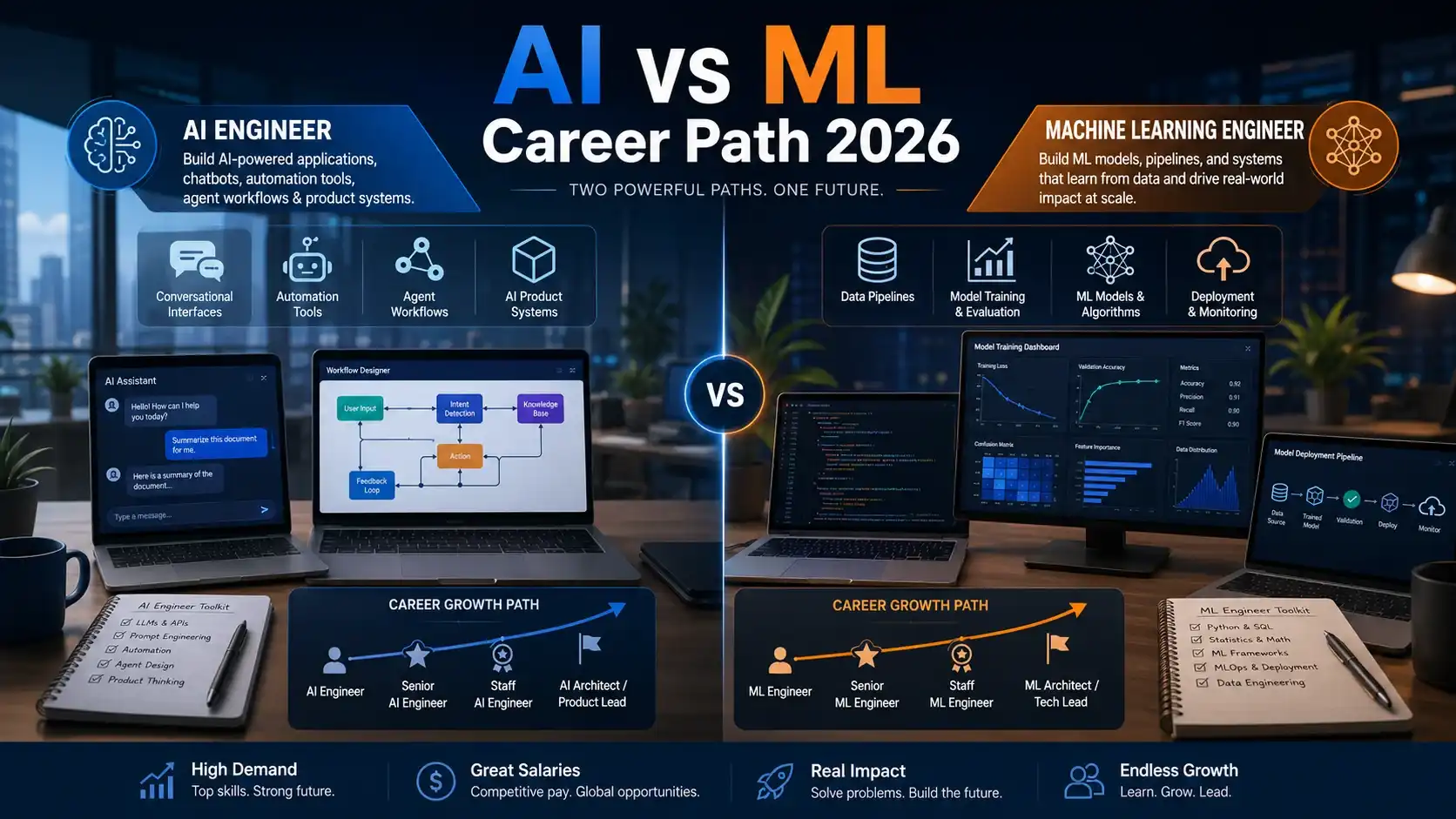
AI Engineer: Product-Focused Builder
An AI Engineer usually builds real applications that use AI features. This role often connects models, APIs, data, prompts, tools, and user workflows into working products.
- Build AI assistants, workflow tools, chatbots, and automation systems.
- Connect large language models with apps, databases, and business processes.
- Test output quality, safety, latency, cost, and user experience.
- Use Python, JavaScript, APIs, cloud tools, and retrieval systems.
Machine Learning Engineer: Model-Focused Builder
A Machine Learning Engineer works more deeply with data, model training, evaluation, deployment, and monitoring.
- Prepare data, train models, tune parameters, and evaluate accuracy.
- Build fraud models, recommendation engines, forecasting tools, and classifiers.
- Monitor model drift, bias, performance, and real-world behavior.
- Use Python, SQL, PyTorch, TensorFlow, scikit-learn, and MLOps tools.
AI vs ML Salary 2026: Safe US Salary Context
Salary numbers vary by role title, location, seniority, company type, and source. The Bureau of Labor Statistics does not publish one exact “AI Engineer” category, so the safest official comparison is to use related technical categories.
For beginners, the smartest move is not chasing one title. Learn Python, data basics, model evaluation, APIs, cloud deployment, and responsible AI testing.
Best Languages to Learn
- Python: Best first language for AI, ML, data science, automation, and model work.
- SQL: Needed for databases, analytics, and structured data.
- R: Useful for statistics, research, and data analysis.
- C++: Useful when speed matters in robotics, embedded AI, and high-performance systems.
- JavaScript/TypeScript: Helpful for AI-powered web apps and product interfaces.
Quick Career Decision
Choose AI Engineering if you enjoy building user-facing AI tools, connecting APIs, designing assistants, and shipping product features.
Choose Machine Learning Engineering if you enjoy data pipelines, training models, testing accuracy, improving performance, and deploying predictive systems.
The strongest professionals understand both sides enough to build useful, safe, and measurable systems.
Frequently Asked Questions
1. What is the main difference between AI and machine learning?
AI is the broad field of making machines act intelligently. Machine learning is a subset of AI where systems learn patterns from data to make predictions, classifications, or decisions.
2. Is machine learning better than AI?
No. Machine learning is not better than AI because it is part of AI. AI is the larger goal, while ML is one powerful method used to build intelligent systems.
3. Is ChatGPT AI or machine learning?
ChatGPT is an AI system powered by machine learning and deep learning. It is usually called generative AI because it can create text responses from learned patterns.
4. Which career pays more in 2026: AI or ML?
Pay depends on title, company, location, experience, and skill. Many AI and ML roles are high-paying, but official BLS categories do not separate every modern AI job title.
Final Takeaway
The cleanest explanation is this: AI is the umbrella, machine learning is the engine, deep learning is a powerful engine design, and generative AI is one of the most visible modern applications.
If you are learning for a career, build strong foundations first. Learn Python, understand data, practice with Machine Learning models, study deep learning basics, and create real projects that solve practical problems.
Titles change fast. Skill, judgment, and useful projects last longer.
- Are AI voices safe for YouTube monetization
- Realistic Indian Accent AI Voices for Free: 3 Best Tools
- ElevenLabs Free Alternatives for Emotional Voices: 3 Picks
- Best Free AI Voice Generators for Faceless YouTube Shorts
- Top 5 Free AI Voice Generator Realistic Tools
- Free AI Video Generators Without Watermark: 2026 Truth
- AI vs Machine Learning: Powerful 2026 Career Truth
- Generative AI Uses and Risks: 11 Real-Life Lessons for Beginners
- What is Generative AI? 12 Powerful Basics for Beginners
- What is AI? 11 Powerful Basics Every Beginner Should Know